Raised Feeders for Older Dogs: Right for a Few, Wrong for the Ones Most Often Given Them
This is the one senior comfort product where the default answer for a large deep-chested dog is no. Who genuinely benefits, who should stay at floor level, and how to get the height right.
petsupplies.co earns a commission if you buy through the product links on this page, and the price you pay is the same either way.

Raised feeders are sold as an obvious kindness for an older dog. Less bending, easier on the neck, better posture: it reads as common sense, and it is the sort of thing people buy without much deliberation.
For one large group of dogs it is the wrong purchase, and the reason is serious enough to lead with.
The association that runs the other way
Gastric dilatation-volvulus is a surgical emergency in which the stomach distends and rotates. It kills quickly without intervention. The American College of Veterinary Surgeons overview and the Merck Veterinary Manual entry are worth reading in full if you own a deep-chested breed.
The risk picture is multi-factorial. Chest conformation carries most of the signal, which is why Great Danes, Weimaraners, Setters and Standard Poodles dominate the case series. Age, having a first-degree relative with GDV, and rapid eating all appear.
So does raised feeding, associated with increased risk in large and giant breeds, not reduced. Causation has not been established, and the finding is an association from observational work rather than proof. But weigh the two sides honestly: on one hand a modest, largely aesthetic comfort benefit for a dog with no specific medical need; on the other a possible contribution to a condition that kills within hours. For a deep-chested dog that is not a close call.
Floor level, for a large deep-chested dog, unless a veterinarian has given you a specific reason otherwise. See gastric dilatation-volvulus, bloat and GDV and elevated feeder.
Know the emergency signs regardless of what your dog eats from: unproductive retching, a distended and tight abdomen, restlessness and drooling. Recognizing it in the first hour is worth more than any equipment decision.
Who genuinely benefits
The category is not useless. It is simply indicated rather than universal, and the indications are specific.
Megaesophagus. Here elevation is not a comfort measure, it is treatment. Dogs with an enlarged, poorly motile esophagus depend on gravity to move food toward the stomach, and elevated or fully upright feeding (sometimes in a purpose-built chair) is a standard part of management. If your dog regurgitates undigested food shortly after eating, that is a veterinary conversation, and this is one of the possibilities.
Cervical spine arthritis or neck injury. A dog for which lowering the head is genuinely painful gets a real benefit from not having to. This is a diagnosis rather than an assumption, and worth confirming.
Limited mobility in the neck or forelimbs. Dogs that cannot comfortably brace to lower their heads: some spinal cases, some severe forelimb arthritis. See osteoarthritis and intervertebral disc disease.
Small breeds. The GDV association concentrates in large and giant deep-chested dogs. For a small dog the calculation is different and elevation is a reasonable comfort choice.
Cats. Cats do not get GDV. The argument simply does not apply.
Getting the height right
The most common mistake among people who should be using one is setting it far too high.
Aim for roughly at or just below the elbow or lower chest, so the dog's head reaches slightly downward into the bowl. The goal is to remove deep neck flexion, not to bring food up to the mouth. Chin height forces the neck to extend upward, which is its own strain and encourages more air swallowing.
Two checks. Watch your dog eat: the neck should be roughly level or angled gently down, never craning upward. And watch it swallow: a dog stepping backward to swallow is telling you the bowl is too high.
Adjustable stands are worth the small extra cost precisely because the correct height is hard to guess and changes as a dog loses muscle or condition.
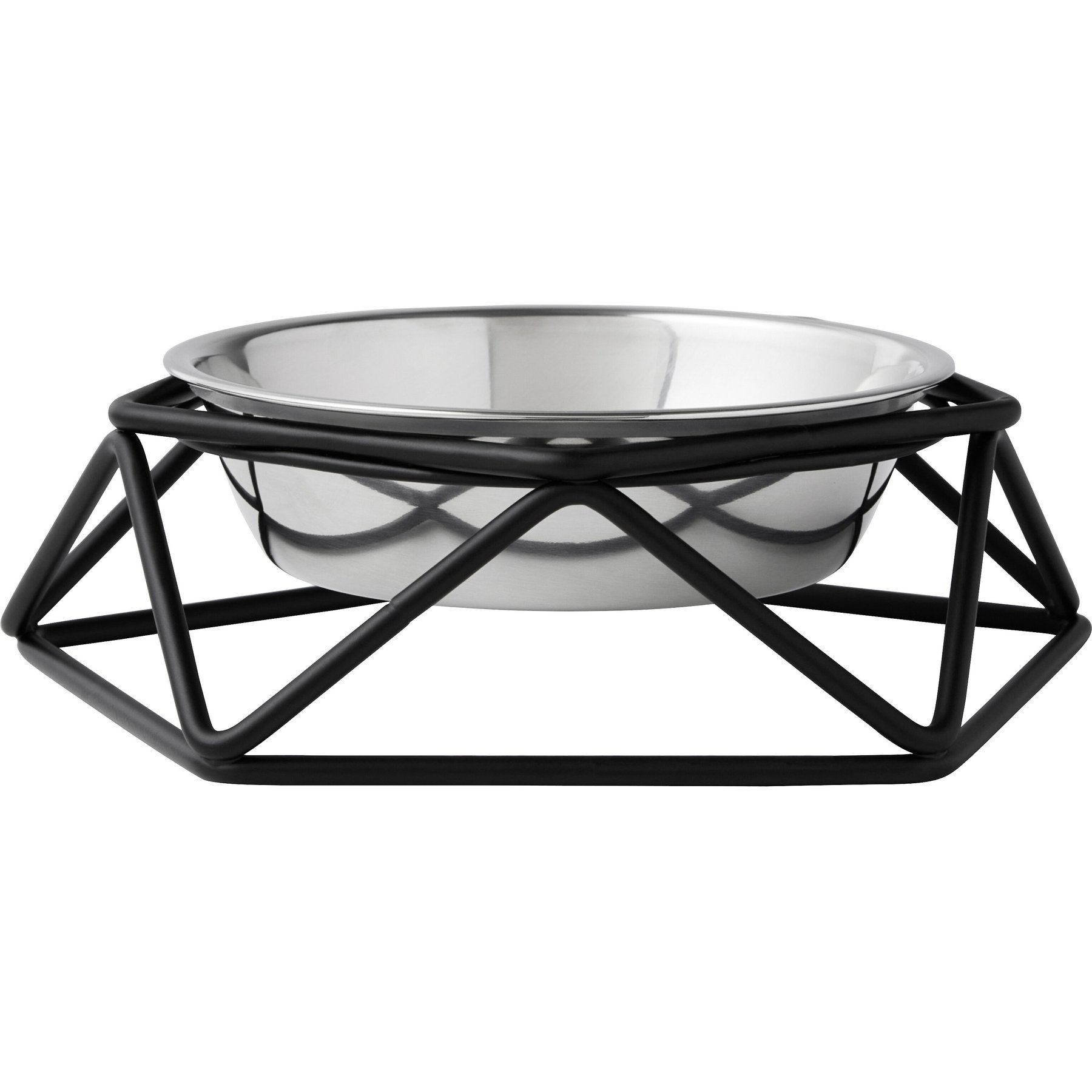
For small dogs, a low fixed stand with a stainless bowl is usually all that is needed, and stainless is easier to keep genuinely clean than plastic.
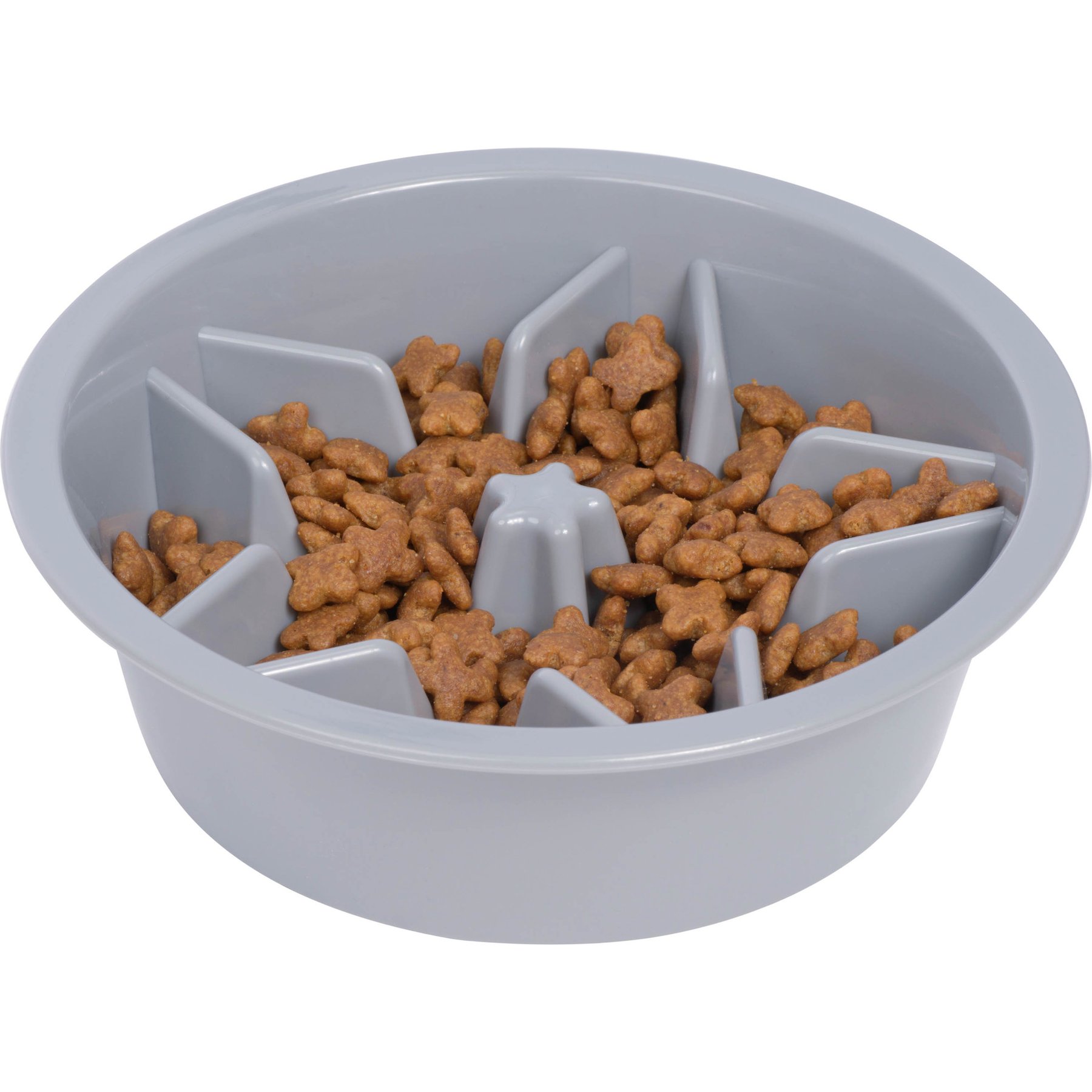
If your dog also eats fast, combining the two functions avoids stacking a maze bowl on top of a stand, which is how people accidentally build something far too tall. For a large deep-chested dog the slow-feeding is the part worth having and the elevation is the part to leave out. See slow feeder.
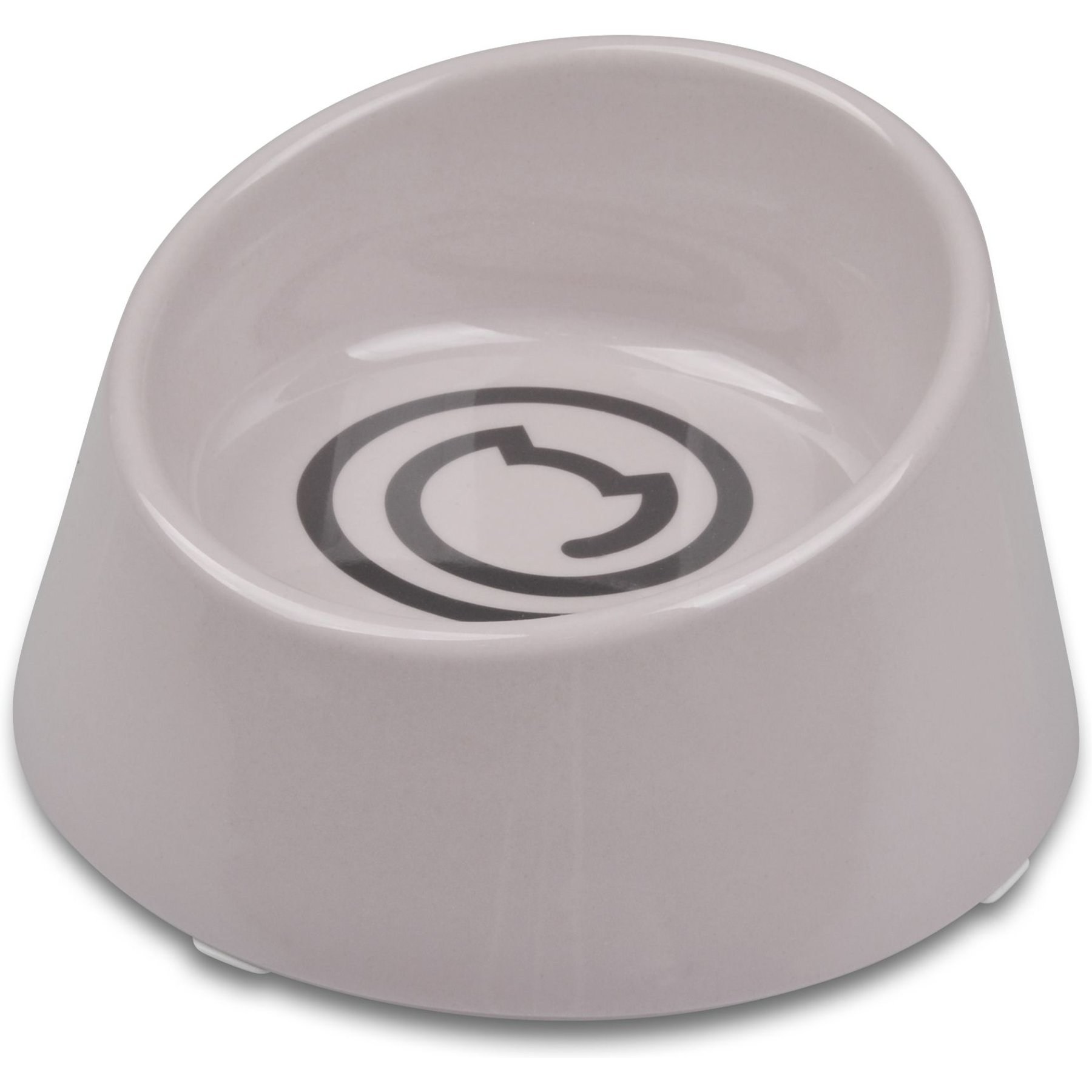
For cats, a modest elevation and a wide shallow dish is the combination that helps an arthritic older cat, and whisker contact against the sides of a deep bowl matters at least as much as height.
What usually helps more than height
For most older dogs that seem uncomfortable at the bowl, the height is not the problem.
Traction under the bowl and around it. A great deal of apparent discomfort is a dog bracing on a floor it is slipping on. A rubber mat under the bowl and a runner on the approach costs very little and frequently solves the whole complaint.
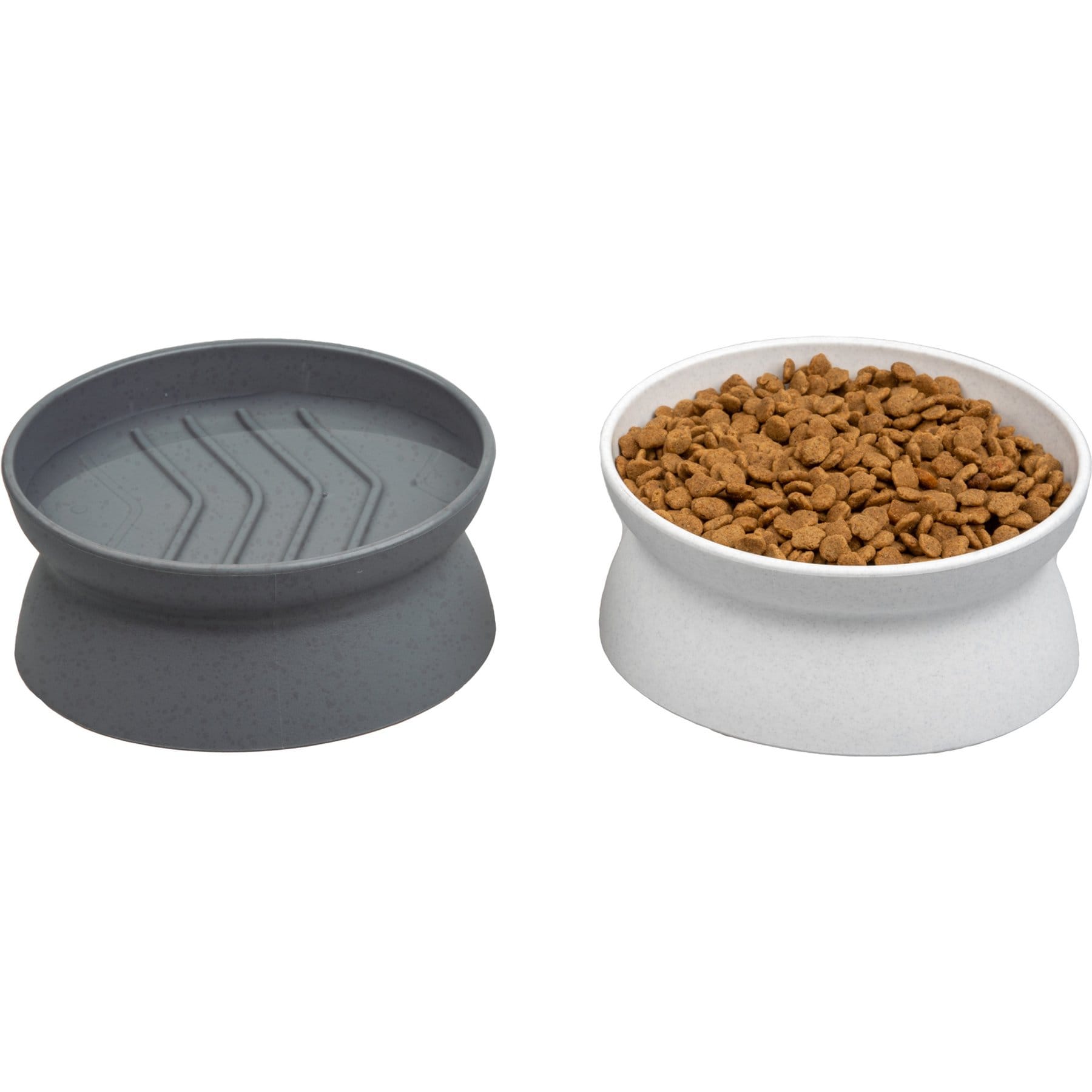
A wider, shallower bowl. Less neck flexion needed, no rim pressing on the face, and easier for a stiff dog to reach the last of the food.
Smaller, more frequent meals. Easier on a dog that finds standing at the bowl tiring, and sensible practice for deep-chested breeds anyway.
Softened or wet food. If chewing is part of the difficulty, texture is the lever rather than furniture.
A veterinary examination. Reluctance to lower the head is a symptom. It may be neck pain, dental pain or nausea, and all three are treatable.
And the weight. Every kilogram is load through the joints that are making this uncomfortable. Get a body condition score, work from how much should I feed my dog, and see canine obesity.
How this goes wrong
| What gets bought | Why it disappoints | What to do instead |
|---|---|---|
| Raised feeder for a large deep-chested dog | Associated with increased GDV risk; modest upside | Floor level, plus a non-slip mat |
| Stand set at chin height | Neck extends upward; more air swallowed | Elbow height or slightly below |
| Maze bowl stacked on a stand | Combined height far above target | A single combined product, correctly sized |
| Raised bowl for a dog that regurgitates | May be masking megaesophagus | Get the regurgitation investigated |
| Heavy ceramic on a tall stand | Falls, breaks, and startles the dog off the bowl | Stainless in a stable frame |
| Bowl raised to fix a slipping problem | Wrong variable entirely | A rubber mat under the bowl |
What to skip
- Raised feeders for large and giant deep-chested breeds. The one clear recommendation here.
- Height chosen by eye. Measure to the elbow; too high is the common error.
- Stacking a slow feeder on a stand. Buy one product that does both, or neither.
- Anything unstable. A stand that tips once will be avoided afterwards, and a heavy bowl falling on a foot ends the relationship immediately.
- A raised bowl as a response to regurgitation, without a diagnosis. That symptom deserves investigation.
How to choose
If your dog is large and deep-chested, do not buy one. Put a rubber mat under a floor-level bowl and learn the signs of bloat.
If your dog has megaesophagus, cervical arthritis or a diagnosed mobility problem, buy an adjustable stand and set it at elbow height or slightly below.
If your dog is small, or you have a cat, this is a low-stakes comfort decision and a modest elevation is fine.
And if the only evidence is that your dog seems to find eating awkward, get the neck and mouth examined before you buy furniture. Discomfort at the bowl is usually a symptom of something, and most of the somethings are treatable.
FAQ
Frequently asked
Do raised bowls cause bloat?
Causation has not been established, but the association is the wrong way around from what most owners assume. Raised feeding appears in the veterinary literature on gastric dilatation-volvulus as a factor associated with increased risk in large and giant breeds, not decreased. Since GDV is a rapidly fatal surgical emergency and the comfort benefit of a raised bowl for a healthy dog is modest, the sensible position for a deep-chested dog is floor level unless a specific medical reason says otherwise.
So who should actually use one?
Dogs with megaesophagus, where elevated or fully upright feeding is a standard part of management and genuinely important. Dogs with significant cervical spine arthritis or a neck injury that makes lowering the head painful. Dogs with limited neck or forelimb mobility for other reasons. Small breeds, where the bloat association is not the concern it is in large deep-chested dogs. And cats, who do not get GDV at all.
How high should a raised bowl be?
Lower than most people set it. A reasonable starting point is roughly at or just below the dog's elbow or lower chest, so the head reaches slightly downward into the bowl rather than up or straight out. Chin height is too high. If your dog is extending its neck upward or has to step back to swallow, the stand is too tall and you have created a different problem.
My old dog seems uncomfortable eating from the floor. What else can I try?
Several things that carry no risk. Put a non-slip mat under the bowl, because much of the discomfort is bracing against a slipping surface rather than the height itself. Add traction along the route to the bowl. Try a shallower, wider bowl so less neck flexion is needed. Feed smaller meals more often. And have the neck and forelimbs examined, since the reluctance may be a treatable pain problem rather than a furniture problem.
Are raised bowls fine for cats?
Yes. Cats do not get gastric dilatation-volvulus, so the main argument against elevation in dogs does not apply. For an arthritic older cat a slight elevation can make eating more comfortable, and a wide shallow dish that avoids whisker contact against the sides usually matters more than the height does.
Featured in this guide
The picks referenced above—priced and in stock at time of publication.
Affiliate links. Prices and availability change—we filter unavailable items nightly, but the retailer's page is source of truth.
Keep reading
Discussion
Talk about Raised Feeders for Older Dogs: Right for a Few, Wrong for the Ones Most Often Given Them
Real questions from real pet owners. Add yours—signed-in members only, first three posts held for review.
Loading threads…