Low-Impact Toys for Older Dogs: Keep the Play, Lose the Landing
An old dog that has stopped playing has usually not lost interest. It has lost the version of play its joints will tolerate. What to swap in, what to retire, and why the nose is the point.
petsupplies.co earns a commission if you buy through the product links on this page, and the price you pay is the same either way.

An old dog that has stopped playing has rarely lost interest in play. It has lost the version of play its body will still tolerate, and nobody has offered another.
That distinction matters because the usual response is the wrong one. Owners watch a ten-year-old Labrador decline the ball it once lived for and conclude the dog has slowed down, which is true, and that it therefore wants to be left alone, which is not. What the dog is declining is the sprint, the twist and the landing. Offer the same dog a game that happens at floor level and at walking pace and it will usually take it.
So this guide is about swapping the mechanics of play rather than retiring it. The joints get less. The nose and the brain get more.
What changes, and what does not
Two things change in an aging dog that bear on toys. The first is the joints. Osteoarthritis is one of the commonest chronic painful conditions in dogs, it is progressive, and the signs are subtle long before they are obvious, so a dog that still gallops on a good day can be paying for it on the bad ones. See osteoarthritis and the Merck Veterinary Manual's owner overview. The second is the mouth. Worn, cracked or painful teeth make the hard chews of youth unpleasant, and periodontal disease is close to universal by this age.
What does not change is the need. A two-year longitudinal study in aging beagles found that dogs given an enriched routine of exercise, a rotating set of toys and problem-solving tasks kept learning ability that unenriched dogs lost, and the effect was strongest when enrichment was combined with a fortified diet (Milgram and colleagues, reviewed here). An old dog's world shrinks as walks get shorter. Toys that make it sniff and think are one of the few ways to keep the brain busy without asking the joints for anything, and they are also part of how cognitive dysfunction is managed once it appears.
Low-impact describes the dog, not the toy
A toy is not inherently low-impact. A tennis ball rolled across a carpet is gentle; the same ball thrown down a garden is a series of hard stops on arthritic elbows. The question to ask of any game is what the dog's body has to do to take part.
Landings. Anything that leaves the ground comes back down. Jumping for a toy, leaping off a step to chase one, and the skid at the end of a fetch all load joints that are already sore.
Twisting. Tug played with a dog standing braced, and the whiplash turn of a chase, both put shear through the neck, spine and hips. A dog with intervertebral disc disease in its history should not be tugging at all.
Bracing. Even a static game can hurt if the dog has to hold an awkward position to play it. A puzzle placed on a slippery floor makes an arthritic dog splay to stay upright, which is why the footing under a toy matters as much as the toy.
Biting down. Hard rubber, nylon and bone are chewing toys for a mouth that can take it. An old mouth often cannot, and a dog that has quietly stopped chewing may be telling you about a tooth rather than a preference.
Everything below passes those four tests.
Nose work first
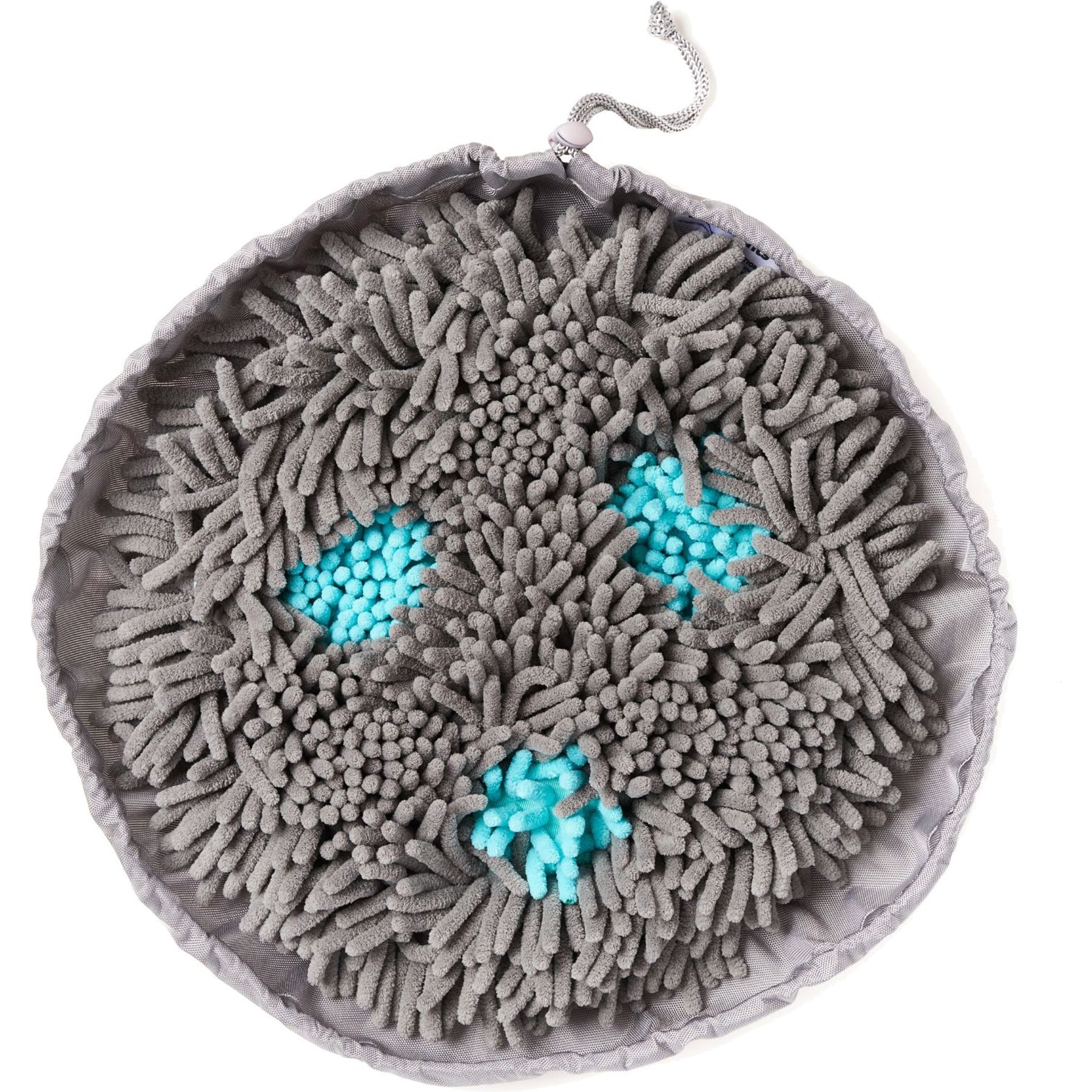
If an old dog is going to own one new toy, it should be a snuffle mat. Kibble or small treats are pushed into a mat of fabric strips and the dog forages for them with its nose. The dog stands, or lies down, and sniffs. Nothing leaves the ground and nothing has to be bitten.
It suits old dogs for reasons that go beyond the joints. A dog with failing eyesight is not disadvantaged, because the nose is doing the work. There is no wrong answer to frustrate a dog whose patience has shortened. And scenting is tiring in a way owners underestimate, so ten minutes on a mat can settle a dog that a short walk no longer does. See snuffle mat and enrichment.
This one is sold as a slow feeder as much as a toy. Feeding an old dog's whole ration through a mat turns two meals a day into two foraging sessions, at no cost in joints, and it slows a fast eater as a side effect. The fabric is soft, the pockets are deliberately shallow so the dog succeeds early, and it goes in the washing machine.
A dog that finds even a mat too much on a bad day can do the same thing lying down with a lick mat, which we covered in best lick mats for dogs.
Treat dispensers that roll instead of bounce
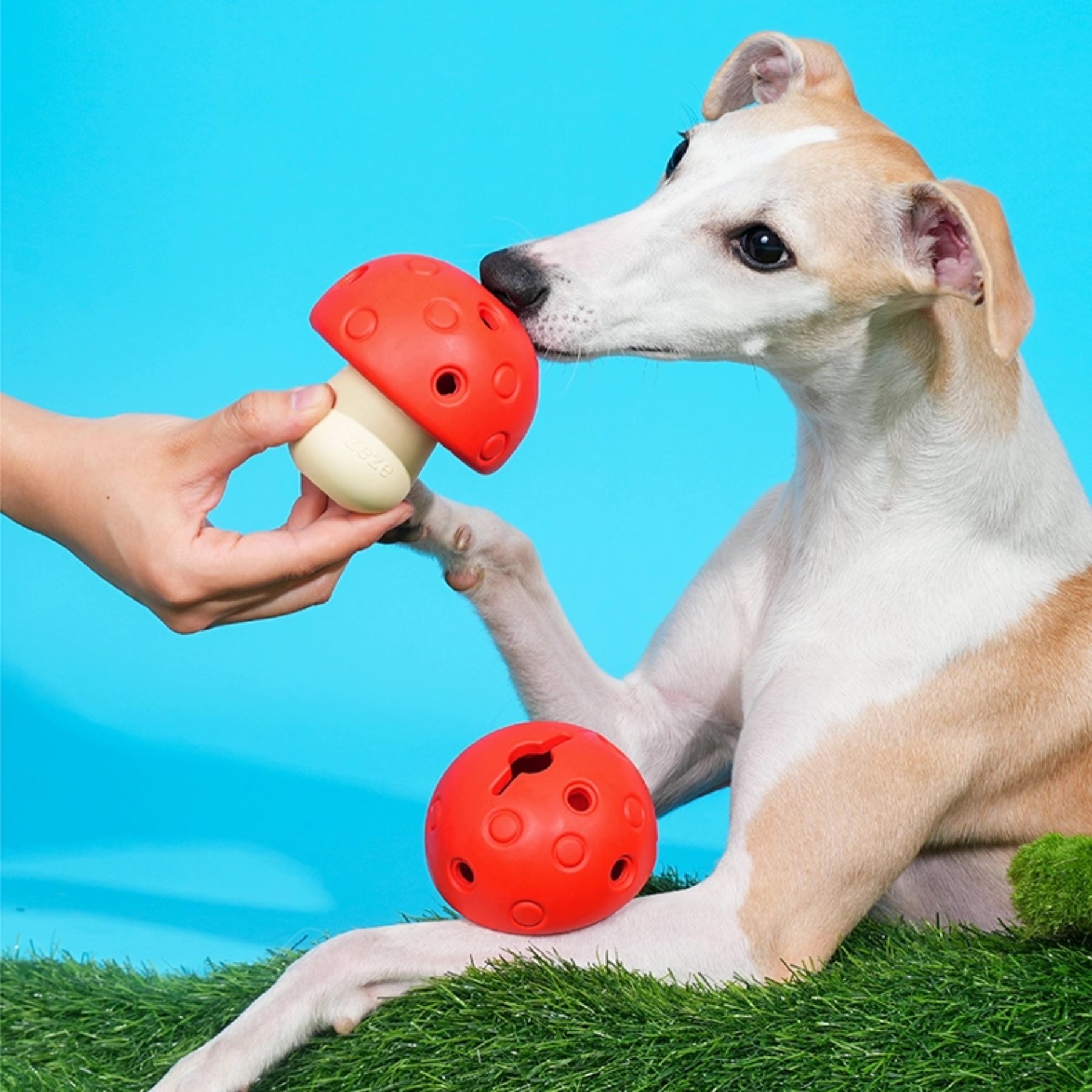
The classic hard treat ball bounces, skitters and has to be chased, which is the exact mechanic to avoid. Two things make a dispenser suit an older dog: it should roll along the floor rather than bounce off it, and it should be soft enough to be mouthed without hurting a worn tooth.
The rubber is the point here. It is described as gentle, with a rounded shape and smooth curves, and the dispensing holes release treats gradually as the dog nudges it, so the game is nose and paw rather than teeth and chase. Put it on a rug rather than a hard floor so it does not travel far, and start with easy treats that fall out readily. A dog that gives up on a dispenser has usually been given one that is too stingy.
Soft toys that are still toys
Most old dogs keep a version of the carry-and-squeak instinct long after they stop shredding. That is the moment soft plush becomes the right toy rather than the disposable one.
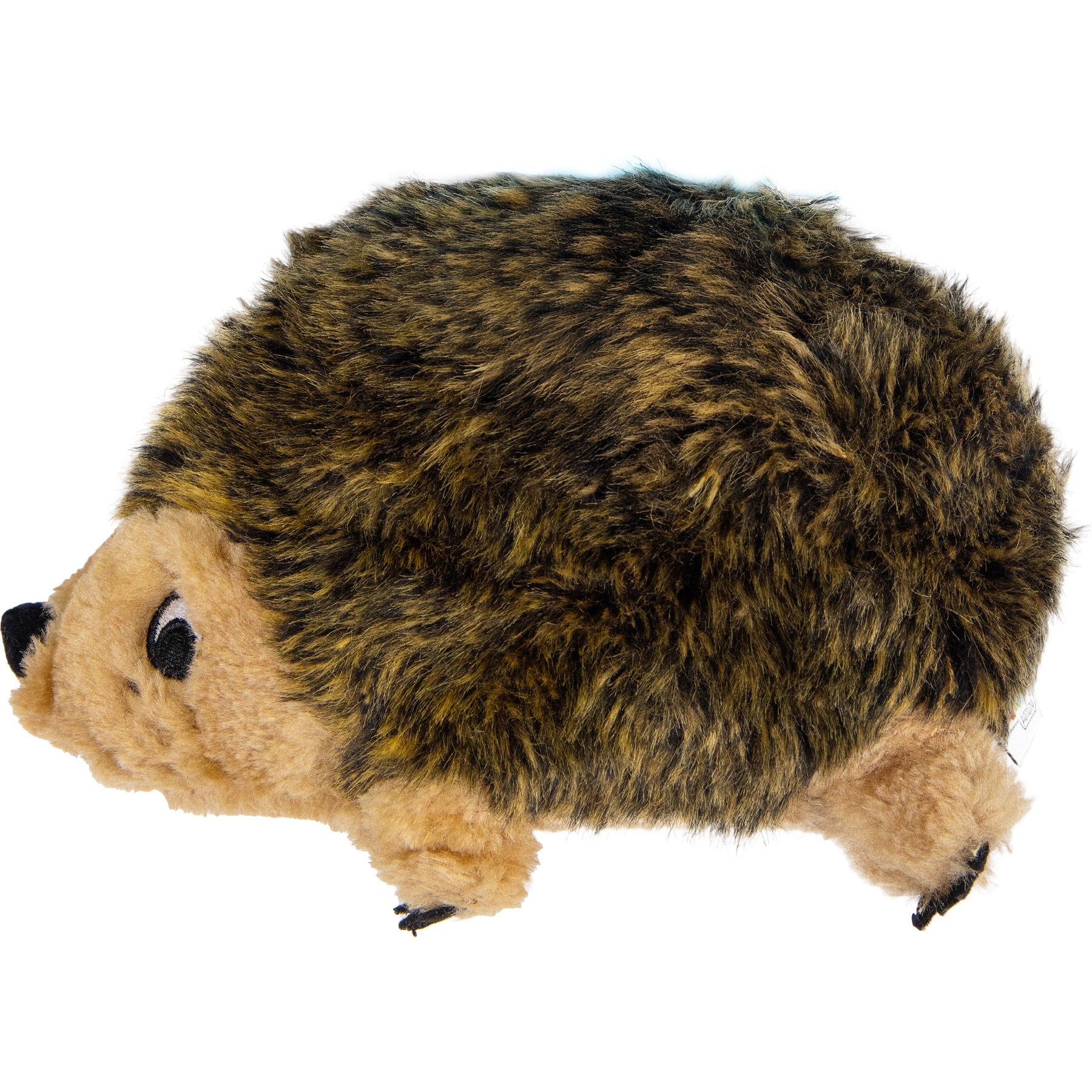
Soft faux fur, a squeaker, and a construction with minimal seams so it lasts against a mouth that mouths rather than tears. It is inexpensive, it comes in sizes, and for a dog that likes to parade a toy around the house before settling with it, this is the whole job. Supervise a dog that still shreds, as with any plush.
Stuffing-free plush is light, floppy and has nothing inside to clean up when it finally goes. The rope running through this one gives it some body for a dog that likes to shake a toy, and a looped end for a gentle hold-and-release game played sitting on the floor with the dog, which is the only kind of tug an arthritic neck should be offered. It ships in a random animal design.
Puzzles at the right level
Puzzle toys are marketed on difficulty, and difficulty is the wrong thing to buy an old dog. A level that frustrates a young dog into persistence sends an old one to bed. Start at the beginning and treat the puzzle as a nose game with a few moving parts rather than an intelligence test. See puzzle feeder.
A level 1 board: rods set in a tray that the dog nudges with nose or paw to uncover treats underneath. It sits flat on the floor, so the dog plays standing or lying without bracing, and it has non-slip rubber feet, which is the detail that makes it usable for an arthritic dog on a hard floor. The controlled dispensing also suits a dog whose weight needs watching, and most older dogs' weight needs watching. See body condition score and how do I know if my dog is overweight.
Chewing in an old mouth
Chewing is calming and most dogs want to keep doing it. The question is what they chew. Antlers, nylon bones, cooked bones and the hardest rubber toys chip and fracture worn teeth, and a slab fracture in an old dog means an extraction. If your dog still needs to chew, choose something with give in it, keep sessions short, and treat any new reluctance to chew as a reason to look in the mouth. Our dental care for older pets guide covers what home care can honestly do at this age, and dental chew covers what a chew can and cannot achieve.
A soft rubber dispenser filled with something worth working for satisfies most of the chewing urge with a fraction of the force.
Sessions: short, often, and on footing the dog trusts
The technique matters more than the toy.
Short and often. Several five-minute sessions beat one long one. Holding a position is the hard part for a stiff dog, not the sniffing.
Non-slip footing. Play on a rug or a mat. A dog that feels its feet slide will not commit to a game, and for an old dog a slip is an injury in itself.
Stop early. End while the dog still wants more. A dog that walks away from a puzzle has usually been asked to work too long, not too hard.
Watch for the tell. A dog that used to play and now turns away from a toy it once loved is reporting something. Pain, a tooth, or a change in vision are all more likely than boredom. See how much exercise does my dog need for the walking side of the same question.
How this goes wrong
| What happens | Why it matters | What to do instead |
|---|---|---|
| Fetch continues because the dog still runs for it | The sprint and the stop load arthritic joints; the dog pays later | Roll the ball along the ground, or swap to nose work |
| Old dog is given the hard chews it had at three | Worn teeth chip and fracture | Soft rubber, and a look in the mouth if chewing has stopped |
| Puzzle bought at the hardest level | Frustration; the dog gives up and the toy is retired | Level 1, then progress only if the dog is keen |
| Puzzle on a slippery floor | Dog splays to brace; painful and unsafe | Play on a rug or mat |
| Tug played standing, with the dog braced | Shear through neck, spine and hips | Gentle hold-and-release on the floor, or no tug at all |
| Toys are retired because the dog seems uninterested | Enrichment stops just when the brain needs it most | Offer floor-level, scent-led play and watch what happens |
What to skip
- Anything thrown. Rolled is fine. Thrown asks for a landing.
- Antlers, nylon bones and the hardest rubber. Wrong for an old mouth.
- Laser pointers. Chasing a dot with no catch at the end frustrates dogs of any age and is a sprint-and-stop game besides.
- The hardest puzzle in the range. Difficulty is not the goal.
- Raised platforms and steps as part of a game. Every climb has a descent.
- Assuming disinterest. An old dog that declines a ball has declined the ball, not play.
How to choose
Buy a snuffle mat first and feed at least one meal a day through it.
Add a soft rubber dispenser for the chewing urge and a soft plush for the carrying one.
If the dog takes to the mat, add a level 1 puzzle and let the dog set the pace from there.
Keep every session short, on footing the dog trusts, and stop while it still wants more.
And if a toy the dog loved has suddenly lost its appeal, look at the dog before you look for a new toy.
FAQ
Frequently asked
Why has my older dog stopped playing?
Usually because the play on offer hurts. Fetch, tug and anything with a landing load the same joints that osteoarthritis has made sore, and a dog that declines a ball is often declining the sprint and the stop rather than the game. Offer play that happens at floor level and at walking pace, such as a snuffle mat or a rolling treat dispenser, and most dogs pick it up again. A dog that also declines those, or has changed in other ways, is a veterinary question first.
Do old dogs still need toys at all?
Yes, and arguably more than young ones. A two-year study of aging beagles found that dogs given an enriched routine of exercise, toys and problem-solving tasks kept learning ability that unenriched dogs lost, and the effect was strongest when it was combined with diet. An old dog's world tends to shrink as walks get shorter. Toys that ask the dog to sniff and think are one of the few ways to keep its brain working without asking anything of its joints.
Are squeaky plush toys safe for a senior dog?
For most, yes, with the usual rule that a dog that disembowels toys is supervised and stuffing-free designs are preferred. The change with age is the mouth, not the squeaker. Worn or painful teeth make hard chews unpleasant and sometimes unsafe, so the soft plush that a young dog would have destroyed in an afternoon is often exactly right for an old one that now carries and mouths rather than shreds.
How long should a play session be for an old dog?
Short and frequent beats long and rare. Five to ten minutes of nose work several times a day suits an arthritic dog far better than one long session, because holding a position or a pace is the hard part for a stiff animal, not the activity itself. Stop while the dog still wants more, and always on a surface it cannot slip on.
Is a snuffle mat better than a puzzle toy for an older dog?
For most old dogs a snuffle mat comes first. It asks nothing of the joints, it works for a dog with poor eyesight because the nose does the work, and there is no wrong answer to frustrate a dog whose patience has shortened. A beginner-level puzzle is a good second step once the dog has the idea, and a lick mat suits a dog that finds even a mat too much effort on a bad day.
Featured in this guide
The picks referenced above—priced and in stock at time of publication.

Affiliate links. Prices and availability change—we filter unavailable items nightly, but the retailer's page is source of truth.
Keep reading
Discussion
Talk about Low-Impact Toys for Older Dogs: Keep the Play, Lose the Landing
Real questions from real pet owners. Add yours—signed-in members only, first three posts held for review.
Loading threads…