Harnesses for Arthritic Dogs: A Walking Harness and a Lifting Harness Are Not the Same Thing
Two products, one shelf, entirely different jobs. Which end of your dog is failing decides what you need, and one common design makes an arthritic shoulder worse.
petsupplies.co earns a commission if you buy through the product links on this page, and the price you pay is the same either way.

Two quite different products get sold as harnesses for older dogs, and buying the wrong one is the usual outcome.
A walking harness attaches to a leash. Its job is steering, and for an arthritic dog the main consideration is that it does not interfere with the shoulder.
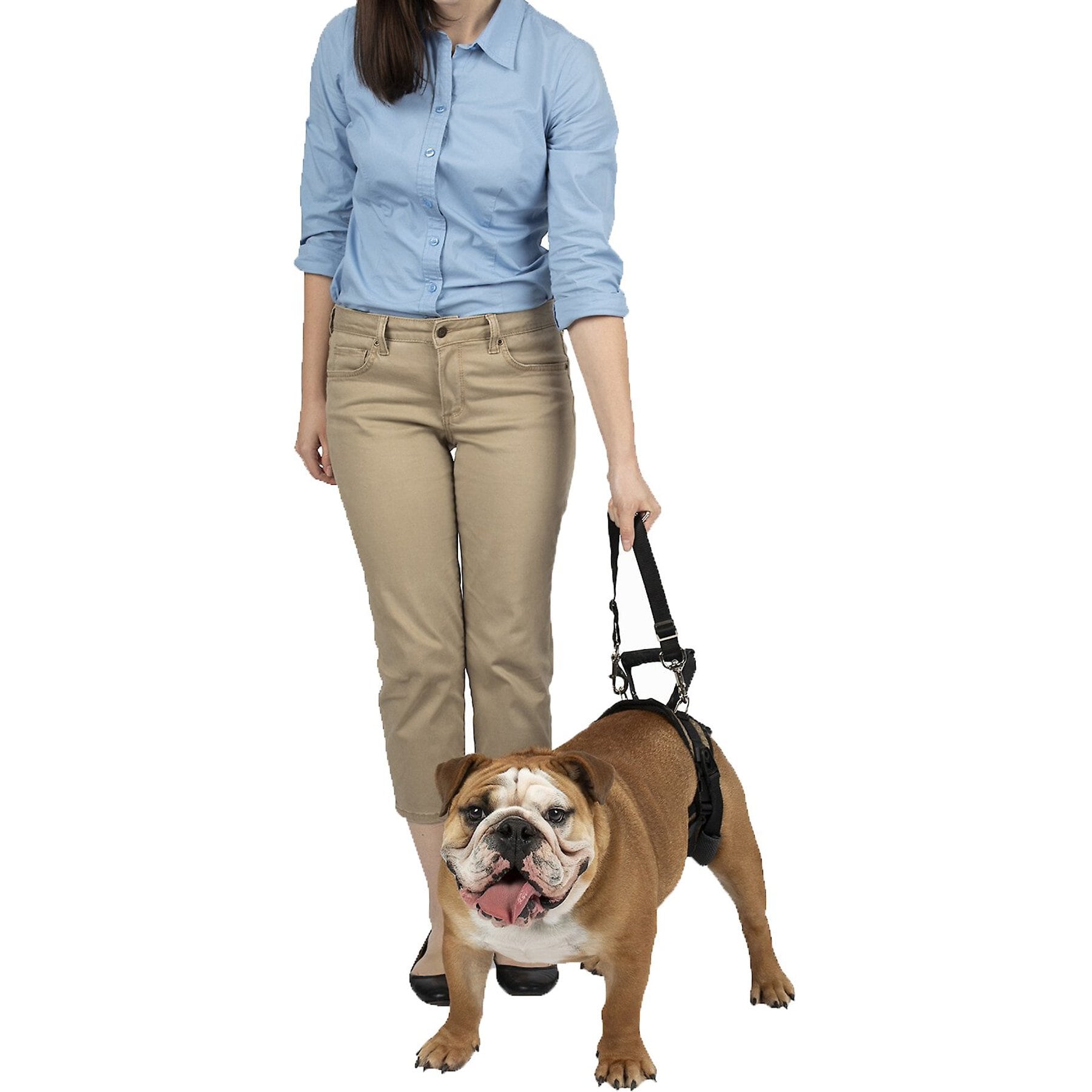
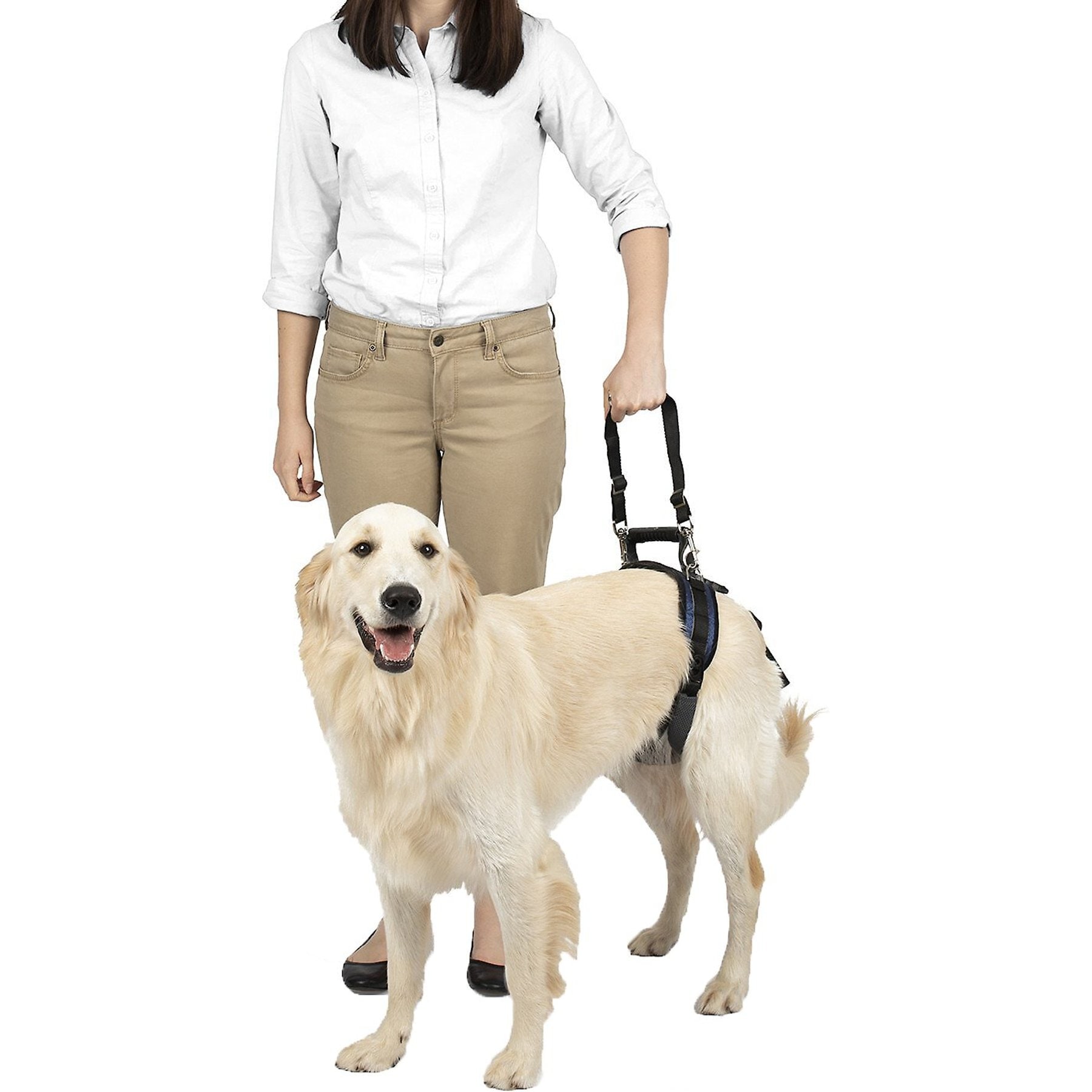
A support or lift harness has padded handles and exists so that you can take some of your dog's weight: helping it rise from a tiled floor, steadying it on stairs, getting it into a car, supporting a hind end that has begun to give out.
Most dogs that need the second still need the first. Neither treats anything: they are handling equipment for a dog whose osteoarthritis, hip dysplasia or spinal disease is being managed elsewhere with weight control, exercise and veterinary pain relief.
Work out which end is failing
This determines almost everything, and it is worth watching your dog properly rather than assuming.
Hind end. The common presentation. The dog struggles to rise from lying, its back legs slide out on smooth floors, it hesitates at stairs, it sits down partway through a walk, or it sways at the hips when walking away from you. Hip arthritis, cruciate ligament disease and intervertebral disc disease all present this way. Rear-support harness.
Front end. Less common and easier to miss. The dog is reluctant to go down stairs rather than up, shifts weight backwards when standing, or is stiff and short-strided in the forelimbs. Elbow and shoulder arthritis. Chest-supporting design.
Both, or neurological. A dog that is weak at both ends, knuckling over on its paws, or losing coordination needs full-body support with handles fore and aft, and needs a neurological examination, because some of the causes are time-sensitive.
One important distinction before buying anything: a support harness is for a dog that can bear weight but struggles. A dog that genuinely cannot bear weight has a problem that needs diagnosing now, and equipment is a decision for afterward. Sudden hind-limb collapse, particularly in a long-backed breed, can be an emergency.
The design fault that makes arthritis worse
This applies to walking harnesses and to the walking function of combined ones.
A harness with a strap that runs horizontally across the front of the chest, sitting over the point of the shoulder, physically restricts the shoulder's forward reach. On a young healthy dog that is a gait inefficiency. On a dog with front-end arthritis it is a strap pressing on a painful joint and shortening the stride it can take.
What you want instead is a Y-shaped front, where the straps run either side of the chest and meet at the breastbone, leaving the shoulder blades free to rotate. Run your hand under the front of any harness while the dog walks: if a strap crosses the moving shoulder, choose something else.
Two related points. Anything that puts pressure on the throat is unsuitable for an old dog; see front-clip harness and no-pull harness, and be aware that some no-pull designs work precisely by restricting shoulder movement, which is the opposite of what an arthritic dog needs. And an arthritic dog that still pulls is a training question rather than a hardware one: see how do I stop my dog pulling on the leash.
Choosing a support harness
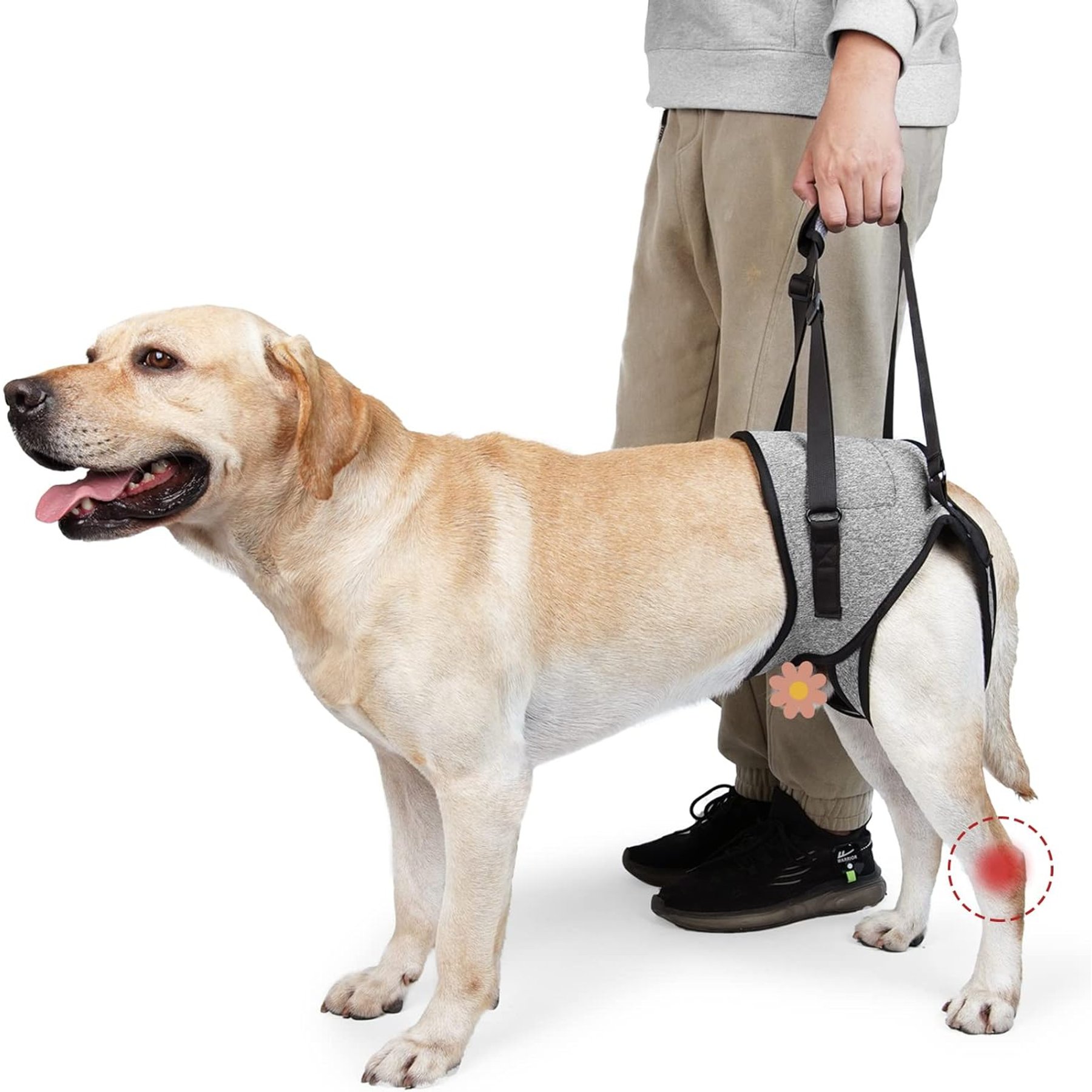
The rear-support design is the one most owners need, and it is the least intrusive: a padded sling under the pelvis and abdomen with a handle above the hips, quick to fit and easy to take off.
Sizing on these is not decorative. Too loose and it slides back and lifts by the abdomen; too tight and it presses on the hips it is supposed to be assisting. Measure rather than estimate, and size up rather than down if your dog is between sizes.
For dogs that need help at both ends, or that need steadying rather than lifting, a full-body harness with handles fore and aft distributes the load better and gives you more control on stairs.
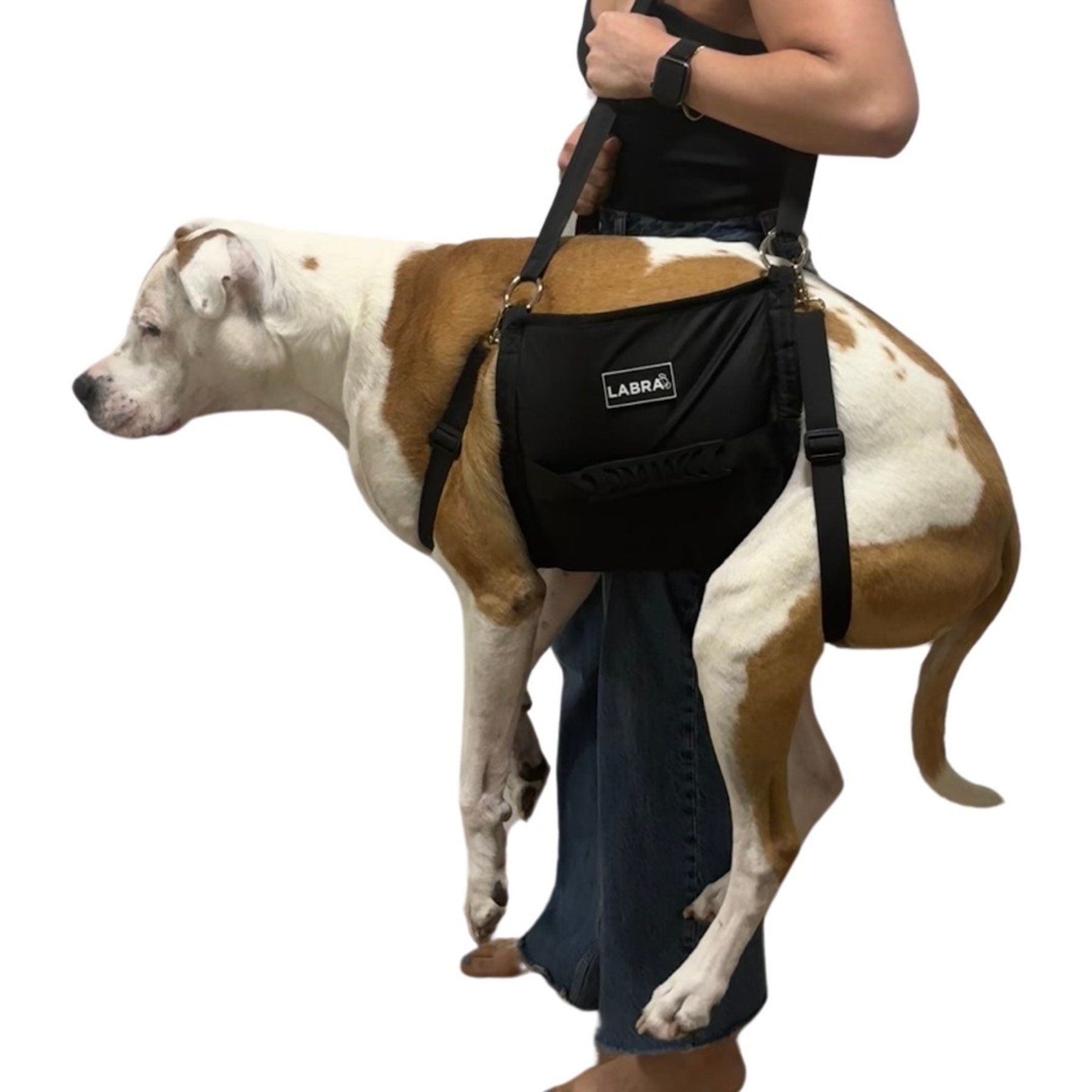
A sling-style carry harness is the right tool for the occasional situation where a dog has to be moved rather than assisted: an emergency, a vet visit, a flight of stairs it cannot manage at all.
For smaller dogs, or where the harness needs to live in a car or a bag for occasional use, a lighter portable design is more likely to actually be with you when it is needed.
Fit, and the skin underneath
| Property | How it fails | What good looks like |
|---|---|---|
| Chest strap geometry | Horizontal strap over the shoulder point restricts reach | Y-front, shoulder blades free |
| Padding width | Narrow webbing concentrates pressure into a line | Wide, padded load-bearing surfaces |
| Handle position | Too far forward or back; you lift at an angle and twist | Directly over the part being supported |
| Adjustment range | Fits when bought, not after weight change | Adjustable at chest, girth and length |
| Fastening | Buckles under a dog that cannot stand easily | Fastens with the dog lying down |
| Wear time | Left on continuously; rubbing and trapped moisture | Off daily, skin checked underneath |
That last row matters more than it sounds. Older dogs often have thinner coats, less muscle padding and more fragile skin, and pressure sores develop under padding surprisingly quickly. Take the harness off at least daily and look at what is underneath, particularly in the armpits, over the hips and along the midline.
Lifting without hurting either of you
The harness is half of it; technique is the other half.
Lift the weight, do not hoist the dog. The aim is to remove enough load that the dog can use its own legs. Taking a dog fully off the ground removes its ability to help and makes balance worse.
Bend your knees. Owners injure their backs doing this daily, and a bad back means the dog stops getting helped.
Let the dog set the pace on stairs. Support, wait, let it place its own feet. Rushing causes slips.
Do it in the same order every time. Older dogs, particularly any with cognitive dysfunction, cope much better with a predictable routine than an improvised one.
Fix the floors as well. Traction is the cheapest intervention available: runners along the routes the dog uses mean fewer situations that need lifting at all. A dog that slips once becomes hesitant, and hesitancy accelerates muscle loss.
And keep the weight down. Every kilogram is load through the joints and load in your arms. A body condition score from your vet gives you something to work against; the WSAVA global nutrition guidelines treat that as a routine part of every examination. See canine obesity.
What to skip
- Harnesses with a horizontal strap across the shoulder. Wrong for any dog, worse for an arthritic one.
- Anything that loads the neck. Collars and neck-pressure designs are unsuitable for old dogs.
- A towel as a permanent system. Fine in an emergency, poor daily, and hard on your back.
- Buying a lift harness instead of getting sudden weakness examined. Equipment supports a diagnosis; it does not replace one.
- Leaving a task harness on all day. Rubbing and pressure sores, especially on thin senior skin.
- Assuming the harness is the plan. It is handling equipment. The plan is weight, pain relief, controlled exercise and traction. See how much exercise does my dog need.
How to choose
Watch your dog rise, walk away from you and go down a step. That tells you which end to support.
For most arthritic dogs, buy a rear-support harness, measure properly, and keep it near the door the dog struggles with.
Choose a Y-front for anything that also functions as a walking harness, and check the shoulder is free while the dog is moving.
Take it off daily and look at the skin, particularly if your dog is thin.
And put runners down first. It costs less than the harness and reduces how often you need it.
FAQ
Frequently asked
What is the difference between a support harness and a walking harness?
A walking harness attaches to a leash and controls where the dog goes. A support or lift harness has padded handles and is made for you to take some of the dog's weight: getting up from the floor, managing stairs, steadying on a slippery surface, getting into a car. They solve different problems and most dogs that need the second still need the first. Some products combine both, and the combined ones are usually a compromise on each.
Front, rear, or full-body support?
Match it to which end is failing. Hind-limb weakness (the common presentation in hip arthritis, cruciate disease and many spinal conditions) needs rear support, which is also the easiest to fit and the least intrusive to leave on. Front-end problems such as elbow or shoulder arthritis need a chest-supporting design. A dog that is weak at both ends, or has a neurological condition, needs full-body support with handles at both ends.
Can I use a towel instead?
For an emergency, yes, and it is better than nothing. A folded towel under the belly works for a short-term lift. It is a poor daily solution because it concentrates pressure on a narrow strip of abdomen, it slips, it does not distribute load over the chest or pelvis, and it usually needs two hands, which leaves you none for a door or a leash. If lifting has become a daily routine, a purpose-made harness is more comfortable for the dog and considerably safer for your back.
My dog cannot get up at all any more. Is a lift harness the answer?
Not on its own, and this warrants an appointment rather than a purchase. A harness helps a dog that can bear weight but struggles to rise or stabilize. A dog that genuinely cannot bear weight has something that needs diagnosing, and if that change happened suddenly, particularly with a long-backed breed, it may be urgent. Get it examined and then work out what equipment supports the plan.
Should I leave the harness on all day?
Only if it is made for it, and check the skin regularly if you do. Many support harnesses are meant to be fitted for a task and taken off afterward. Left on continuously, straps rub, they trap moisture underneath, and pressure sores develop under padding in dogs with thin coats or poor condition. Some models are made for extended wear and say so; even with those, take it off daily and look at the skin underneath.
Featured in this guide
The picks referenced above—priced and in stock at time of publication.
Affiliate links. Prices and availability change—we filter unavailable items nightly, but the retailer's page is source of truth.
Keep reading
Discussion
Talk about Harnesses for Arthritic Dogs: A Walking Harness and a Lifting Harness Are Not the Same Thing
Real questions from real pet owners. Add yours—signed-in members only, first three posts held for review.
Loading threads…