LED Collars for Night Safety: Light That Does Not Need Headlights
Reflective gear only works when a car's lights are on the dog. An LED works everywhere else. What a light-up collar is for, where the light has to sit, and the five pieces worth charging.
petsupplies.co earns a commission if you buy through the product links on this page, and the price you pay is the same either way.

Reflective gear has one weakness, and it is a large one: it needs a light shining on it. Under headlights a reflective harness blazes. In a park at dusk, on a canal path with cyclists, or on a residential street lit from above, it is a dark harness on a dark dog. An LED fixes exactly that gap, and creates a couple of its own.
We covered the passive half of night visibility in reflective gear for evening walks. This is the active half: what a light-up collar is for, where the light has to sit to be seen, and the difference between a collar that is a light and a light you can put wherever you like.
What a light does that reflection cannot
A retroreflective strip returns light to its source, so it is brightest to the person whose headlights are on it and invisible to almost everyone else. An LED emits its own light, which means it is seen from any angle, at any distance its brightness allows, by anyone at all: the cyclist with no lights, the driver whose beams are pointed at the bend rather than at your dog, the person on the other side of the park trying to work out where their own dog has gone. That last one is not trivial. For a dog that ranges off-leash in the dark, the light is as much for you as for traffic.
What a light cannot do is draw an outline. A collar is a loop of light around the neck; a clip-on module is a point. A driver sees that there is something there, and with a flashing mode sees it early, but does not get the shape and gait that a reflective vest gives. Which is why the honest recommendation is one of each rather than a choice between them, and why the last pick in this guide is a harness that does both.
The road figures make the case for taking the dark seriously at all. An archived Federal Highway Administration pedestrian safety course records that sixty-five percent of all pedestrian incidents occurred at night. A dog is smaller, lower and darker than a pedestrian.
Steady or flashing
Every collar here has a steady mode and at least one flash. The trade is simple. A flash catches the eye sooner, particularly at the edge of a driver's vision; a steady light is easier to judge for distance and direction and easier to track continuously. On a road, where the job is to be noticed by someone not expecting a dog, a slow flash is a reasonable default. In a park, where the job is tracking the dog yourself, steady wins. Fast flash modes are mostly there because the chip supports them.
One caution: the light sits near the dog's eyes on a small dog. Most dogs ignore it. A dog that squints, shakes its head or keeps trying to remove the collar is telling you the flash is bothering it, and a steady mode or a chest-mounted clip light solves that.
Where the light has to be
The same geometry that applies to reflective gear applies here. A driver approaching head-on sees the chest and front legs, not the top of the neck. A single LED module at the buckle, worn at the top of the neck, is hidden by the dog's head from the front and by the body from the side on a broad dog. Two designs fix that: a collar whose whole loop glows, so some of it is visible from every angle, and a clip-on light placed low on a harness chest strap. The picks below are chosen with that in mind.
A second point about collars. Most light-up collars are lightweight accessories with a plastic buckle and are not built to take a leash. Unless the maker says a collar is load-bearing, treat it as a second collar worn next to the one the leash is clipped to, and keep the ID tag on the strong one. See microchip for the backup that does not depend on any collar at all.
A collar that glows all the way around
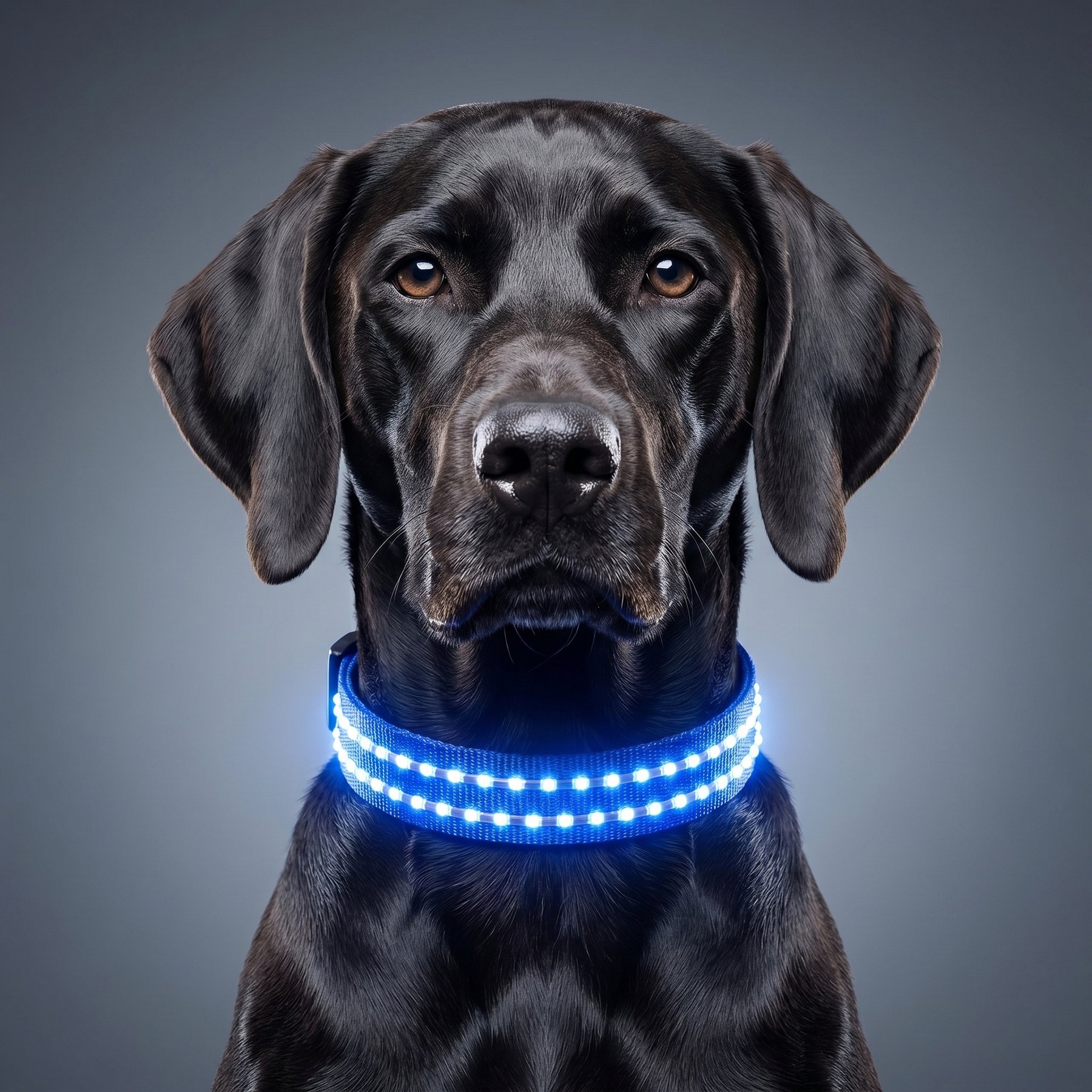
This one lights the whole loop rather than a single module. Two optical fibers run the length of the collar and glow uniformly, so the dog is outlined in light from every side, including from the front on a broad chest. It has three modes, constant, slow flash and fast flash, charges by USB, and includes a waterproof cover for the fiber ends, which is the part that fails first on collars of this type. It fastens with a slip buckle, so it adjusts to the neck rather than to fixed holes. The size linked here is the extra-large for a 24 to 28 inch neck; it is sold in smaller sizes, so measure the neck and pick the right one.
A rechargeable collar with a long run time
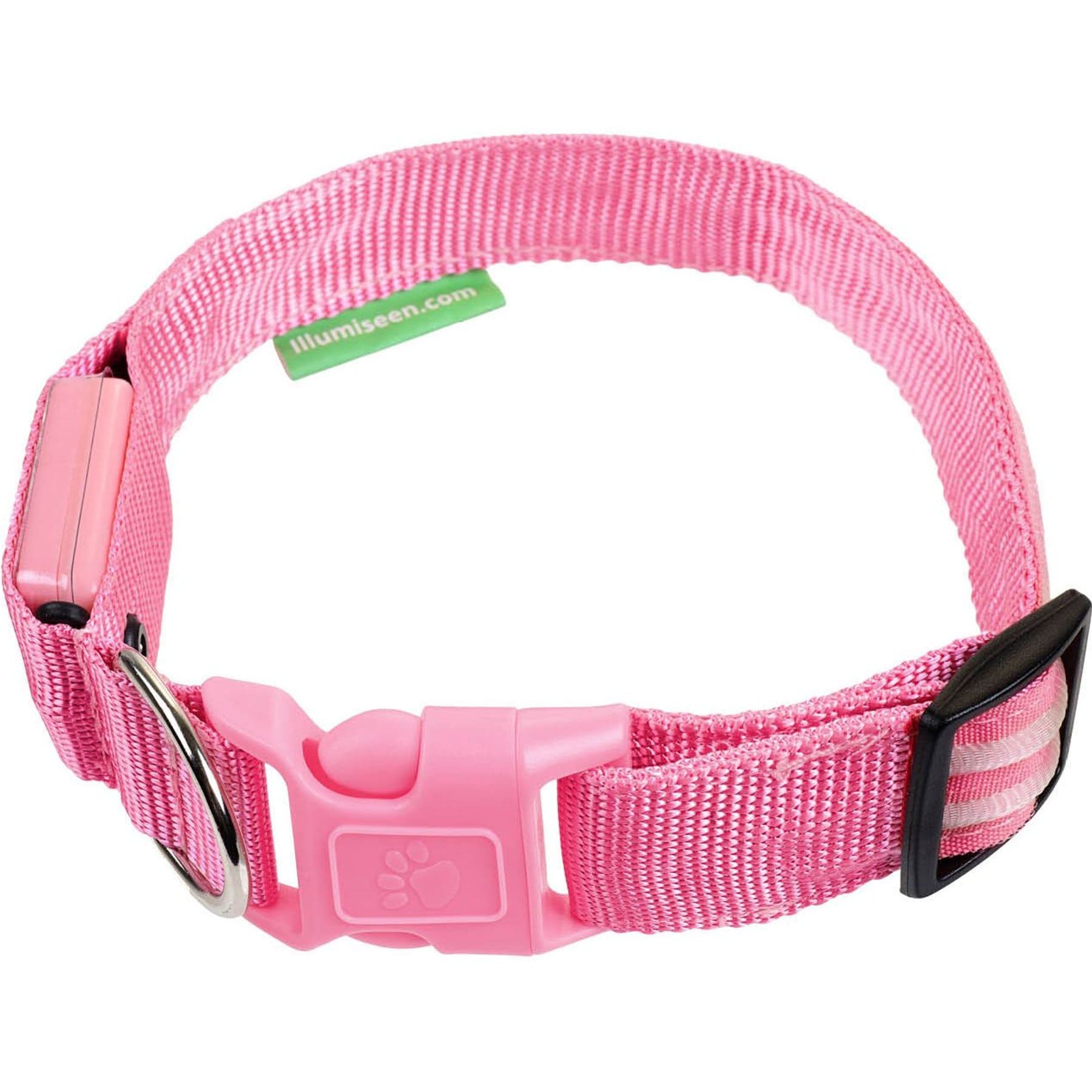
The useful specification on a rechargeable collar is hours of light per hour of charging, and this one states five hours of illumination from a one-hour charge, which is a week of evening walks between plug-ins. The illuminating strips run around the collar so the dog is visible from the sides as well as the front, and the three modes, steady, rapid and slow flash, cycle with a single click. This listing is the small size in pink; it comes in other sizes and colors.
A light you can put anywhere
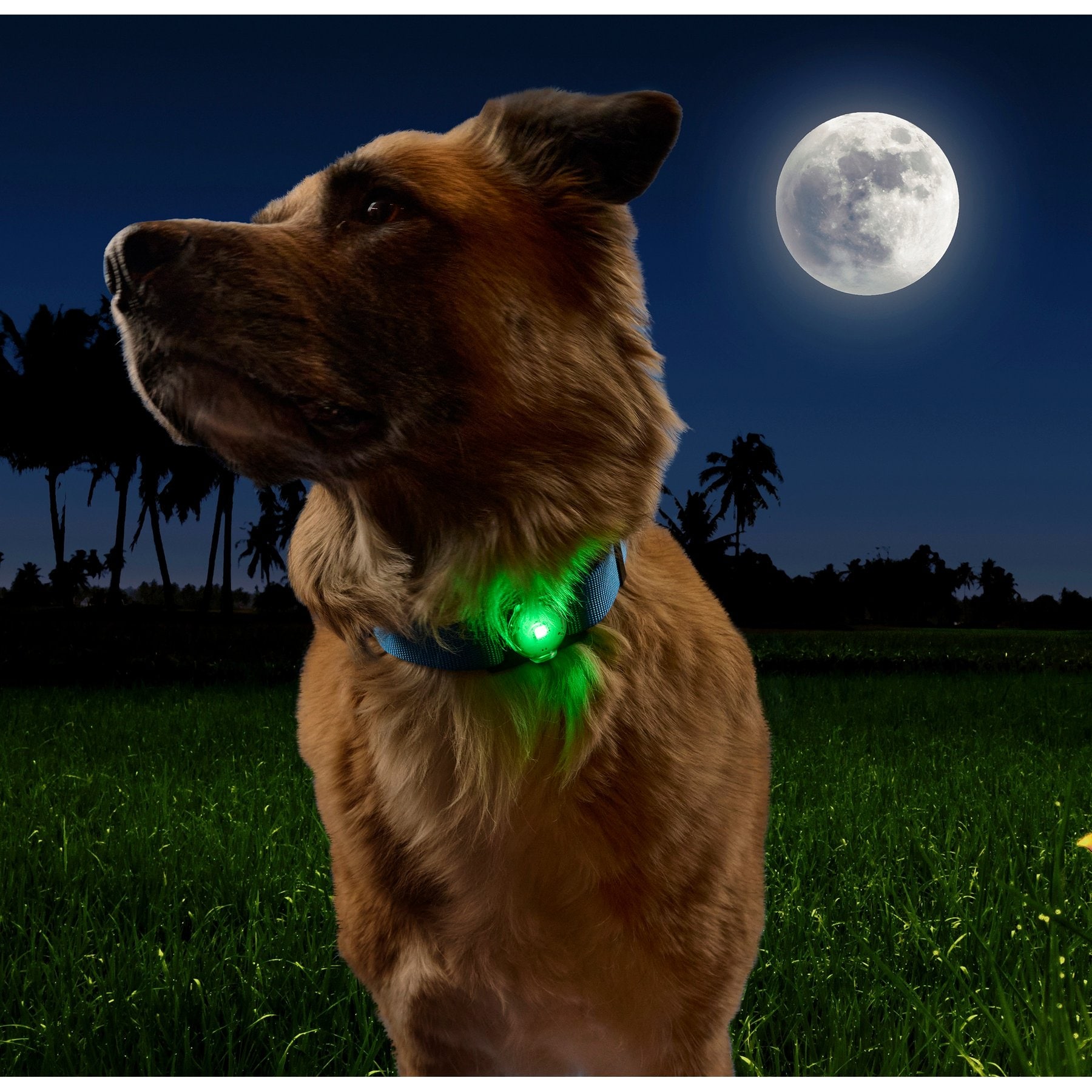
A light that is not a collar. This module clips to any collar, leash or harness strap up to an inch wide, so it can sit low on the chest strap of a harness where a driver sees it first, or on the leash handle to mark you. It has four colors in glow and flash, plus a color-changing mode, in a weather-resistant polycarbonate housing, and it recharges in about two hours from a micro-USB cable, which is not included. For a dog that already wears a reflective harness, this is the single addition that covers the park and the cycle path.
The cheap one for the drawer
A plain LED collar with three light settings, rapid flash, slow flash and constant, at a price that makes it sensible to keep a spare in the car or the coat pocket. It is the one to buy for a visiting dog, a foster, or the night the rechargeable is flat. Buy it as a backup and it will earn its keep; buy it as the only light and you will want the run time and the full-loop glow of the collars above within a month.
A harness that does both jobs
If you are buying a harness anyway, this is the one that settles the reflective-versus-light argument by doing both. Rechargeable LEDs on the harness put the light on the chest and sides, low and forward, exactly where a driver looks; reflective straps handle the headlight case; three side rings give a handler leverage over a puller; and there is a grab handle. It is the most expensive item here and the only one that is a complete answer on its own. The linked size is the extra-small for a 12 to 17 inch chest, so measure and pick the right one. See no-pull harness and how do I measure my dog for a harness.
Charging, weather and the walk it went flat on
The failure mode of every light is the walk it is not on. A rechargeable collar that lives on the hook by the door with a cable beside it gets charged; one that lives in a drawer does not. Check it in the hallway rather than at the first dark corner, and keep the cheap backup for the night you forgot.
Rain is the other one. Look for a weather-resistant housing or a cover over the connector, dry the contacts before charging, and expect any LED collar to die eventually at the point where the cable goes in. That is why the collar with the dust cover and the module with the sealed housing are the ones in this list.
How this goes wrong
| What gets bought | Why it disappoints | What to do instead |
|---|---|---|
| A single-module LED at the buckle | Hidden by the head from the front | A full-loop collar, or a clip light low on the chest |
| The leash clipped to the light-up collar | Plastic buckle; not built for load | Second collar, or clip the light to the harness |
| Fast flash on a small nervous dog | Light near the eyes; the dog objects | Steady mode, or a chest-mounted light |
| Light-up collar instead of reflective gear | A point of light, no outline in headlights | Both: reflective harness plus a light |
| A collar that charges in the drawer | Flat on the night it is needed | Charge by the door, keep a cheap backup |
| Bright light, no reflection, on an unlit road | The driver sees a dot, not a dog | Reflective panels on chest and sides as well |
What to skip
- Any LED collar as the leash collar unless the maker says it is load-bearing.
- A light as the only visibility on a road. It marks a point, not a dog.
- Fast flash by default. Slow flash or steady, and watch the dog.
- Sizing by guess. Every collar here is sold by neck measurement.
- Glow-in-the-dark trim sold alongside these. It is neither a light nor a reflector.
How to choose
If the dog already wears a reflective harness, add the clip-on light to its chest strap and you are done for most walks.
If it does not, a full-loop rechargeable collar is the best single light, worn next to the collar the leash is on.
If you are buying a harness anyway, buy the one with lights and reflective straps built in.
Keep the cheap collar as the spare.
And charge whatever you buy by the front door, because the light that matters is the one that is on.
FAQ
Frequently asked
Are LED collars safe for dogs?
Yes, with two cautions. Most light-up collars are not built to take a leash, so unless the maker says a collar is load-bearing, treat it as a second collar worn alongside the one the leash clips to. And the light sits close to the dog's eyes on a small dog, so choose a steady mode rather than a fast flash for a dog that seems bothered by it, and clip a light to the harness chest instead if the collar position is a problem.
Is a flashing or a steady light better for a dog at night?
Flashing draws attention sooner; steady is easier to judge for distance and direction. For a dog on a leash at the curb, where the point is to be noticed by a driver who is not expecting an animal, a slow flash is a fair default. For a dog off-leash in a park, where the point is for you to track it, steady is easier on everyone. Every pick here has both, so the choice is a button, not a purchase.
Do I still need reflective gear if my dog has an LED collar?
Yes. They cover different failures. An LED is visible from any angle and under any lighting, but it is a small point of light that needs charging, and one that has gone flat is nothing at all. Retroreflective material never runs out and lights up the dog's whole outline in a driver's headlights, but does nothing without them. A reflective harness with one light attached is the combination that works on the road and in the park.
Rechargeable or battery LED collar?
Rechargeable, for a dog walked every evening. A collar that charges by USB in an hour or two and runs for several hours per charge will be charged, because it lives next to the phone charger. A coin-cell collar is cheaper to buy and fine for occasional use, but the battery goes flat on the walk you needed it most and the replacement is never in the drawer. Whichever you choose, check it before leaving the house rather than at the first dark corner.
Where should the light be on the dog?
As low and as far forward as you can manage. A light on the top of the neck is hidden from the front by the dog's head and from the side by its body on a broad dog, which is why a full-loop collar that glows all the way around beats a single module at the buckle, and why a clip-on light on the chest strap of a harness is often better placed than any collar. For a small dog, height matters less; for a large one, a light at chest level is the one a driver sees first.
Featured in this guide
The picks referenced above—priced and in stock at time of publication.

Affiliate links. Prices and availability change—we filter unavailable items nightly, but the retailer's page is source of truth.
Keep reading
halloween safety
Halloween Candy and Dogs: Which Candies Are Dangerous, How Much, and What to Do
halloween safety
Anxiety Wraps for Fireworks and Noise: What the Pressure Does, and What It Cannot
halloween safety
Reflective Gear for Evening Walks: Where It Goes Matters More Than How Much
evergreen
Wand Toys for Cats: The Toy Matters Less Than How You Move It
evergreen
Probiotics for Dogs: What the Evidence Supports, and What the Label Has to Say
holiday wellness planning
Dog Beds for Cold Floors: A Layer Between Dog and Tile Does More Than Extra Fluff
Discussion
Talk about LED Collars for Night Safety: Light That Does Not Need Headlights
Real questions from real pet owners. Add yours—signed-in members only, first three posts held for review.
Loading threads…