Probiotics for Dogs: What the Evidence Supports, and What the Label Has to Say
Probiotics help some dogs in some situations, mostly short, stressful ones, and the science is thinner than the shelf suggests. What a probiotic is, when a vet reaches for one, how to read a label for live counts and named strains, and five products that say what is in them.
petsupplies.co earns a commission if you buy through the product links on this page, and the price you pay is the same either way.

Probiotics are sold to dog owners the way vitamins are sold to people: as a daily habit for the healthy, with the implication that more good bacteria is always better. The veterinary evidence is narrower and more useful than that. Probiotics help some dogs, in some situations, for a while, and the situations are fairly specific. This guide sets out what they are, when a vet reaches for one, what a label has to tell you before a product deserves the name, and five products that say what is in them.
None of the picks is a treatment for a sick dog. A dog with diarrhea for more than a day or two, blood in the stool, vomiting, or weight loss needs a diagnosis, and the canine acute gastroenteritis page explains why.
What a probiotic is
The Merck Veterinary Manual's definition is the one to hold on to: probiotics are cultures of living bacteria that, when fed in sufficient amounts, may improve host health. Every word in that carries weight. Living: the bacteria have to be alive when the dog eats them, which is a problem for a powder that has sat in a warm cupboard. Sufficient amounts: Merck's two cautions are that a probiotic must contain enough living bacteria to cause a substantial change, and that the duration of any change is unknown. May: the evidence is suggestive rather than settled.
The proposed mechanisms are plausible: reduced intestinal permeability, more mucus, short-chain fatty acid production, a shift in gut pH, and some immune stimulation. The commonly used lactobacilli and bifidobacteria, Merck notes, appear to decrease susceptibility to diarrhea. That is the best-supported claim, and it is a modest one. The probiotics glossary entry has the short version.
When they help
The pattern in the evidence is that probiotics earn their keep around a disturbance. Merck's pharmacology reference on probiotics puts it as positive responses being more likely when a stressful change occurs that alters the balance of gut bacteria, and lists the kinds of stress: weaning, transport, and abrupt change. For a pet dog that translates to:
Boarding, travel and house moves. The classic stress diarrhea. Starting a probiotic a few days before and continuing a week after is the most defensible routine use.
A course of antibiotics. Antibiotics disturb the gut flora; a probiotic during and after is widely used to soften the disturbance.
A bout of simple diarrhea in an otherwise well dog, alongside a bland diet, and for a few days only.
Chronic gut disease, under a vet. Merck's reference on chronic enteropathies in small animals lists modulation of the microbiome among the therapies, alongside dietary change and, where needed, drugs. This is a vet's decision about a diagnosed dog, not a shelf purchase.
When they do not
A healthy adult dog on a complete diet with normal stools gains little from a daily probiotic, and the money is better spent on the diet. A dog whose stools only stay normal while it is on a probiotic has a problem the probiotic is masking. A dog with parasites, see canine giardiasis, needs treatment for the parasite. And a probiotic is not a fix for a diet the dog does not tolerate: a food change is.
Reading the label
This is where most products fall down, and it is the reason for the picks that follow.
A named strain. The species name tells you almost nothing. Lactobacillus acidophilus is a species; the effect of a probiotic depends on the particular strain, identified by letters and numbers after the species name. A product that names its strains has, at least, something that could have been tested.
A count that is guaranteed. Live bacteria are counted in colony-forming units, CFU. The number that matters is the guaranteed count per dose at the end of shelf life, not the number at manufacture, because the bacteria die in the tub. Spore-forming species such as Bacillus survive storage and stomach acid better than lactobacilli, which is why several products use them.
Storage instructions. If the label says refrigerate, refrigerate.
Prebiotics named as such. Inulin, fructo-oligosaccharides, pumpkin and other fibers feed the bacteria and, Merck notes, may increase lactobacilli and bifidobacteria in dogs and cats while reducing potential pathogens. They are a reasonable addition. They are not a probiotic on their own. See dietary fiber.
A chew with a stated count and a stated use
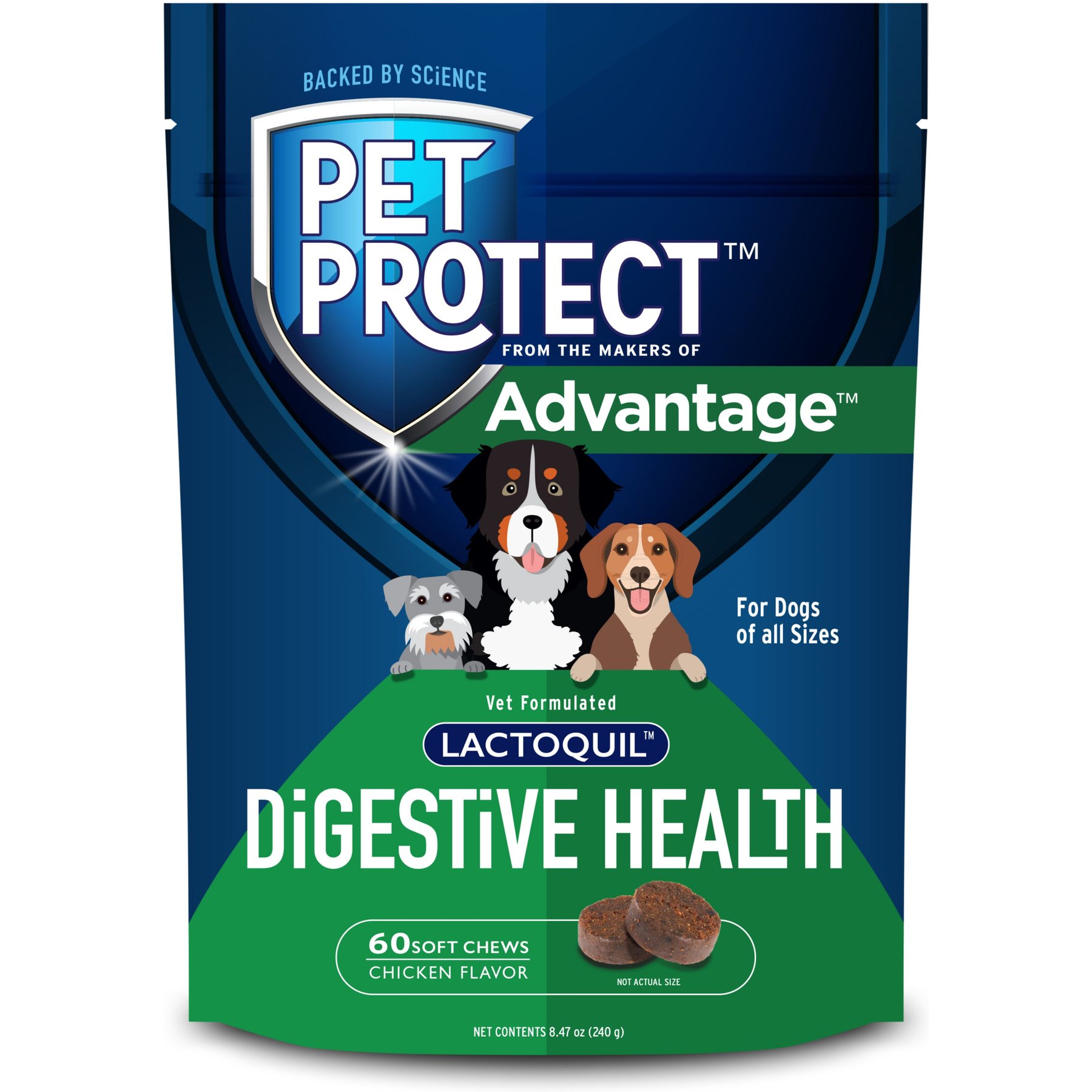
This is the pick that reads most like the label described above. Nine strains of live probiotics plus prebiotic inulin, a stated minimum of 1.5 billion CFU per chew, and, unusually, a stated purpose that matches the evidence: digestive upsets caused by traveling, boarding, antibiotic therapy or deworming. Sixty chicken-flavored chews, one a day for a medium dog, which covers two weeks before and after a kennel stay several times over. Check the expiry date on arrival and the storage instructions on the tub.
A high-count powder for a longer disturbance
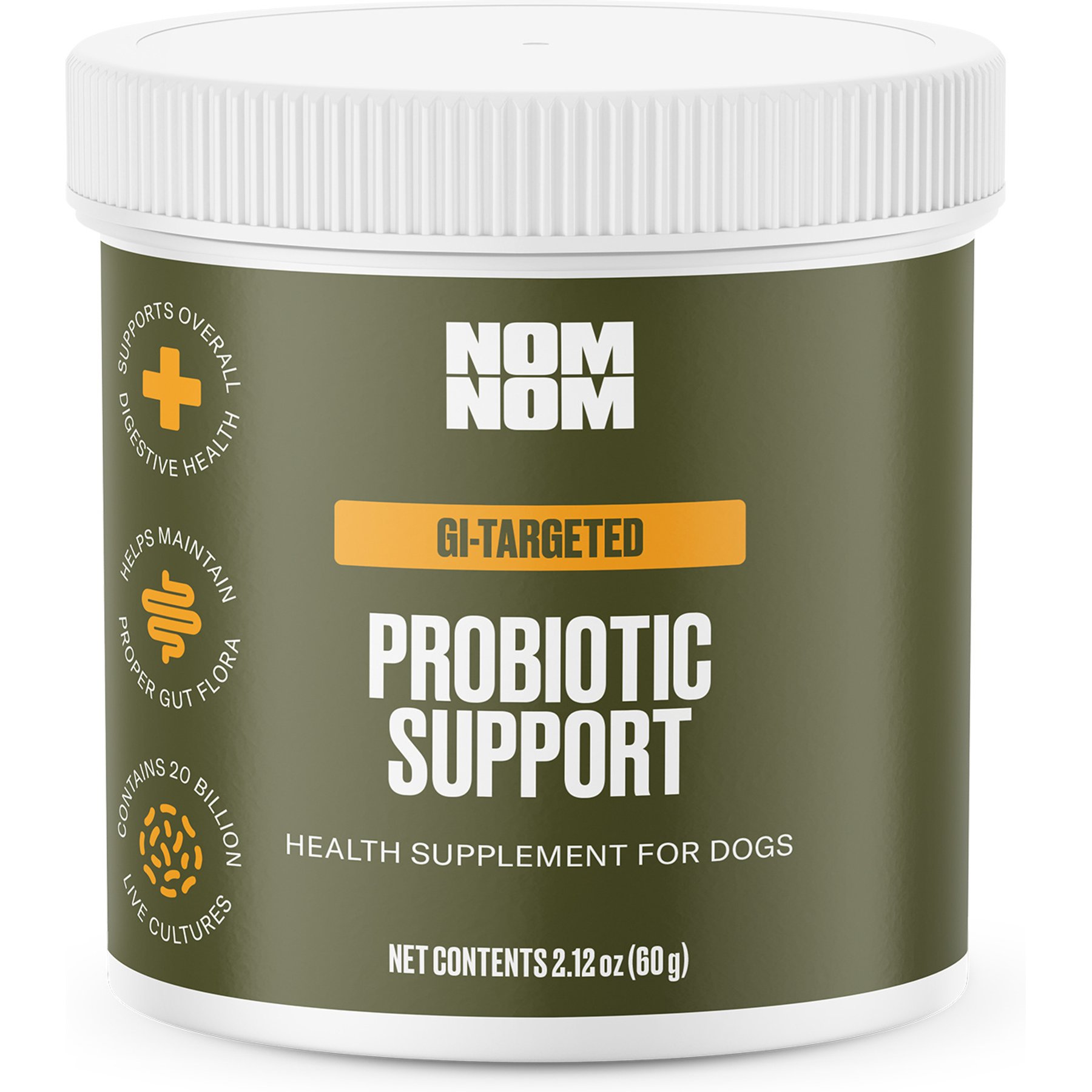
For a dog that needs cover through a longer disturbance, a long course of antibiotics for instance, the count per serving is the number to compare. This powder states 20 billion CFU and five probiotic strains per serving, plus prebiotic fiber. The maker says a veterinary nutritionist and a microbiologist developed it to improve stool quality. It comes in a 2.12-ounce jar and is the most expensive pick here. The listing gives the number of strains but not their names, so read the jar for them, and check the expiry date and storage instructions on arrival.
A daily powder with prebiotics from food
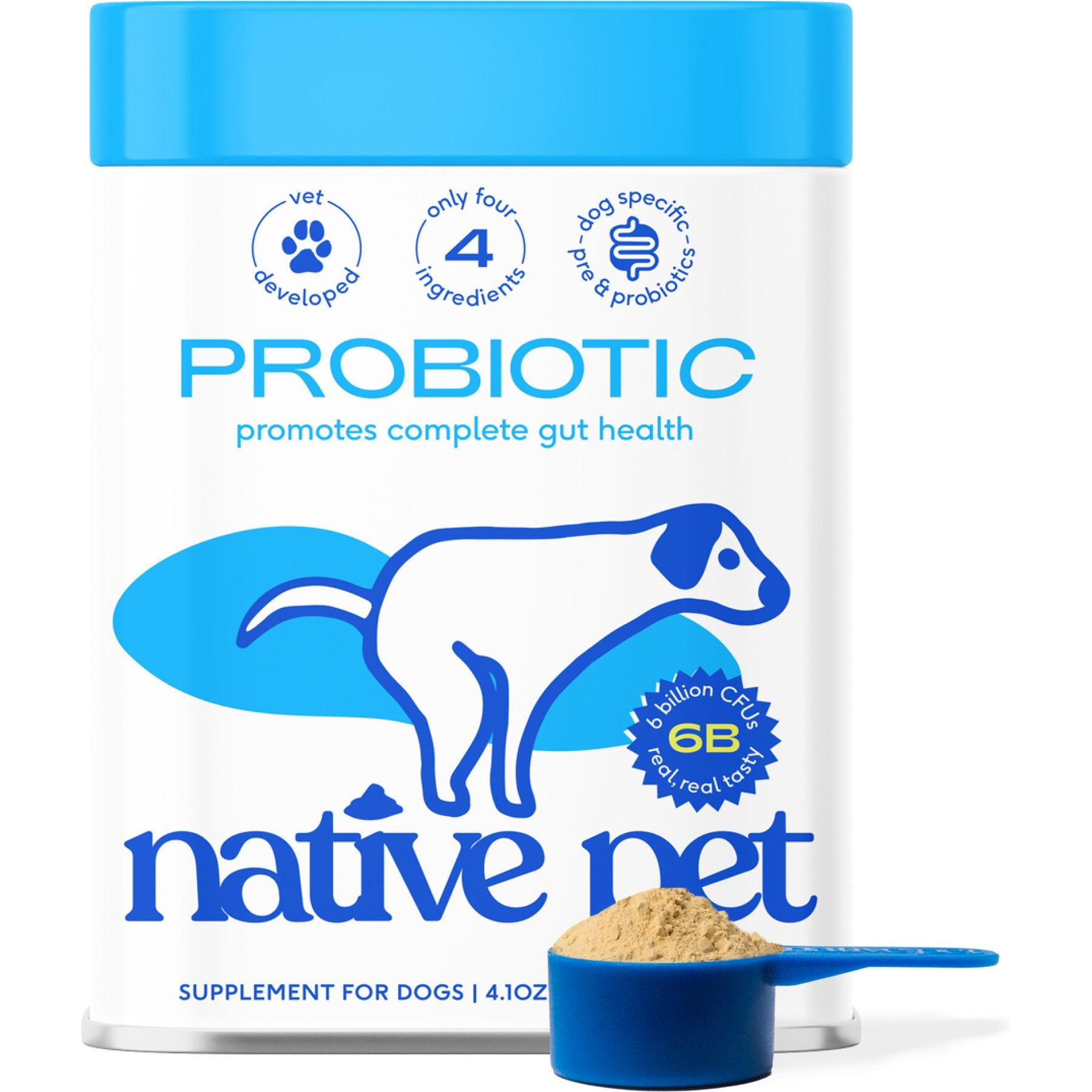
For an owner who wants something to sprinkle rather than a chew, this is a powder combining four probiotic strains with prebiotics from organic pumpkin seed and Jerusalem artichoke, flavored with beef bone broth so it goes onto wet or dry food without argument, with no fillers, soy, dairy or gluten. The four-ounce tub is the sensible size to try; the maker sells larger. As with any powder, keep the lid on and the tub dry, and check the guaranteed count against the dose on the label rather than the headline.
For the owner who wants a branded strain
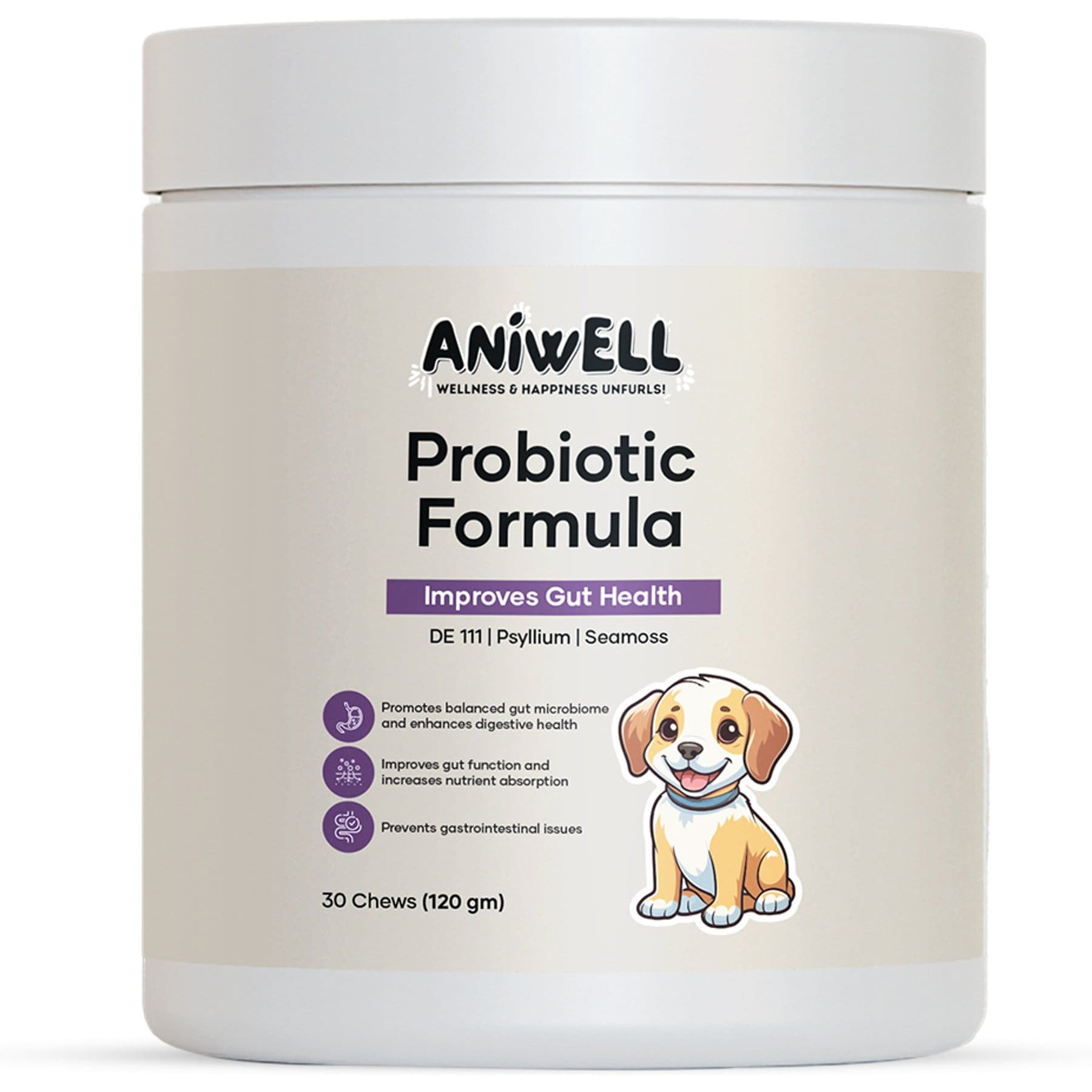
This chew is built around DE111, a branded and trademarked probiotic strain, which is the kind of specificity the label section above asks for, with sea moss and moringa added as sources of antioxidants and mixed tocopherols as the preservative, and no artificial ingredients or fillers. Thirty chews. The strain is the reason to choose it; the botanicals are decoration, and if your dog has a sensitive stomach a simpler product is the safer first try.
The food-form option
Some dogs will not take a chew and spit out a powder. This is dehydrated goat milk with probiotics added, mixed with water and poured over a meal or offered on its own, made in the United States with no soy, corn, wheat, legumes or artificial additives. It is the gentlest way to get a fussy dog to take something, and the least precise, because a food topping does not state strains and counts the way a supplement does. Treat it as a palatable carrier with some probiotic benefit rather than a dosed product, and count its calories, since milk is not free.
Giving it properly
Start before the stress, not after: two or three days before the kennel, the flight or the antibiotics. Give the dose on the label for the dog's weight, with food. Continue through the disturbance and for about a week after. Store as directed, and throw away anything past its date. If the stool has not improved within a week, stop and ask the vet, because the probiotic was not the answer.
And keep the rest of the picture in view. A dog's gut is mostly the product of its diet, and a good complete food fed at the right amount, see how much to feed, does more for it than any supplement.
How this goes wrong
| What happens | Why it matters | What to do instead |
|---|---|---|
| Daily probiotic for a healthy dog | Little evidence of benefit; money better spent on diet | Use around stress, then stop |
| Label lists species but no strain or count | Nothing testable, nothing dosed | A named strain and a guaranteed CFU per dose |
| Powder kept in a warm cupboard for a year | The bacteria are dead | Storage as directed, expiry respected |
| Probiotic given for diarrhea that is really parasites or a diet problem | The cause is untreated | A vet visit if it lasts beyond a day or two |
| Started after the kennel stay | The disturbance has already happened | Two or three days before |
| A dog that needs it forever | A masked condition | Diagnosis, not supplement |
What to skip
- Any product that does not state a live count. It cannot be dosed.
- Yoghurt as a probiotic. Lactose, little culture.
- Human capsules for a sick dog. Ask the vet.
- Probiotics in place of a diet change for a dog that does not tolerate its food.
- Probiotics for a dog with blood in the stool, vomiting or weight loss. That is a vet visit.
How to choose
Decide whether there is a reason: a kennel stay, a trip, a course of antibiotics, a short bout of simple diarrhea. If there is not, there is probably no product to buy.
Read the label for a named strain, a guaranteed count per dose, and storage instructions.
Choose the format the dog will take: a chew for most, a powder for a sprinkler, a high-count powder for a long course, goat milk for the fussy.
Start before the stress and stop a week after.
And if the dog is actually ill, this is not the aisle.
FAQ
Frequently asked
Do probiotics actually work for dogs?
Sometimes, for some things. The best-supported use is short-term, around a stressful change that disturbs the gut: boarding, travel, a course of antibiotics, or a bout of simple diarrhea. Merck's veterinary reference notes that lactobacilli and bifidobacteria in commercial products appear to reduce susceptibility to diarrhea, and that responses are more likely when a stressful change has upset the balance of gut bacteria. As a daily supplement for a healthy dog on a good diet, the evidence for benefit is weak. As part of managing a diagnosed chronic gut disease, they are one tool among several, and the vet should choose it.
What should I look for on a probiotic label?
Three things. A named strain, not just a species: 'Enterococcus faecium SF68' tells you what was tested, 'Enterococcus faecium' does not. A live count in colony-forming units per dose, guaranteed at the end of shelf life rather than at manufacture, because bacteria die in the tub. And an expiry date with storage instructions you can follow. Merck's plain statement is that a probiotic must contain enough living bacteria to cause a substantial change, which is the whole reason the count matters. A product that lists none of these is a flavored powder.
Can I give my dog human probiotics or yoghurt?
Yoghurt contains a small amount of live culture and a lot of lactose, which many dogs digest poorly, so it is a poor probiotic and an occasional treat at best. Human probiotic capsules contain strains selected for human guts at human doses; some overlap with canine products and some do not. Neither is dangerous for a healthy dog, but neither is a substitute for a product whose strains and counts were chosen for dogs. If the reason for the probiotic is a sick dog, ask the vet rather than the fridge.
How long does it take for a probiotic to work?
For a short-term use, a few days to a week, and if there is no change in the stool within that window it is unlikely to come. The bacteria in a probiotic mostly pass through rather than colonize, and Merck notes that how long any change lasts is unknown, which is why probiotics are usually given for the duration of the stressful period and a week beyond it rather than forever. A dog that needs a probiotic permanently to keep its stool normal has a condition that needs a diagnosis, not a supplement.
What is the difference between a probiotic and a prebiotic?
A probiotic is live bacteria. A prebiotic is food for bacteria: fibers such as inulin, fructo-oligosaccharides or pumpkin that the dog cannot digest and the gut bacteria can. Merck's reference notes that prebiotics may increase lactobacilli and bifidobacteria in dogs and cats while reducing potential pathogens, and they have the advantage of not needing to be alive in the tub. Many products combine both, which is reasonable; a product that is only prebiotic fiber is not a probiotic, whatever the front of the pack says.
Featured in this guide
The picks referenced above—priced and in stock at time of publication.
Affiliate links. Prices and availability change—we filter unavailable items nightly, but the retailer's page is source of truth.
Keep reading
evergreen
Scratching Posts Cats Actually Use: Tall, Heavy, Sisal, and in the Room You Live In
evergreen
Single-Ingredient Dog Treats: One Line on the Label, and What It Does Not Tell You
evergreen
Wand Toys for Cats: The Toy Matters Less Than How You Move It
evergreen
Vertical Space for Indoor Cats: Perches, Shelves and Towers That Make a Small Apartment Bigger
evergreen
Backyard Chicken Waterers: Size for Hot Days, Clean Daily, Then Plan for Freezing Ones
evergreen
Window Bird Feeders: Clean Them Often and Mark the Glass Around Them
Discussion
Talk about Probiotics for Dogs: What the Evidence Supports, and What the Label Has to Say
Real questions from real pet owners. Add yours—signed-in members only, first three posts held for review.
Loading threads…