Wand Toys for Cats: The Toy Matters Less Than How You Move It
A wand toy is the one cat toy that needs you, and that is the point. What the predatory sequence is and why a play session has to finish it, how to move a lure so a cat believes it, how long and how often, and five lures that cover feathers, snakes, birds and the dark.
petsupplies.co earns a commission if you buy through the product links on this page, and the price you pay is the same either way.

Most cat toys are built to be ignored. A ball on the floor, a mouse under the sofa, a plush thing that smelled of catnip a month ago: these are objects, and a cat's interest in objects is brief. A wand toy is different because it moves, and it moves because you move it. It is the only toy in the house that behaves like prey, and it is the one that does the most for an indoor cat's behavior, weight and temperament. It is also the one most owners use badly, waving it in the cat's face for two minutes and then wondering why the cat walked off.
This guide is about the moving, more than the toy. It covers what a cat is trying to do when it plays, how to move a lure so the cat believes it, how long and how often, what to do about a cat that ambushes ankles, and five lures that cover the kinds of prey cats respond to.
What play is
The Merck Veterinary Manual's account of feline behavior is precise about this: object play simulates the predatory sequence and includes stalking, chasing, pawing, pouncing and biting. A cat playing with a wand toy is hunting, and a hunt has a shape: locate, stalk, chase, pounce, catch, kill, eat. Play that runs through the first four and then stops, because the toy went back in the drawer, leaves the cat at the top of the arousal curve with nowhere to go. That is the cat that bites your hand ten minutes later.
So the first rule of a wand session is that it finishes. The cat catches the lure, holds it, bites it, and then gets something to eat: a few pieces of dry food, a treat, or the evening meal. The prey drive glossary entry covers the sequence; the feline veterinary associations' environmental needs guidelines list the opportunity for play and predatory behavior as one of five things every cat's home has to provide.
How to move a lure
Prey does not attack the cat. It moves away, it hides, it freezes, and it makes a mistake. A lure moved like prey does the same.
Away, not towards. Drag the lure away from the cat, across the floor or along a wall. Never towards its face.
Behind things. Around a door frame, under a cushion, behind the leg of a chair, so the cat sees part of it and has to stalk.
Stop. Freeze the lure for a few seconds. Most pounces happen on a still target that then twitches.
Vary the height. Some cats hunt birds and want the lure in the air; more hunt mice and want it on the ground. Try both and notice which one the cat commits to.
Let it be caught. Every minute or two, let the cat get the lure and hold it. A cat that never catches anything stops trying. Then take it gently, and begin again.
End with a catch and a meal. The session is over when the cat has the lure in its mouth and something to eat follows.
Merck's owner guidance adds the practical point: find a number of toys that interest the cat, and play with several until its interest wanes. Cats habituate to a toy within days if it is left out, so wand toys live in a drawer and come out in rotation.
How long, how often
Two or three sessions a day, each running until the cat loses interest, which is five to fifteen minutes for most adults and longer for a young cat. Kittens and young adults need more; older cats want shorter sessions and lower prey. The best times are the ones a cat would hunt: dawn and dusk, which for a household means before breakfast and in the evening. A session before the evening meal, ending with the meal, is the single most useful routine an indoor cat's owner can build. See how long can I leave my cat alone for why the evening session matters most for a cat that is alone all day.
The snake on the floor
Ground prey first, because more cats hunt mice than birds. This is a length of soft boa on a wand, made to be bounced and dragged rather than flown, and its virtue is that it moves like something alive along the floor and around furniture. Drag it slowly away from the cat, let it disappear around a corner, and wait. It is the lure to start with for a cat that ignores feathers.
The bird in the air
For the cat that leaps, a long teaser with feathers at the end, about thirty-five inches from hand to lure, so the bird can be swooped across the room and up onto a chair. The maker labels it for supervised play only, which applies to every wand toy but is worth repeating for one with a long line: put it away after every session. Let the bird land and freeze on the floor between flights, because that is when the pounce comes.
The one that crinkles
Sound is part of prey. This teaser combines bright feathers with a crinkle noise and a stuffing of catnip, sent as one of several characters at random. The crinkle is the thing: a lure that rustles under a cushion gets a cat that a silent one did not. Catnip affects roughly half to three-quarters of cats, so if yours is among the unmoved, the feathers and the crinkle still work. Cheap enough to own two and rotate.
The one that chirps
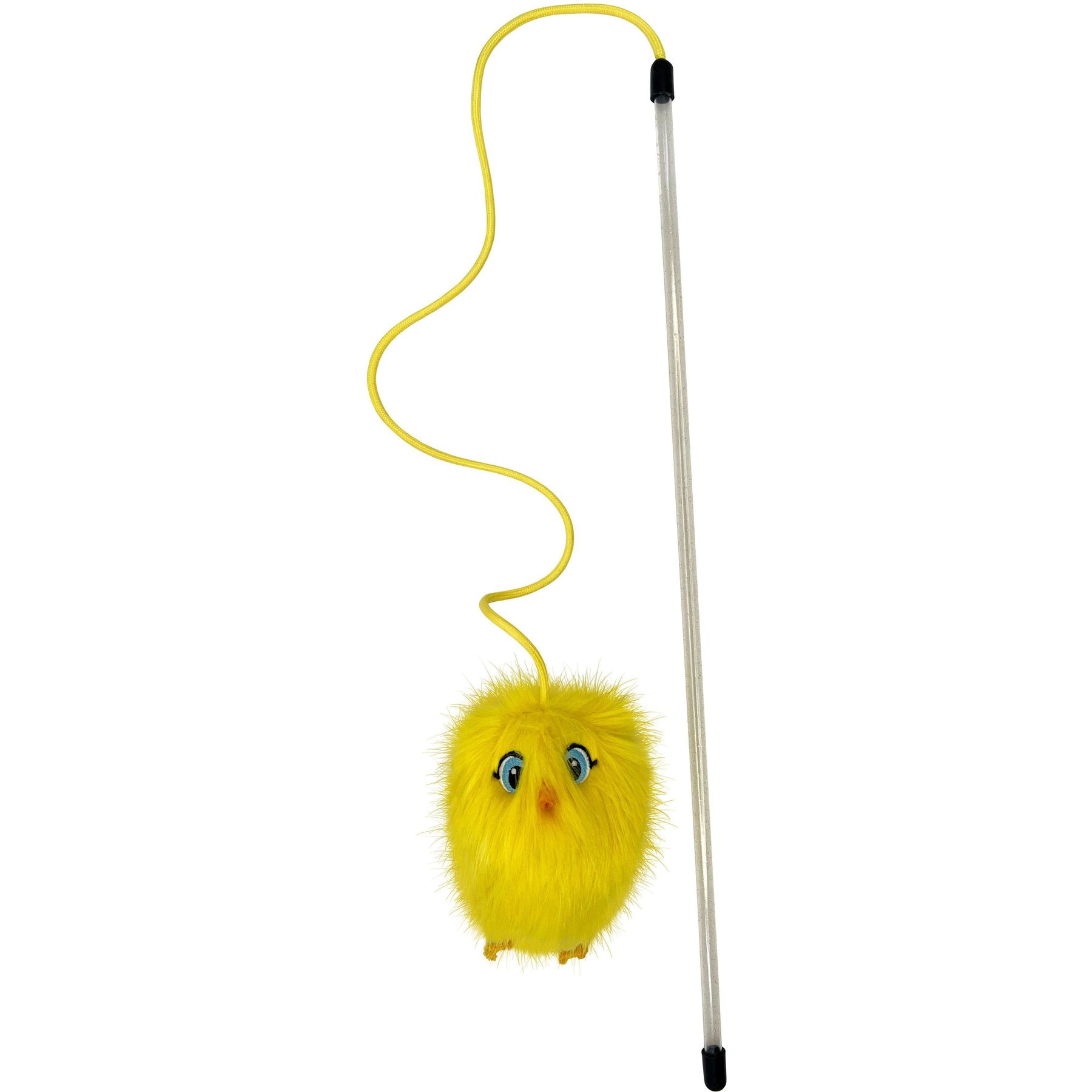
A plush chick that chirps when it is hit, with crinkle inside, dangling legs and catnip, on a long glitter wand and cord. The chirp rewards the pounce, which teaches the cat that landing on the lure is the point, and the plush body is the right size to be held and bitten at the end of a session, which is the catch the sequence needs. Fling it, drag it, bounce it, and let the cat wrestle it before the treat.
Somewhere to hunt from
The best wand sessions happen around cover, because a cat stalks from concealment. This is a thirty-eight inch collapsible tunnel on a steel wire frame with a crinkle tail and a feather spout, folding into its own bag. Lay it across the floor and drag any of the lures above past its mouth; the cat inside will do the rest. It turns a bare room into a hunting ground, and for a nervous cat it is the place from which play first becomes possible.
The cat that attacks ankles
Merck's account of play aggression is blunt: play is a normal ritualized aggressive behavior that can persist into adulthood, and aggression directed toward people might be a sign that the cat's play needs are not being met. Ankles move like prey and are always available; a wand session is a better target that is only sometimes available, and the fix is to make it reliably available. Two or three scheduled sessions a day, ending with a catch and food, and most ankle ambushes fade within a couple of weeks. Never use a hand or a foot as a toy, and never respond to an ambush in a way the cat could read as play. Carry a small toy to throw ahead of you down the hallway if the ambush spot is known. See also redirected aggression for the case where the cat's arousal has another source.
Safety
Strings are the danger. A swallowed string can saw through a cat's intestine and is a surgical emergency. Wand toys are put away after every session, checked before each one, and retired when the cord frays. Feathers and small parts come off with chewing and should be taken away when they do. A cat that is chewing the string rather than chasing the lure has decided the hunt is over: give the treat and end the session.
How this goes wrong
| What happens | Why it matters | What to do instead |
|---|---|---|
| Lure waved in the cat's face | Prey does not do that; the cat loses interest | Away, behind, freeze, twitch |
| Session ends mid-chase | The cat is left aroused with no catch | End with a catch and a meal |
| Toy left out all day | Novelty gone in days | Drawer between sessions, rotated |
| Only feathers in the air | Most cats hunt on the ground | A snake on the floor |
| Hands used as toys | The cat learns hands are prey | Wand only, always |
| Laser with no landing | Chase without a catch | Land the dot on a treat or a toy |
What to skip
- Any wand left within reach. String is a surgical risk.
- Hands and feet as toys. Ever.
- Ten-minute sessions once a week. Two short ones a day.
- Laser-only play. Nothing to catch.
- Toys the cat has not seen move. If it will not move, it will not be hunted.
How to choose
Start on the ground, with something that slides and hides, because that is what most cats hunt.
Add a bird for a cat that leaps, and something that crinkles or chirps for a cat that needs sound to commit.
Give the cat cover to stalk from.
Move the lure away, stop it, twitch it, let it be caught, and end every session with a catch and a meal.
And put the wand away, every time.
FAQ
Frequently asked
How long should I play with my cat with a wand toy?
Two or three short sessions a day, each lasting until the cat's interest fades, is better than one long one. Merck's owner guidance is to find several toys that interest the cat and play until its interest wanes, which for most cats is somewhere between five and fifteen minutes. The session should end with a catch: let the cat seize the lure, hold it, and then give a small treat or a meal, so the sequence finishes the way a hunt does. A session that ends with the toy vanishing into a cupboard mid-chase leaves the cat wound up.
Why does my cat lose interest in toys?
Usually because the lure is being moved like a toy rather than like prey. Prey does not fly at the cat's face or wave in front of it; it moves away, hides, freezes, and darts. A lure dragged behind a sofa cushion, paused, then twitched, holds a cat far longer than one waved in the air. Rotation matters too: a toy left out loses its novelty within days, so wand toys should live in a drawer between sessions and come out in turn. And some cats prefer ground prey to air prey, so a cat bored by feathers may go wild for a snake dragged across the floor.
Is it safe to leave a wand toy out?
No. Wand toys are for supervised play. The strings can be swallowed, which is a surgical emergency in a cat, and feathers and small parts come off with enough chewing. Put the wand away after every session, out of the cat's reach, and check the string and attachment each time before you play. A cat that is chewing the string rather than chasing the lure has caught it and wants the reward; give the treat and end the session.
Can wand play stop my cat attacking my ankles?
Often, yes. Merck describes play aggression in cats as normal predatory play that persists into adulthood, and notes that aggression directed at people can be a sign the cat's play needs are not being met. Ankles move like prey and are always available. Two or three scheduled wand sessions a day, ending with a catch and a treat, give the cat a legitimate target, and the ambush usually fades within a couple of weeks. Do not use hands or feet as toys, ever, and do not respond to an ambush with anything the cat could read as play.
Do laser pointers work as well as wand toys?
They trigger the chase, but they cannot be caught, and a cat that chases a dot for ten minutes and never lands on anything ends the session frustrated. If you use a laser, finish by landing the dot on a physical toy or a treat the cat can seize. A wand toy is better because the lure is real: it can be stalked, pounced on, held and bitten, which is the whole sequence the cat is trying to complete.
Featured in this guide
The picks referenced above—priced and in stock at time of publication.


Affiliate links. Prices and availability change—we filter unavailable items nightly, but the retailer's page is source of truth.
Keep reading
back to school routine
Interactive Cat Toys Reviewed: Most of Them Are Solo Toys
evergreen
Probiotics for Dogs: What the Evidence Supports, and What the Label Has to Say
evergreen
Vertical Space for Indoor Cats: Perches, Shelves and Towers That Make a Small Apartment Bigger
evergreen
Backyard Chicken Waterers: Size for Hot Days, Clean Daily, Then Plan for Freezing Ones
evergreen
Window Bird Feeders: Clean Them Often and Mark the Glass Around Them
evergreen
Scratching Posts Cats Actually Use: Tall, Heavy, Sisal, and in the Room You Live In
Discussion
Talk about Wand Toys for Cats: The Toy Matters Less Than How You Move It
Real questions from real pet owners. Add yours—signed-in members only, first three posts held for review.
Loading threads…