Vertical Space for Indoor Cats: Perches, Shelves and Towers That Make a Small Apartment Bigger
An indoor cat measures a home in height, not floor area. A window perch, a wall shelf and a route between them add more territory than another room. What height does for a cat, how to build a route it will use, and five pieces from a suction-cup perch to a floor-to-ceiling tower.
petsupplies.co earns a commission if you buy through the product links on this page, and the price you pay is the same either way.

A real estate agent measures an apartment in square meters. A cat measures it in places it can get to, and most of those places are above your head. A one-bedroom apartment with a window perch, two wall shelves and a tall tower is, to a cat, a larger territory than a three-bedroom house with nothing to climb. This is the cheapest and most effective change an indoor cat's owner can make, and it is the one most often done badly: a single shelf at random height, a perch on a window the cat cannot reach, a tower in the hallway.
This guide covers what height does for a cat, how to build a route rather than a collection of objects, and five pieces that assemble into one. It runs from a thirty-dollar suction-cup perch to a floor-to-ceiling tower, and the order is deliberate: start at the window, add a way up, and finish with the tall thing only if the room and the cat want it.
Height is territory
The environmental needs guidelines published jointly by the American Association of Feline Practitioners and the International Society of Feline Medicine organize a cat's needs into five pillars, and the first is a safe place, with the rest covering separated resources, play, predictable human contact and scent. Height is how most cats build a safe place for themselves. From a perch a cat can watch the room without being in it, keep a dog or a toddler at a distance without leaving, and retreat upwards instead of out. Merck's owner guidance lists climbing and perching among a cat's major behavioral needs, alongside eating, security, play and scratching, and its advice on fearful cats is that they look for a place to hide or a place to get up.
In a multi-cat home, height is also how cats avoid each other. Two cats that squabble at floor level often coexist once one of them can be up. The glossary entry for vertical territory has the short version.
A route, not a collection
The mistake is to buy things and put them where they fit. The cat does not want a perch; it wants a route from the floor to a high place with a good view, in steps it can manage, ending somewhere it is allowed to stay. That means:
A destination. A window with something to watch, or a high spot overlooking the room the household uses. A perch facing a wall is furniture.
Steps of a comfortable jump. A fit young cat clears four feet from a standstill; an older cat, or a cat with osteoarthritis, wants steps a foot or two apart. See how much exercise for the general point that cats are athletes only while they are young.
A second way down. A cat that can only leave a perch by the leap it arrived on will hesitate to use it. A route with two ends is used twice as much.
Placement in the rooms you use. Cats want to be near the household and above it. A tower in a spare room is a spare tower.
Start at the window
The window is the destination most cats choose for themselves, because the outside world is the best television a cat has. This lounger attaches to the glass with suction cups, has a machine-washable fleece cover, and carries a small planter with an oat grass kit, which gives an indoor cat something to chew that is not your houseplants. It folds up against the glass when you need the blinds. Fit it to clean, dry glass, check the cups every few weeks, and put it on a window the cat can reach without a leap from the floor; a chair or a shelf below it is the step.
The sturdier window seat
Suction cups have limits, and a large cat, a cold window or dusty glass will find them. This is a hammock-style bed on a solid wood frame with reinforced metal brackets and adjustable hooks, which hangs from the sill rather than sticking to the glass, and can also be hooked over a bedside table or other furniture. The cushion cover comes off for the wash. It suits a heavy cat and a house with old windows, and because it hooks rather than sticks it can be moved between rooms as the sun does.
A way up on the wall
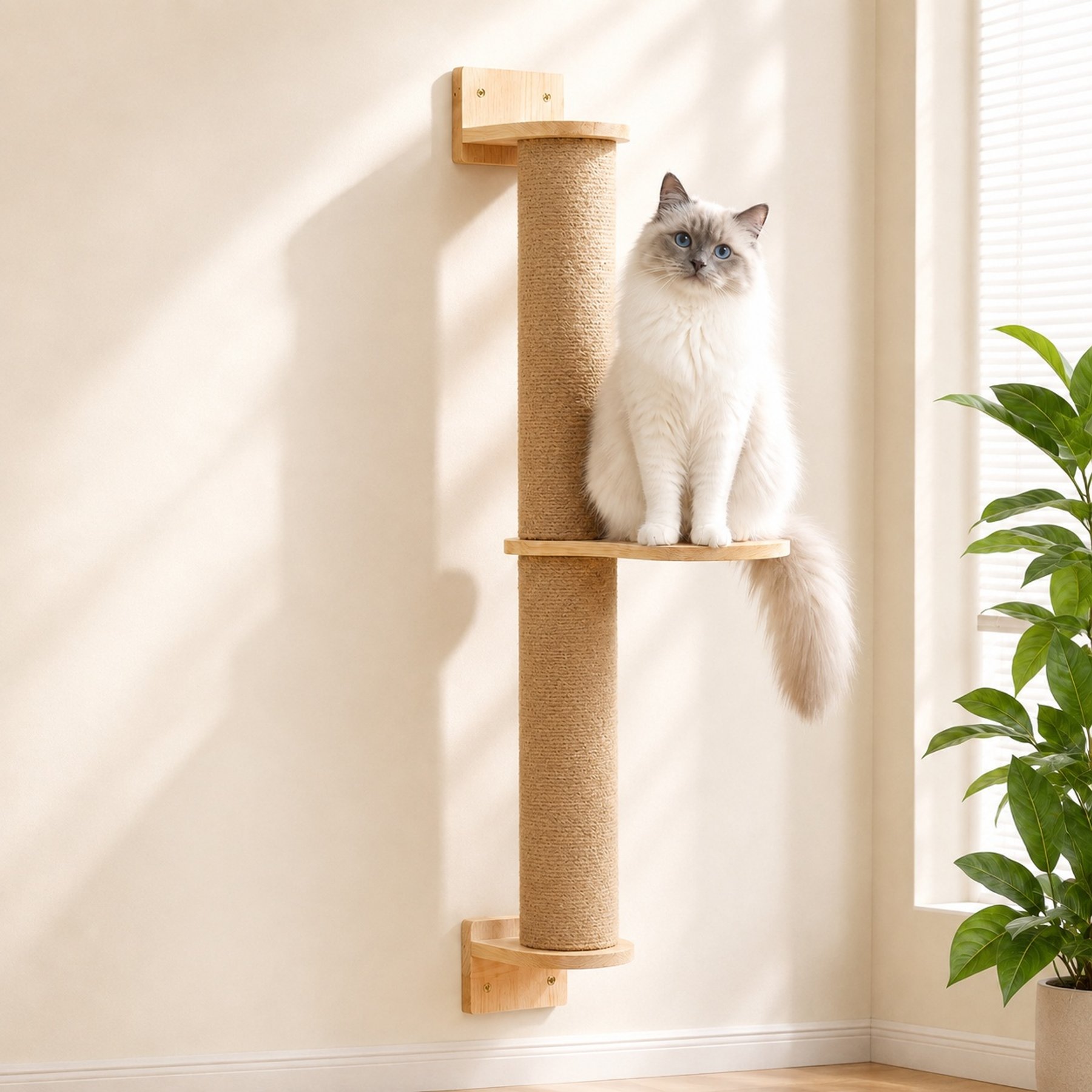
The cheapest way to add a step between the floor and a high place is a single wall-mounted piece. This one is a solid pine unit, about thirty-seven inches tall, fixed to the wall, combining a jute-wrapped scratching post with a perch at the top. It gives the cat a scratch, a climb and a lookout in one fixing, and takes no floor space. Fix it into studs or proper anchors for the wall type, at a height the cat can reach in one comfortable jump from the floor or from a piece of furniture, with the perch positioned so the next step, a shelf or a window, is within reach.
The route itself
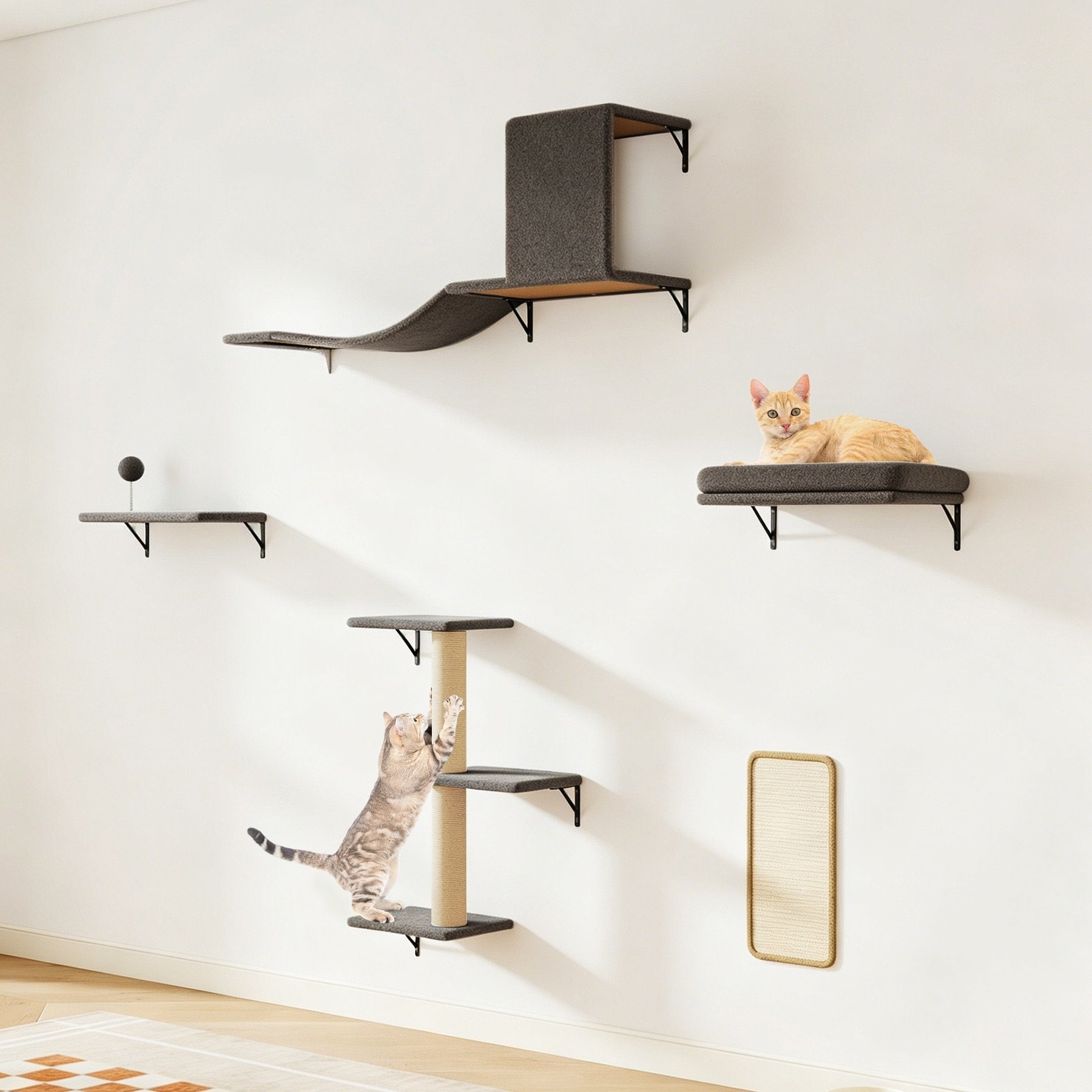
This is the piece that turns a wall into territory. Five wall-mounted components, a covered house, a bridge, a sisal-wrapped post, a scratching post and a jumping platform, made from thick particleboard with sisal wrapping and plush perches, on reinforced metal brackets rated by the maker to twenty-two pounds per shelf, with predrilled holes and labeled parts. The value is in the arrangement: space the pieces so each is a step from the last, run the route towards a window or a high corner overlooking the room, and put the house at the top so the destination is somewhere the cat can stay. For a nervous cat, the house is the point; see indoor enrichment for the general principle that a place to hide comes before a place to play.
Wall type decides everything. Plasterboard needs proper anchors; a stud is better; a cat that has fallen from a shelf once will not use it again for months.
The tall thing, if the room wants it
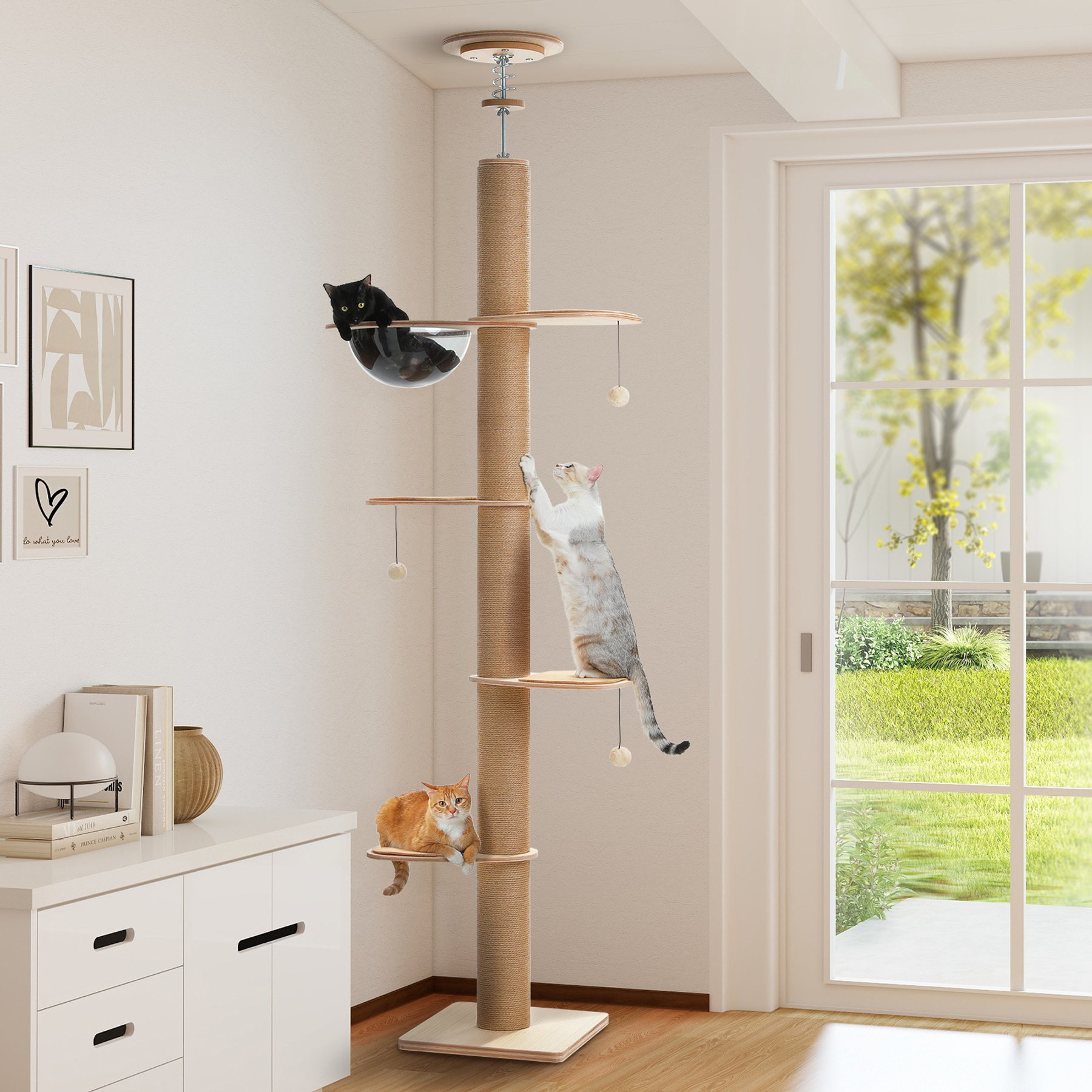
A floor-to-ceiling tower adds the most height for the least floor. This one is a wooden five-tier tower that adjusts without tools from 79 to 103 inches, held by a spring-tension system with two top plates, with thick sisal-wrapped posts, rotatable perches that can be turned towards a window, three hanging balls and an acrylic cave for sleeping. The maker's claim is that it saves most of the floor space of a conventional tree, which is the reason to choose it for a small room. The trade-off is that it depends on the tension: it needs a solid ceiling and a level floor, and it should be checked and re-tightened after the first week. For a very heavy cat, or a ceiling that is high, sloped or unsound, a conventional tree with a wide base is the safer answer, covered in cat trees for indoor enrichment.
Getting the cat to use it
Most cats find a new perch within a day. For the ones that do not, put a treat on each step of the route and let the cat work upwards. Drag a wand toy up the shelves so the cat's pounce lands on the next platform. Put a familiar blanket on the top perch so it smells like home. Do not lift the cat onto a perch. A cat placed somewhere high has not learned the way up, and often has not learned the way down.
For a household bringing in a second cat, height is the first thing to add, before the introduction; see how to introduce a new kitten. And for a cat left alone for long days, a window perch is the difference between a day watched and a day slept through, covered in how long can I leave my cat alone.
How this goes wrong
| What happens | Why it matters | What to do instead |
|---|---|---|
| One shelf at random height | It is a shelf, not a route | Three steps to a destination |
| Perch on a window the cat cannot reach | Never used | A step below it, or a lower window |
| Suction cups on dirty or cold glass | The perch drops, and the cat remembers | Clean glass, checked every few weeks; a hook perch for a heavy cat |
| Shelves into plasterboard with the supplied screws | The shelf comes down with the cat on it | Studs or proper anchors, weight rating respected |
| Tower in the spare room | Cats want height near the household | In the room you use most |
| Steps sized for a young cat, owned by an old one | The old cat stops climbing | Closer steps, and a ramp if needed |
What to skip
- Any perch fitted to a window that opens. A screen is not a barrier.
- Shelves with no destination. A route needs somewhere to end.
- Lifting the cat up. It has to learn the route itself.
- A tension tower under a sloped or hollow ceiling.
- Height for a cat that cannot get down. Old cats need steps, not a summit.
How to choose
Start at the window, with a perch the cat can reach from a chair or a shelf.
Add a way up the wall, one step at a time, towards a high place overlooking the room the household uses, ending somewhere the cat is allowed to stay.
Fix everything into something solid, and check suction cups and tension mounts after a week.
Size the steps to the cat you have, not the cat you had.
And put it all in the rooms you live in, because the point of height is to be above you, not away from you.
FAQ
Frequently asked
Why do cats need vertical space?
Because a cat's territory is three-dimensional and height is where a cat feels safe. From a perch a cat can watch the room without being in it, avoid a dog or a child, and retreat upwards rather than out of the room. The feline veterinary associations' environmental needs guidelines put a safe place and the opportunity to climb and perch among a cat's core needs, and Merck's owner guidance lists climbing and perching alongside eating, security and scratching. An apartment with no height is a smaller territory than its floor area suggests.
How high should a cat perch be?
Above the heads of the people and animals in the room, which for most homes means a shelf or tower platform somewhere between four and six feet, with a window perch at sill height as the second tier. The more useful question is how the cat gets there: a perch at six feet with no step between it and the floor will be used by a young cat and ignored by an old one. Build in steps of a comfortable jump, and for an older or arthritic cat, closer together.
Are window perches safe?
The suction-cup and sill-mounted kinds are safe when fitted to the maker's weight rating on clean glass or a sound sill, and checked every few weeks, because suction cups lose grip as glass gets dirty or cold. Fit them to a window the cat can reach without a leap from the floor, and never to a window that is opened: an insect screen is not a barrier for a cat that lunges at a bird. A wooden-framed sill perch that hooks over the sill is sturdier than a cup perch for a heavy cat.
Do wall shelves work for cats?
They work if they are fixed into something solid, spaced so the cat can step rather than leap, and arranged as a route with a destination. A single shelf on a wall is a shelf; three shelves that climb to a window or a high bed are territory. Fix into studs or use proper anchors for the wall type, respect the weight rating, and put a rug or a soft surface below while the cat learns the route. A shelf the cat has fallen from once is a shelf it will not use again for months.
Is a floor-to-ceiling cat tower better than a cat tree?
For a small home, usually. A tension-mounted tower takes a fraction of the floor space of a conventional tree, reaches the ceiling, and can sit in a corner beside a window. The trade-off is that it depends on being fitted tightly between floor and ceiling, so it needs a solid ceiling and re-checking after the first week as the tension settles. A conventional tree with a wide base is the safer choice where the ceiling is high, sloped or unsound, and for a very heavy cat.
Featured in this guide
The picks referenced above—priced and in stock at time of publication.

Affiliate links. Prices and availability change—we filter unavailable items nightly, but the retailer's page is source of truth.
Keep reading
evergreen
Wand Toys for Cats: The Toy Matters Less Than How You Move It
evergreen
Probiotics for Dogs: What the Evidence Supports, and What the Label Has to Say
evergreen
Backyard Chicken Waterers: Size for Hot Days, Clean Daily, Then Plan for Freezing Ones
evergreen
Window Bird Feeders: Clean Them Often and Mark the Glass Around Them
evergreen
Scratching Posts Cats Actually Use: Tall, Heavy, Sisal, and in the Room You Live In
evergreen
Single-Ingredient Dog Treats: One Line on the Label, and What It Does Not Tell You
Discussion
Talk about Vertical Space for Indoor Cats: Perches, Shelves and Towers That Make a Small Apartment Bigger
Real questions from real pet owners. Add yours—signed-in members only, first three posts held for review.
Loading threads…