Scratching Posts Cats Actually Use: Tall, Heavy, Sisal, and in the Room You Live In
Most scratching posts are ignored because they wobble, they are too short to stretch on, or they are hidden in a spare room. What makes a cat choose a post over the sofa, how to place it, and five surfaces that cover the ways cats scratch.
petsupplies.co earns a commission if you buy through the product links on this page, and the price you pay is the same either way.

The sofa gets scratched because it is the best scratching post in the house. It is tall, it does not move, it has a fabric that gives under a claw, and it sits in the room where the cat spends its day. The eight-dollar post in the spare bedroom loses on every one of those counts. Fixing the problem is not a matter of finding a post the cat likes more than the sofa; it is a matter of understanding why the sofa wins and building something that wins for the same reasons.
This guide covers what scratching is for, what a post has to be, where it has to go, and how to move a cat from furniture to post without a fight. The five picks cover the shapes cats scratch: a tall vertical post, a second vertical for a second room, a horizontal sisal mat, a cardboard lounger, and a curved cardboard protector that goes exactly where the damage is.
Why cats scratch
Scratching is not a habit and not a vice. Merck's guidance for owners lists it plainly among a cat's major behavioral needs, alongside eating, security, play, climbing and perching, and the joint environmental needs guidelines from the feline veterinary associations treat the opportunity to scratch as part of a healthy home rather than a problem to suppress. Cats scratch to shed the outer sheath of the claw, to stretch the whole body on waking, and to mark: the scent glands in the paws leave a signal, and the visible shredding is a signal too. That is why cats scratch where they live and near where they sleep, and why a post tucked out of sight is ignored.
The scratching post glossary entry has the short version; how do I stop my cat from scratching furniture covers the redirection in brief. This guide is the long version.
What a post has to be
It must not move. The ASPCA's advice on destructive scratching puts it first: all cats want a sturdy post that will not shift or collapse when used. A cat leans its weight into a scratch. A post that rocks on the first pull is rejected on the first pull, and the sofa, which weighs sixty kilos, never rocks. Look for a wide, heavy base, and if the post still wobbles, put it in a corner or against a wall.
It must be tall enough. The same guidance: most cats like a post tall enough that they can stretch fully. That is the cat on its hind legs, forelegs at full reach, pulling down. For an adult cat the scratching surface needs to be comfortably above two feet; a big cat wants more. A post shorter than the cat's reach is a kitten post. See how tall should a scratching post be.
It must have a surface that gives. Sisal rope and sisal fabric are the standard for a reason: they offer resistance and shred slowly. Corrugated cardboard is softer and cheaper and some cats prefer it. Carpet is the surface to avoid on a post if you also have carpet on the floor, because it teaches the cat that carpet is for scratching.
It should match how your cat scratches. The ASPCA's practical note is that some cats prefer horizontal posts, others vertical or slanted, and some prefer a vertical grain for raking while others favor a horizontal grain for picking. Watch the damage. A raked sofa arm wants a tall vertical post; a shredded doormat wants a mat.
Where it goes
Next to the thing being scratched. Not in the same room, next to it. Scratching is a marking behavior tied to place, and the place the cat has chosen is the place the post must be. Near the cat's sleeping spot is the other candidate, because cats scratch on waking.
Once the post is being used, it can migrate a few inches a day towards where you would prefer it, but it should stay in the rooms the household uses. And one post is rarely enough: a cat that lives in three rooms wants a scratching surface in three rooms, and a multi-cat household wants at least one per cat, separated, because cats do not share marking posts gracefully.
The vertical post for the living room
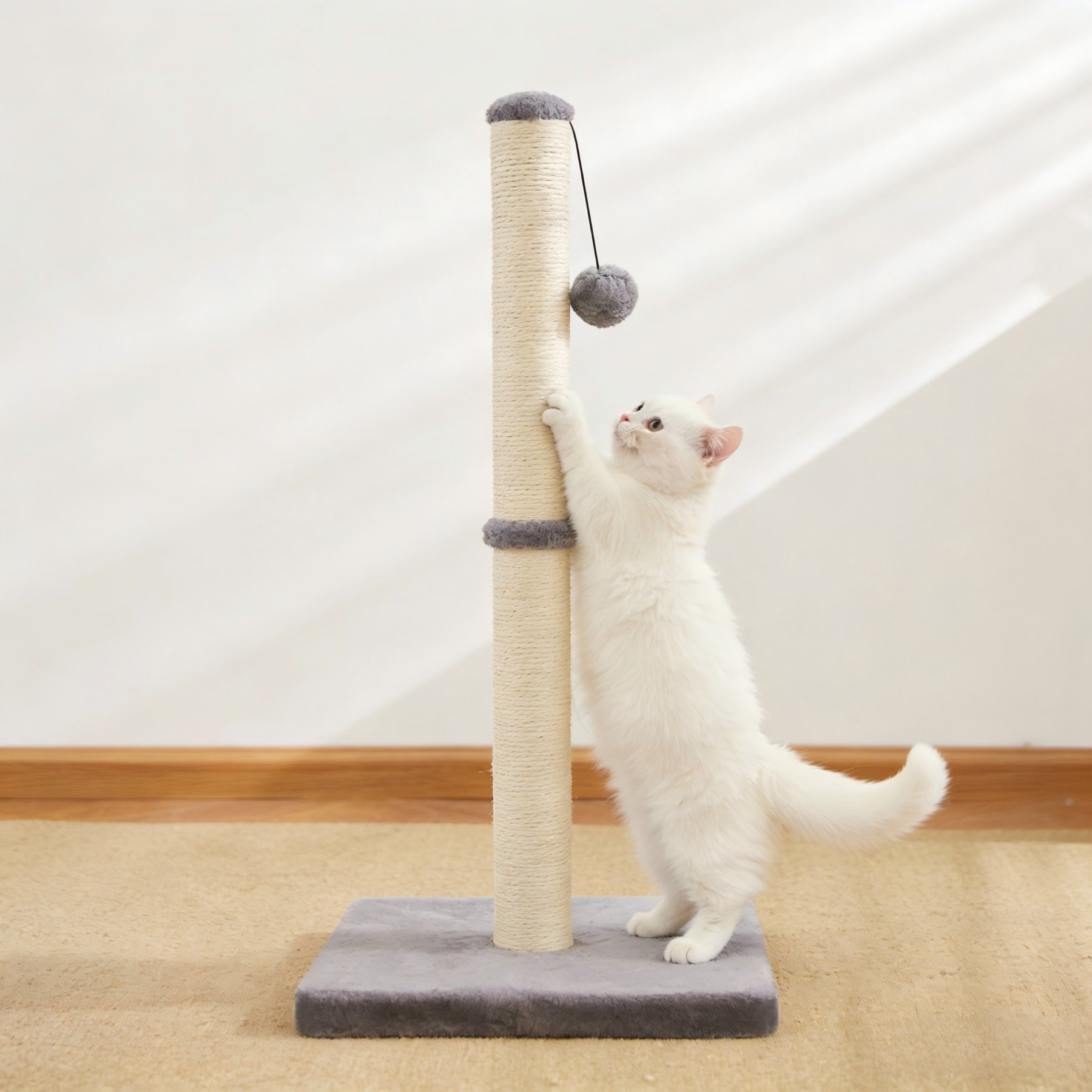
A twenty-five inch post wrapped in natural sisal rope on a square base, with a hanging toy, sized for small spaces. The height is enough for most adult cats to stretch fully; a very large cat will want something taller, which is where a cat tree comes in, covered in cat trees for indoor enrichment. Put it against the arm of the sofa that is currently being scratched, on the side the cat approaches from. If it rocks at all under your own hand, move it into a corner so two walls brace it.
A second post for a second room
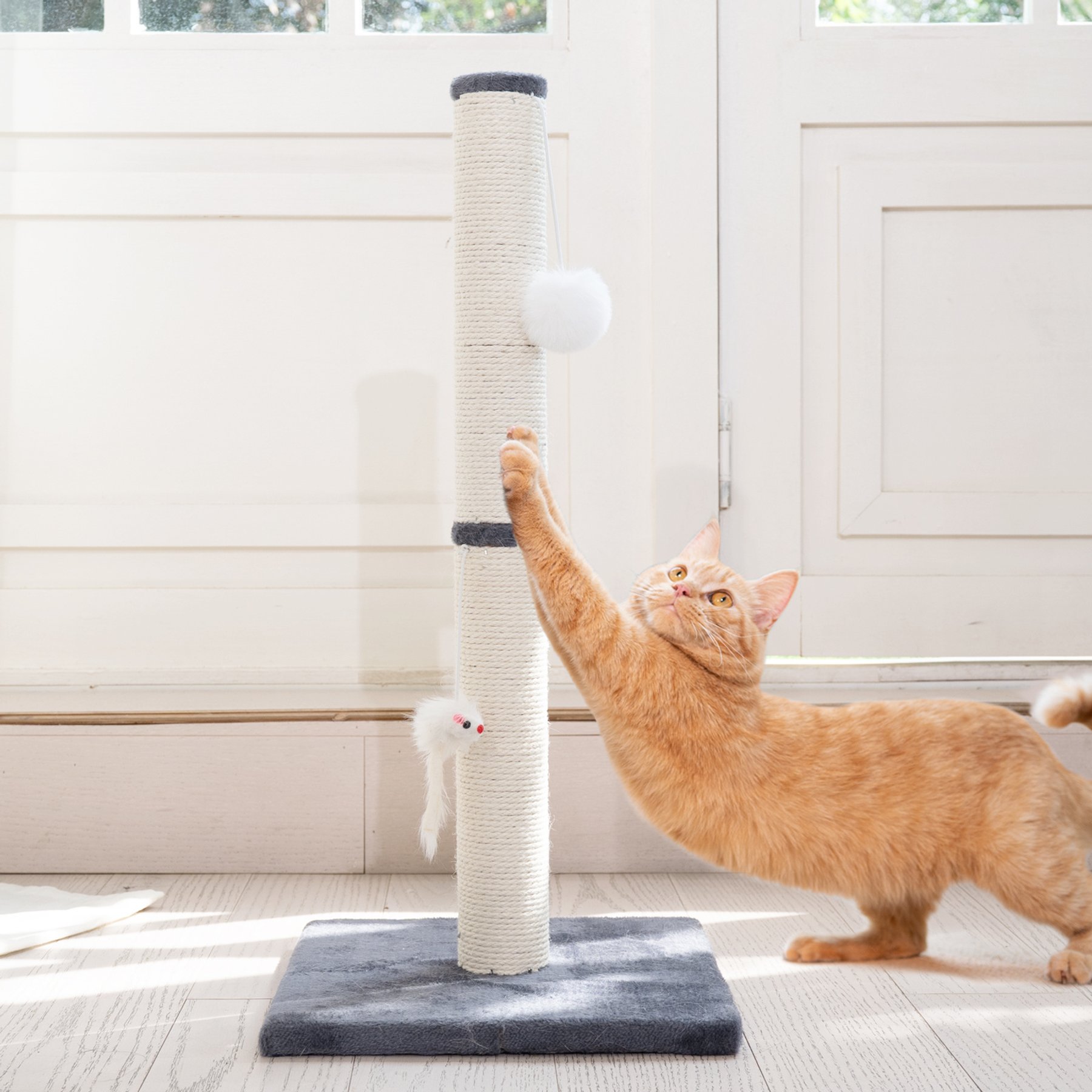
The same height, wrapped in natural sisal, on a wooden base, with two teaser toys included and a plain white finish that disappears into a bedroom. The point of owning two posts is that the cat should never have to cross the house to find one, and bedrooms are where cats wake and stretch. The base is the thing to check on delivery: press the top of the post sideways with the weight of your hand, and if it moves, brace it against a wall.
For the cat that scratches the floor
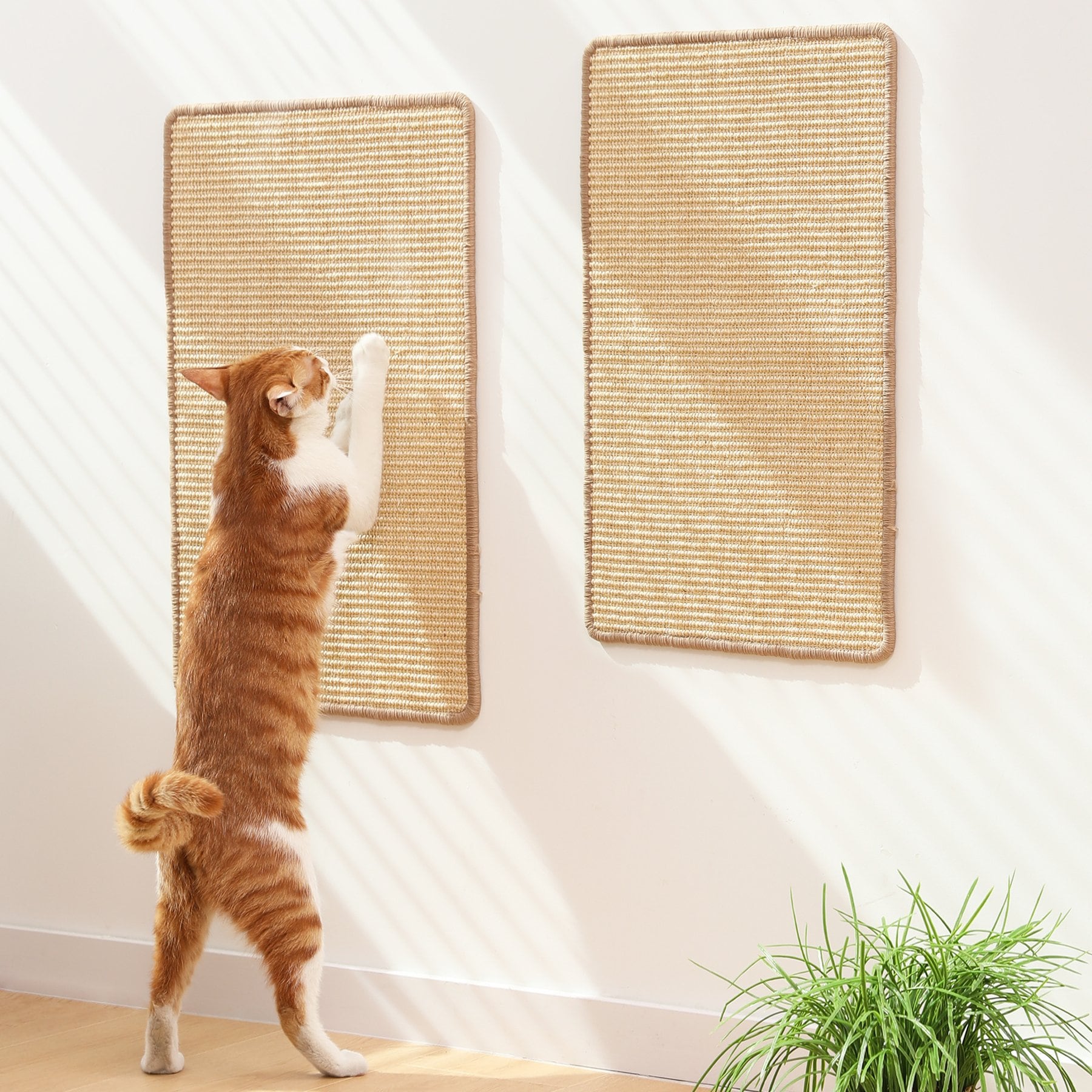
Some cats rake carpet rather than sofas, and for them a vertical post is the wrong answer. These are two flat mats of natural sisal, sold with tape so they can be fixed to a floor, a wall or the side of a piece of furniture. Laid on the patch of carpet the cat has chosen, they take over the job; taped to the side of a chair, they protect it and become the post. The maker's tip is to flatten a new mat under a rug for a day before use so it lies flat, and to guide the cat to it the first time.
For the cat that prefers cardboard
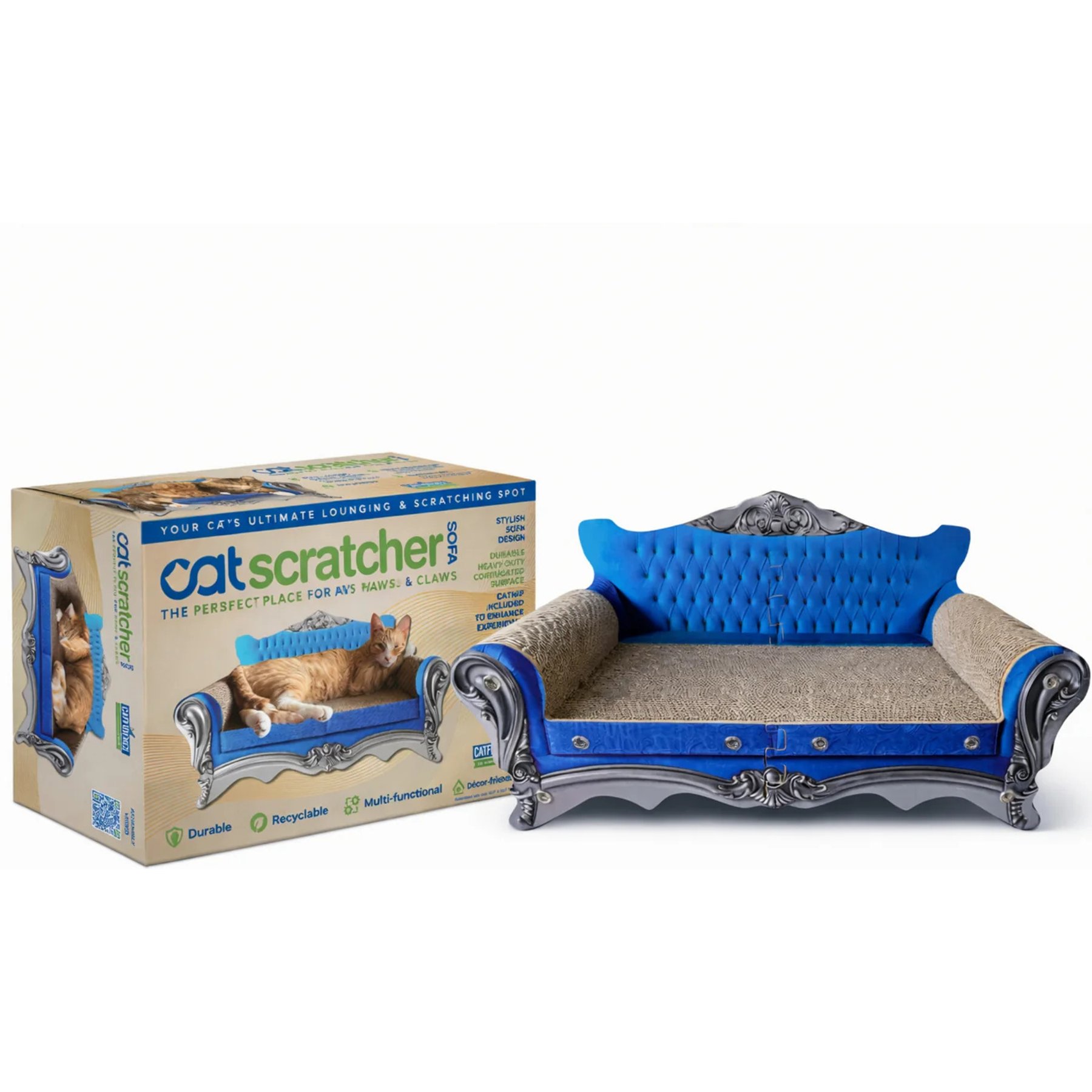
Corrugated cardboard is the surface some cats choose over everything else, and a lounger shape doubles as a bed, which matters because cats scratch where they sleep. This is a thick corrugated lounger in a sofa shape, assembled without tools, supplied with catnip to bring the cat to it. It sheds cardboard confetti as it is used, which is the trade-off with the material, and it is a horizontal scratcher, so it suits a picker rather than a raker. Put it where the cat naps.
The one that goes exactly where the damage is
The most direct fix for a scratched sofa arm is a scratcher that sits on the sofa arm. This is a curved, L-shaped pad of recycled corrugated cardboard, about twenty-seven inches long, that can be mounted on a wall or draped over furniture, or laid on the floor as a lounger, with a jingle ball for good measure. Placed over the exact spot the cat has been shredding, it turns the sofa into the post, which is the honest solution: the cat already likes the location. Two come in the pack, so the other arm is covered too.
Moving the cat from sofa to post
Put the post beside the damage. Make the damage less pleasant: double-sided tape on the fabric, or a throw tucked tightly over the arm, which Merck's behavior guidance lists among ways to change the appeal of a location. Then reward the post: a treat or a game every time the cat uses it, which is positive reinforcement doing what it does. Rubbing catnip into the sisal, or dragging a wand toy up the post so the cat's claws land in it mid-pounce, gets the first scratch to happen. After that the cat's own scent on the post does the work.
Do not shout, spray or carry the cat to the post; that makes the post a place where bad things happen. Trimming the claws every few weeks reduces the damage while the switch is underway. Declawing is not a solution and is opposed by the feline veterinary associations.
How this goes wrong
| What happens | Why it matters | What to do instead |
|---|---|---|
| The post wobbles | Rejected on the first pull | Wide heavy base, or braced in a corner |
| The post is shorter than the cat's stretch | It does not do the sofa's job | A surface well above two feet for an adult cat |
| The post is in the spare room | Scratching happens where the cat lives | Beside the damage, near where the cat sleeps |
| One post for three cats | Cats do not share marking posts | One per cat, in separate places |
| Carpet-covered post, carpeted floor | Teaches that carpet is for scratching | Sisal or cardboard |
| Cat punished at the sofa | Scratching moves to when you are out | Tape on the sofa, reward at the post |
What to skip
- Short, light posts sold as a bargain. They are kitten posts.
- Carpet posts in a carpeted home.
- Sprays and shouting. They make you the problem, not the sofa.
- A single post moved from room to room. Buy a second.
- Declawing. A surgical amputation to solve a furniture problem.
How to choose
Watch how your cat scratches: raking up a vertical surface wants a tall sisal post; picking at the floor wants a mat or a cardboard lounger.
Buy for stability and height before anything else, and test the post with your own hand on delivery.
Put it beside the damage, and put a second one where the cat sleeps.
Reward the post, cover the sofa, and give it two weeks.
FAQ
Frequently asked
Why does my cat ignore the scratching post?
Usually one of three reasons. The post moves when the cat leans into it, which no cat will tolerate twice. It is too short for the cat to stretch to full height, so it does not do the job the sofa does. Or it is in a room the cat does not use, when scratching is a marking behavior that happens where the cat lives and near where it sleeps. Fix stability and height first, then move the post next to the thing being scratched, and most cats switch within two weeks.
How tall should a scratching post be?
Tall enough for the cat to stand on its hind legs, reach up and pull down with the whole body without touching the top. For an average adult cat that means the scratching surface should be well over two feet; for a large cat, taller still. The ASPCA's guidance is that most cats want a post tall enough to stretch fully, and that all cats want one sturdy enough not to shift or collapse. A short post suits a kitten and a horizontal scratcher, not a full-grown cat that wants to stretch.
Sisal or cardboard?
Both, ideally, because cats have preferences and the way to find yours is to offer more than one. Sisal rope or fabric on a vertical post gives the resistance most cats want for a full-body rake. Corrugated cardboard is softer, cheaper, and the favorite of cats that prefer to scratch horizontally or to pick at a surface rather than rake it. Watch what your cat does to the furniture: a cat that rakes the arm of the sofa wants a tall sisal post, and a cat that shreds the carpet wants a cardboard or sisal mat on the floor.
Where should I put the scratching post?
Next to whatever the cat is scratching now, and near where it sleeps, because cats scratch on waking and scratch to mark the places they use most. A post in the hallway or a spare room is a post that will not be used. Once the cat has switched to the post, it can be moved a few inches a day towards where you would rather it lived, but it should stay in the rooms the household uses. A second post in a second room is better than one post moved around.
Should I punish my cat for scratching the furniture?
No. Scratching is a normal behavior that cats need an outlet for; punishment teaches the cat that you are unpredictable and pushes the scratching to when you are not there. Make the furniture less appealing with double-sided tape or a cover, put a better post right beside it, and reward the cat when it uses the post. Merck's owner guidance is that rewarding the right location is how a cat learns where to scratch, and that scratching sits alongside climbing and perching as one of a cat's basic behavioral needs.
Featured in this guide
The picks referenced above—priced and in stock at time of publication.
Affiliate links. Prices and availability change—we filter unavailable items nightly, but the retailer's page is source of truth.
Keep reading
evergreen
Probiotics for Dogs: What the Evidence Supports, and What the Label Has to Say
evergreen
Single-Ingredient Dog Treats: One Line on the Label, and What It Does Not Tell You
evergreen
Wand Toys for Cats: The Toy Matters Less Than How You Move It
evergreen
Vertical Space for Indoor Cats: Perches, Shelves and Towers That Make a Small Apartment Bigger
evergreen
Backyard Chicken Waterers: Size for Hot Days, Clean Daily, Then Plan for Freezing Ones
evergreen
Window Bird Feeders: Clean Them Often and Mark the Glass Around Them
Discussion
Talk about Scratching Posts Cats Actually Use: Tall, Heavy, Sisal, and in the Room You Live In
Real questions from real pet owners. Add yours—signed-in members only, first three posts held for review.
Loading threads…