Reflective Gear for Evening Walks: Where It Goes Matters More Than How Much
Most reflective dog gear is a strip of stitching on the top of a collar, which is the one place headlights never reach. What actually makes a dog visible to a driver, and the five pieces that do it.
petsupplies.co earns a commission if you buy through the product links on this page, and the price you pay is the same either way.

Once the clocks go back, the evening walk happens in the dark, and most of the reflective gear sold for it is a strip of stitching along the top of a collar. That is the one place on a dog a driver's headlights never reach.
This guide is about geometry more than products. Reflective material is cheap and it works, but only when it is where the light will hit it and where the driver will look. Put it in the right place and a dog appears in a driver's view long before its dark coat would. Put it in the wrong place and the collar is doing its job for the benefit of the streetlamp.
The number worth knowing
Pedestrian crashes are overwhelmingly a night problem. An archived Federal Highway Administration course on pedestrian safety puts it plainly: sixty-five percent of all pedestrian incidents occurred at night, and later federal figures run higher still. A dog is a harder target than a pedestrian. It is low, it is often dark, it moves unpredictably at the curb, and a driver who has just picked out the person may not have registered the animal a leash-length ahead of them.
Two things follow. The dog needs to be visible in its own right, not as an afterthought to the person. And the person needs marking too, because a reflective dog next to an invisible owner gives a driver half a picture.
Reflective, retroreflective and glow are not the same thing
The word reflective covers three different things and only one of them is useful on a dog.
Retroreflective material, the kind in road signs and the strips on high-visibility jackets, is built from tiny glass beads or prisms that return light towards the source it came from. When a car's headlights hit it, the light bounces straight back at the driver, and the material appears to blaze. That is the whole trick, and it depends on the light source being close to the viewer's line of sight. A driver behind headlights sees it. A person standing to one side without a light sees almost nothing. The 3M stripes and micro-prism fabrics in the picks below are this kind.
Reflective stitching on ordinary nylon is usually a thin retroreflective thread. It works on the same principle, but a millimeter-wide line returns a fraction of what a panel returns, so it reads as a faint outline at distance rather than a shape.
Glow-in-the-dark coatings are neither. They emit a dim light for a while after being charged by daylight, and they are invisible against headlights and useless within an hour of dusk. Nothing in this guide relies on them.
The practical consequence is that reflective gear does nothing until a light is on it. Under streetlamps, in a park, or to a cyclist without lights, a reflective harness is a dark harness. That is not an argument against it. It is an argument for knowing what it is for, which is the moment a car's headlights sweep across your dog, and for pairing it with something that emits light of its own when you walk where there are no cars but there are bikes.
Where on the dog it has to be
Think about what a driver sees as a dog approaches or crosses. Head-on, they see the chest and the front legs. From the side, they see the flank and the legs again. From behind, the rump and the back legs. What they do not see from any of those angles is the top of the neck, which is where a collar sits.
So the rule is: reflective material on the chest first, then the sides, then the legs if you can, and the collar last. Movement matters as well. A reflective patch on a moving leg is read by a driver as an animal walking, where a static patch could be a bollard or a trash can. Anything that puts material on the limbs or low on the body earns its keep.
That is why a harness or vest is the right first purchase rather than a collar. A harness wraps the chest and the sides, sits low, and moves with the dog. See front-clip harness and how do I measure my dog for a harness before ordering, because a reflective harness that rides up into the armpits is a harness the dog will refuse to wear in two weeks.
A vest that reflects everywhere, not in a line
The whole vest is made of a micro-prism reflective fabric, so it reflects across its entire surface and, as the maker puts it, in all directions when lit. That is a different proposition from a strip of piping. Head-on it lights the whole chest, from the side the whole flank. The fit is a wrap with a hook-and-loop fastener and a padded buckle, and the clasp is the brand's own quick-attach design. Sizing is by chest measurement and the small here fits a 15 to 17 inch chest, so measure. It is the most visible single item in this guide and priced accordingly.
The same idea at a third of the price
A mesh step-in vest with 3M reflective stripes across it. The stripes are retroreflective bands rather than stitching, so they return real light, and they run across the chest and sides where they are seen. The step-in design is quick on a dog that dislikes things over its head, and the mesh suits a dog that runs warm even in autumn. The medium fits a 20 to 26 inch chest. For a dog walked on lit streets, this covers the job for most owners.
A serious harness with reflective trim
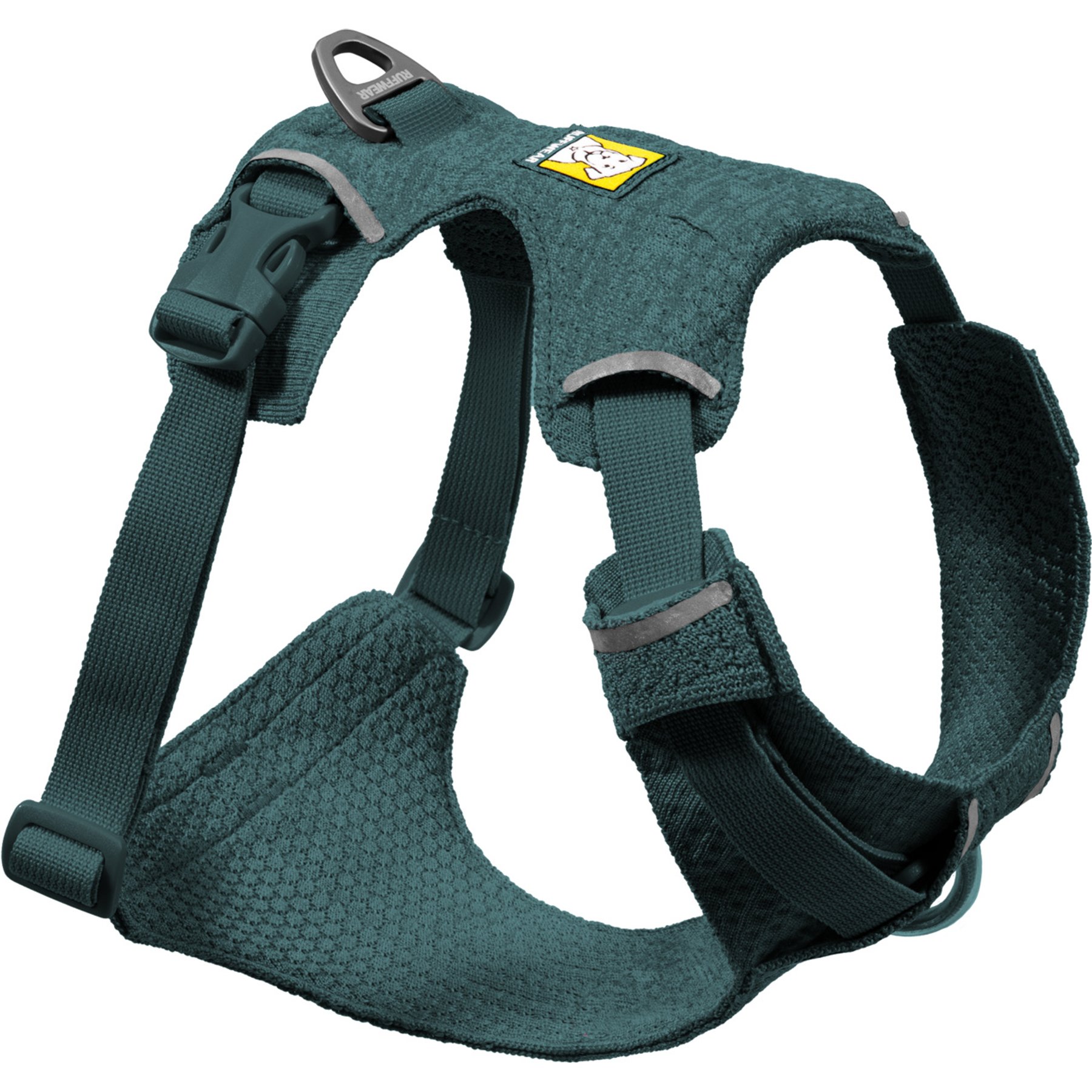
If the dog needs a proper harness anyway, buy the harness first and let the reflection come with it. This is an engineered-knit harness built to move with the dog and minimize rubbing, with a front clip that gives a handler leverage over a puller. The reflective element is trim rather than panels, so on visibility alone it sits behind the two vests above, but it is the one of the three you would choose for a dog that pulls or for a long walk. The medium fits a 27 to 32 inch chest. See no-pull harness for what a front clip does and does not do, and stop my dog from pulling on the leash for the training that has to go with it. A dog with arthritic shoulders needs a different harness again, which we covered in harnesses for arthritic dogs.
The collar, last and cheapest
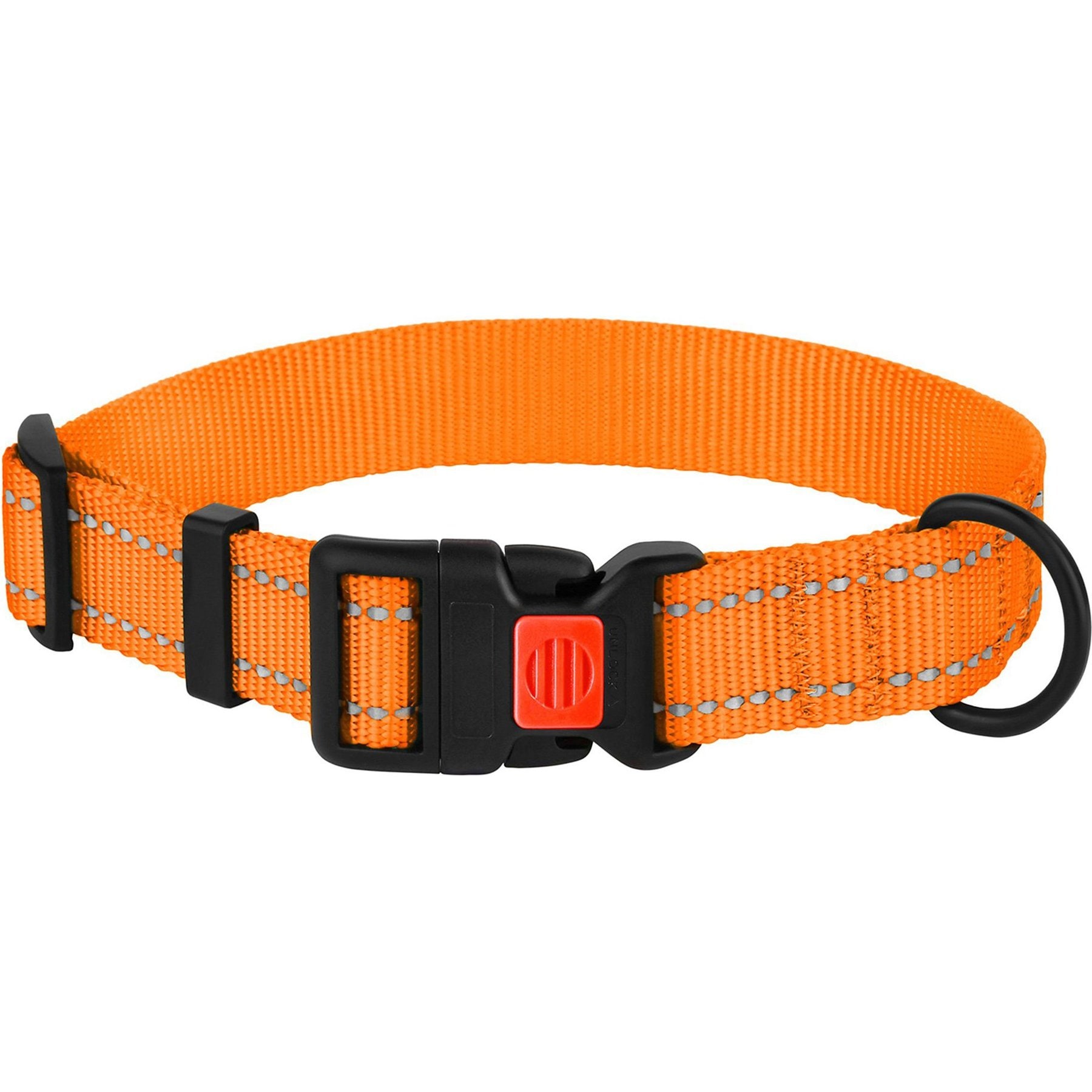
A collar is the wrong place for the main reflection and the right place for the ID tag, so the sensible move is a bright collar with reflective stitching that costs less than a coffee. This one is soft nylon with reflective stitching, a lockable side-release buckle and a metal D-ring, in saturated colors that help a driver in daylight and dusk as well. It is a supplement to the harness, not a substitute for it. See breakaway collar for why a cat's version of this has to be built differently.
The human end of the leash
The leash is the piece people forget, and it is the one that tells a driver the dog and the dark shape behind it are connected. This is a six-foot rip-stop nylon leash with reflective stitching along its length and a comfort handle. Six feet is the right length for a road walk; a retractable leash at night puts the dog a car-width away from you in the dark, which is a reason on its own to leave it at home. See retractable leash.
Then mark yourself. A strip of reflective tape on a jacket sleeve, a reflective armband, or a small light clipped to your side turns the two of you into one obvious shape. Where there is no sidewalk, walk facing traffic so the nearest cars have their headlights on you both.
Reflective is not control
None of this changes what the dog does at the curb. Being visible buys a driver time; it does not stop a dog stepping into the road after a cat. Keep the dog on the house side of you at the curb, shorten the leash at junctions, and treat a dark walk as a walk where the dog's recall is assumed to be worse than it is. Reflective gear is the layer that helps when everything else has already gone slightly wrong.
How this goes wrong
| What gets bought | Why it disappoints | What to do instead |
|---|---|---|
| A reflective collar and nothing else | Hidden from the front; a thin line from the side | A harness or vest with panels on the chest and sides |
| Reflective gear worn under a coat | Nothing to reflect | Reflection on the outer layer, or a coat with its own panels |
| Glow-in-the-dark trim | Faint, fades, invisible against headlights | Retroreflective material |
| Dog is reflective, owner is not | Driver sees an animal and a mystery | Reflective leash, plus tape or a light on yourself |
| Retractable leash on a dark road | The dog is far out of the light you are in | A fixed six-foot leash |
| Reflective harness relied on in an unlit park | No headlights, so nothing to reflect | Add a clip-on light for places with bikes and no cars |
What to skip
- Reflective stitching as the only reflection. A line, not a shape.
- Glow-in-the-dark anything. It is not reflective.
- A retractable leash after dark. Distance is the problem, not the mechanism.
- Sizing by breed. Measure the chest. Every pick here is sold by measurement.
- Marking the dog and not yourself. Half a picture.
How to choose
Buy a harness or vest with reflective panels on the chest and sides, sized by measurement. If the dog pulls, buy the front-clip harness and accept less reflection.
Add a reflective leash, and put something reflective on yourself.
Keep a bright reflective collar for the tag.
If you walk where there are bikes and no cars, add one light that emits rather than reflects.
And walk facing traffic, with the dog on the inside, because visibility buys time and only handling spends it well.
FAQ
Frequently asked
Does reflective dog gear actually work?
Retroreflective material works, and works well, but only in one situation: when a light source is close to the viewer's eyes, which is exactly the geometry of a driver behind headlights. It returns that light straight back, so the dog lights up in the driver's view at a distance where a dark coat would be invisible. Under street lights, or seen from the side by someone without a light, the same material does almost nothing, which is why it should be treated as one layer and not the whole answer.
Where should the reflective material be on my dog?
On the parts a driver sees first and the parts that move. A dog approaching a car head-on shows its chest and front legs, not the top of its neck, so a chest strap or vest panel does far more than a collar. Reflective material on a moving limb is also easier for a driver to read as an animal rather than as a roadside object. A collar alone, worn on top of the neck, is often hidden by the dog's own head from the front and by its body from the side.
Is a reflective collar enough for evening walks?
For a dog walked on a leash, on a sidewalk, under street lighting, a reflective collar is a modest improvement and better than nothing. For a dog walked along an unlit road, or one that ranges off-leash, it is not enough on its own: too little area, in the wrong place, and hidden from the front. Add a harness or vest with reflective panels on the chest and sides, and mark the person holding the leash as well.
Reflective or light-up: which is better for a dog at night?
They fail in different ways, so the honest answer is both. Reflective material is passive, never runs flat, and is brightest exactly when a car's headlights are on the dog, but it needs that light to do anything. An LED is visible from any angle and under any lighting, including to a cyclist without lights or a driver whose beams are pointed elsewhere, but it needs charging and it is a small point rather than an outline. A reflective harness plus one clip-on light covers both cases.
Do I need reflective gear for myself as well as the dog?
Yes, and it is the part most people skip. A driver who spots a reflective dog and not the dark shape holding the leash six feet away has been given a puzzle, not a warning. A reflective leash marks the line between you and the dog, and a reflective strip on your own jacket or a small light at your side turns the two of you into one obvious shape. Walk facing traffic where there is no sidewalk so that both of you are in the headlights of the cars closest to you.
Featured in this guide
The picks referenced above—priced and in stock at time of publication.


Affiliate links. Prices and availability change—we filter unavailable items nightly, but the retailer's page is source of truth.
Keep reading
halloween safety
Halloween Candy and Dogs: Which Candies Are Dangerous, How Much, and What to Do
halloween safety
LED Collars for Night Safety: Light That Does Not Need Headlights
halloween safety
Anxiety Wraps for Fireworks and Noise: What the Pressure Does, and What It Cannot
evergreen
Wand Toys for Cats: The Toy Matters Less Than How You Move It
evergreen
Probiotics for Dogs: What the Evidence Supports, and What the Label Has to Say
holiday wellness planning
Dog Beds for Cold Floors: A Layer Between Dog and Tile Does More Than Extra Fluff
Discussion
Talk about Reflective Gear for Evening Walks: Where It Goes Matters More Than How Much
Real questions from real pet owners. Add yours—signed-in members only, first three posts held for review.
Loading threads…