Best Slow Feeders for Fast Eaters: What the Evidence Actually Supports
Slow feeders are sold as bloat insurance. The honest case is narrower and still worth it. What the risk data says, which pattern suits which dog, and when a bowl is the wrong fix.
petsupplies.co earns a commission if you buy through the product links on this page, and the price you pay is the same either way.

Slow feeders are marketed as bloat insurance. That claim is stronger than the evidence supports, and the honest version is narrower, which is a shame, because the honest version is still a good enough reason to own one.
The useful framing is this: a fast eater is not a dog with a bowl problem. It is a dog whose eating speed is a symptom of something (competition, hunger, habit, or occasionally disease), and the bowl only addresses the mechanics. Getting the mechanics right helps. Believing the bowl has solved the underlying thing does not.
What the bloat evidence actually says
Gastric dilatation-volvulus is the reason most people buy a slow feeder, so it is worth being precise about what is known.
GDV is a surgical emergency in which the stomach distends and rotates, and it kills quickly without intervention. The American College of Veterinary Surgeons overview and the Merck Veterinary Manual entry are the two references worth reading in full if you own a deep-chested breed.
The risk picture from the veterinary literature is multi-factorial. Chest conformation (deep and narrow relative to width) carries most of the signal, which is why Great Danes, Weimaraners, Setters and Standard Poodles dominate the case series. Age, having a first-degree relative with GDV, and raised feeding bowls also appear. Rapid eating shows up as an associated factor too, and that is the entire basis for the slow-feeder claim.
Two things follow, and both matter:
- Association is not prevention. Slowing a meal addresses one contributor. It does not make a deep-chested dog safe, and no bowl ever will. Our gastric dilatation-volvulus reference covers presentation and what to do, and bloat and GDV has the short version. Know the signs (unproductive retching, a distended and tight abdomen, restlessness, drooling), because recognizing it in the first hour is worth more than any bowl.
- Do not solve one risk factor by adding another. Many slow feeders are sold as part of an elevated stand. Raised bowls are the factor with the clearer adverse association in large and giant breeds, so a raised slow feeder can trade one small risk down for a larger one. See elevated feeder. Floor level, for a deep-chested dog, every time.
The realistic benefit of a slow feeder is more mundane and better supported: fewer post-meal regurgitations, less air swallowed, a dog that is not staring at an empty bowl eleven seconds after it was filled, and (in multi-pet homes) a meal that lasts long enough for you to notice who is eating what.
Match the pattern to the muzzle
Slow feeders fail in a specific way: the dog cannot get the food, gives up, and you quietly go back to a flat bowl. Pattern and depth are what decide this, not brand.
| Pattern | How it fails | Suits |
|---|---|---|
| Shallow spiral or wave | Barely slows a determined gulper | First-timers, flat-faced breeds, cats |
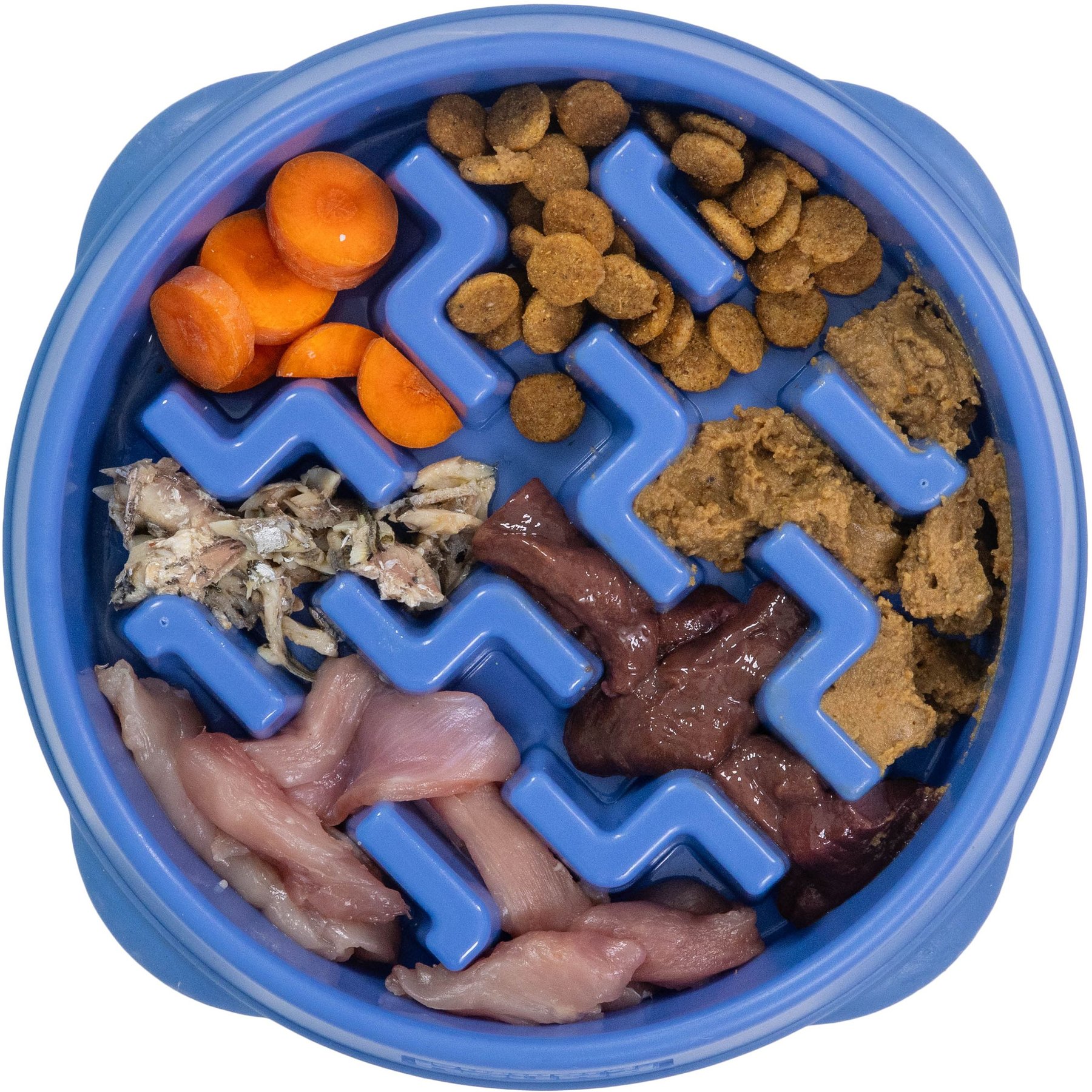
| Deep maze / interlocking ridges | Too hard for short muzzles; food lodges in corners | Long-muzzled dogs already used to working for food |
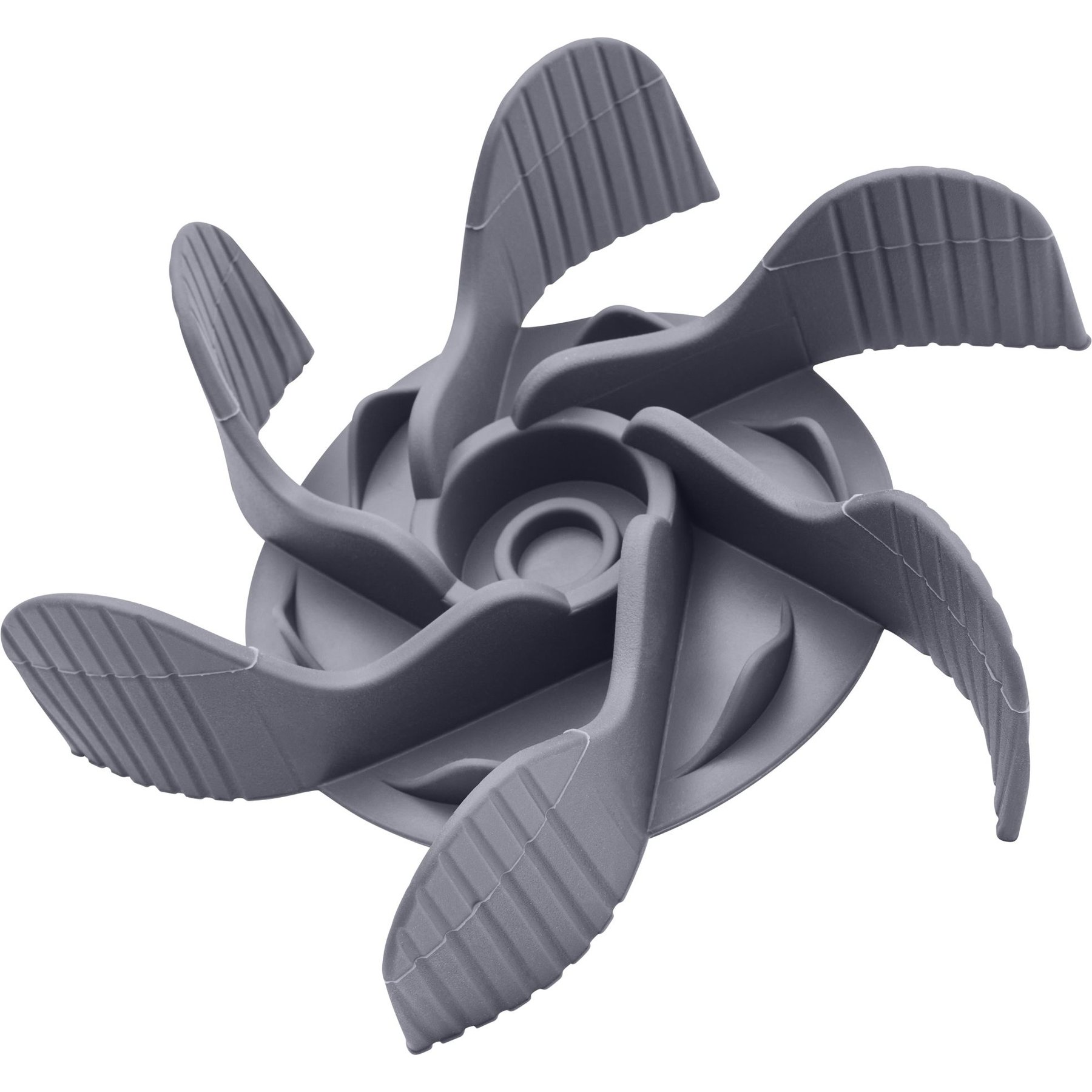
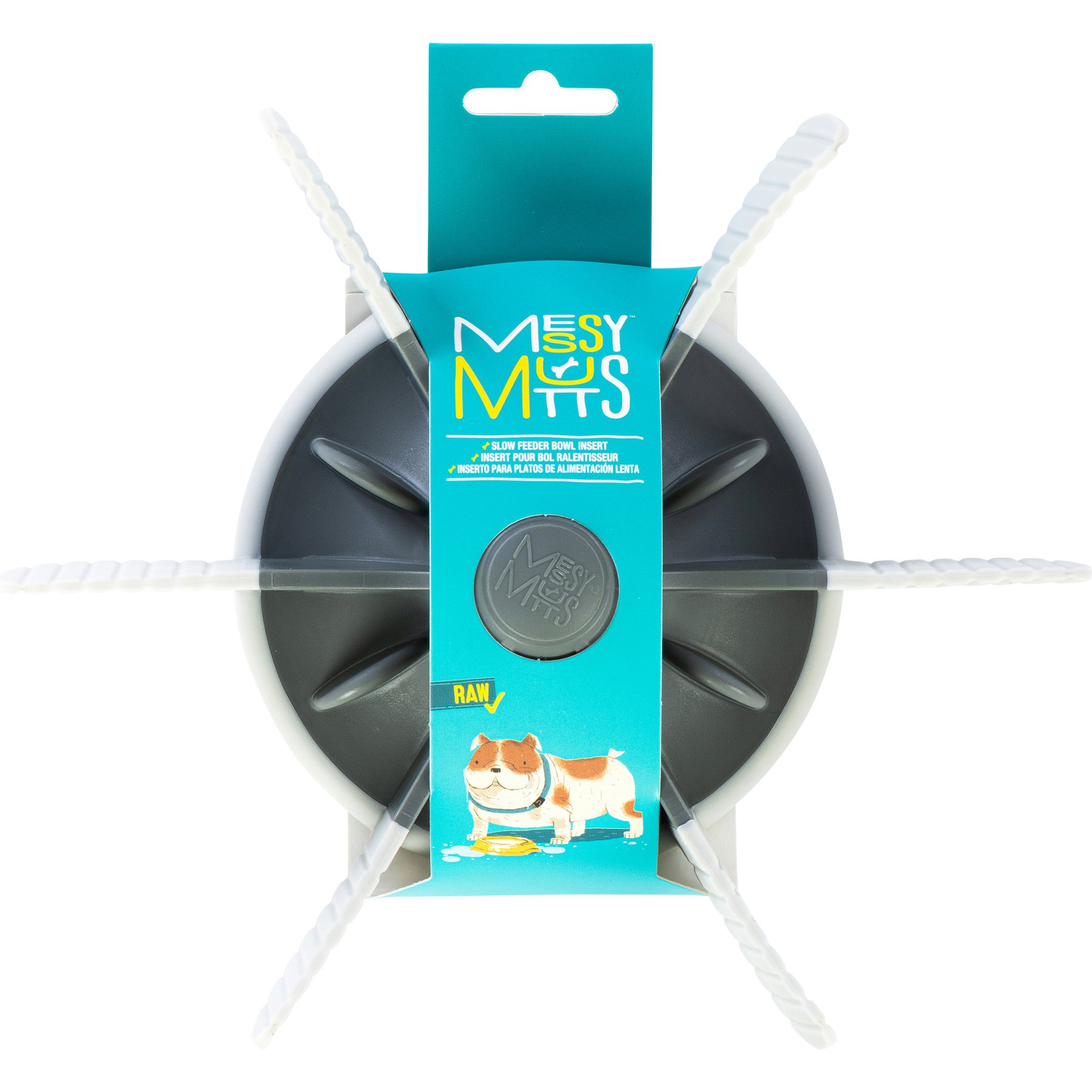
| Insert placed in your existing bowl | Slides or gets flipped unless it seats properly | Dogs with an existing bowl that fits, travel, multi-bowl homes |
| Silicone lick surface | Not a meal solution for dry kibble | Wet food, calming routines, stretching a small portion |
Brachycephalic dogs (Bulldogs, Pugs, Frenchies, Persians) are the group most often given the wrong bowl. A deep maze sized for a Labrador muzzle is close to unusable for a face that cannot reach into a channel, and the result is a frustrated dog and an owner who concludes slow feeders do not work.
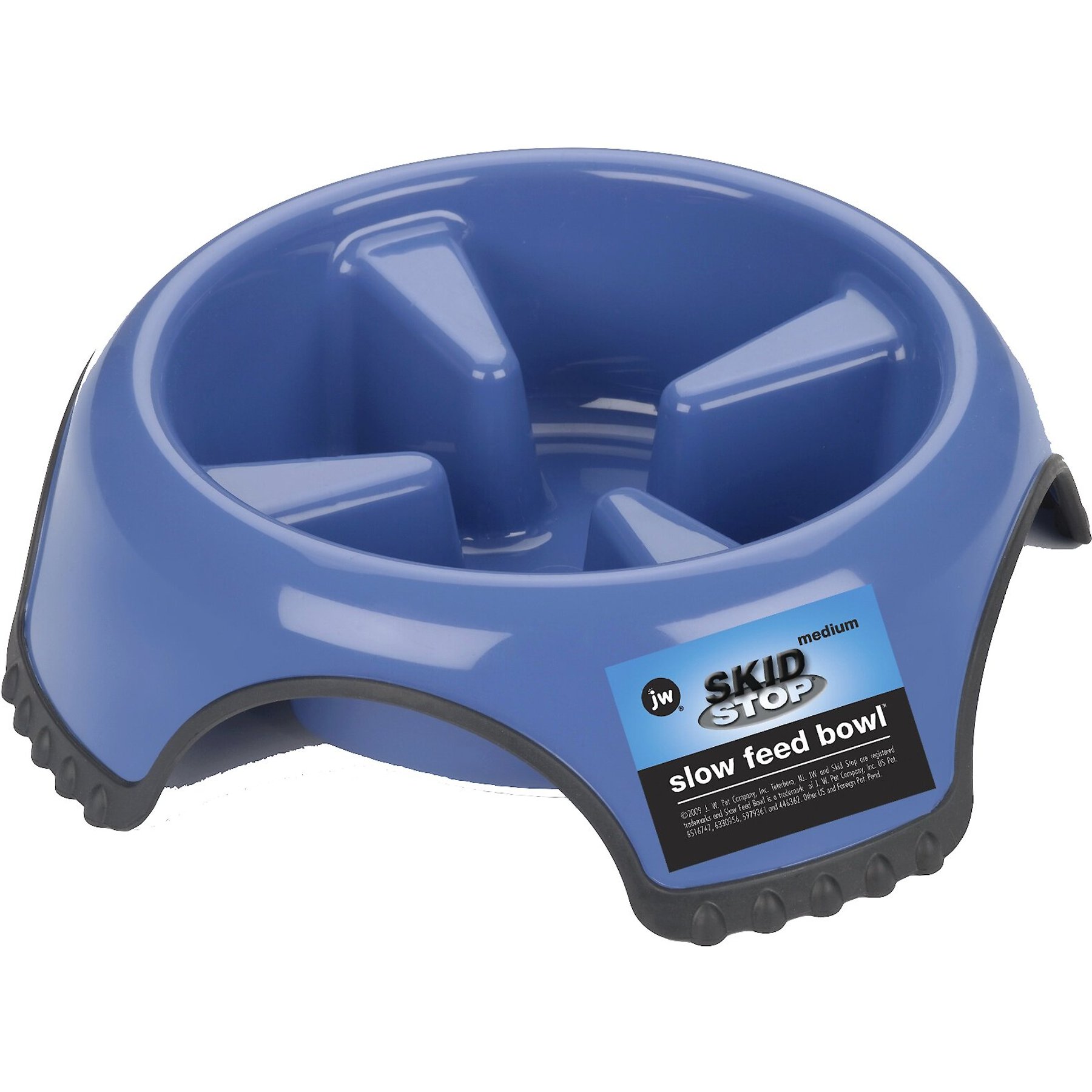
The standard maze bowl is the default for a normally-muzzled dog, and the reason it stays the default is that the ridges are tall enough to matter and wide enough to reach into.
If you already own a bowl your dog likes, an insert is the cheaper and often better answer. It keeps the bowl, the height and the location the dog is used to, and changes only the difficulty.
Inserts that suction to the base solve the failure mode where a determined dog simply lifts the insert out and eats underneath it.
For small dogs, capacity is the constraint rather than difficulty. A 2-cup maze holding a half-cup ration spreads the food so thin that the maze stops doing anything.
Cats need their own geometry. Whisker contact is a real aversion for some cats, so shallow and wide beats deep and narrow, and a cat that walks away from a new bowl is usually objecting to the shape rather than the food.
Portion first, speed second
A slow feeder changes how fast the food goes in. It does nothing about how much.
This is the part worth more than the bowl. In the Purina lifetime study, Labrador Retrievers fed a restricted ration lived a median of roughly two years longer than their free-fed littermates and developed chronic disease later (Kealy et al., JAVMA, 2002). The WSAVA global nutrition guidelines treat body condition assessment as a routine part of every examination for the same reason.
So before buying anything:
- Get a body condition score on the 9-point scale from your veterinarian, written down.
- Work from your food's actual caloric density in kcal per cup rather than a generic chart: densities vary by more than 60 percent between foods, so "one cup" is not a unit.
- Split the daily ration across meals, then weigh every two weeks and adjust. See how much should I feed my dog and how do I know if my dog is overweight.
If the dog is already overweight, the bowl is a tool inside a plan: our canine obesity reference covers the clinical side.
When fast eating is not a habit
Most fast eaters are just fast. A minority are telling you something, and the bowl will not fix any of it.
- A sudden change in eating speed in an adult animal, particularly with weight loss or increased thirst, is a veterinary question first.
- Gulping followed by regurgitating undigested food repeatedly can be mechanical, but it can also be esophageal. Recurrence is the signal.
- Competitive speed in multi-pet homes is a management problem. Feed in separate rooms and the speed often resolves on its own.
- A dog that guards the slow feeder when it did not guard a flat bowl has been made anxious by the difficulty. Reduce it.
What to skip
- Any slow feeder sold as bloat prevention. The claim overstates the evidence. Buy the bowl for the mechanics and learn the emergency signs instead.
- Elevated slow-feeder stands for deep-chested dogs. This is the one combination actively worth avoiding.
- The hardest maze available. Difficulty is not the goal; a slightly longer meal the dog will actually eat is.
- Ceramic or heavy stoneware mazes for enthusiastic dogs. They shatter when flipped, and a maze bowl gets flipped.
- Buying a bowl instead of a scale. The kitchen scale that measures the ration will do more for the dog's lifespan than the bowl that slows it.
How to choose
Normal muzzle, dry kibble, ordinary enthusiasm: a standard maze bowl sized to the actual ration, on the floor.
Flat-faced dog or a cat: shallow and wide, and expect to accept a smaller slowdown.
A bowl that already works: buy the insert, not a new bowl.
And if the dog is deep-chested, the slow feeder is the least important thing you will do this week. Learning to recognize GDV, and knowing which emergency clinic is open at 2 a.m., is worth considerably more.
FAQ
Frequently asked
Do slow feeders prevent bloat?
No product prevents gastric dilatation-volvulus. Rapid eating appears in the veterinary literature as one associated risk factor among several, alongside chest conformation, age and raised bowls, so slowing a meal addresses one contributor rather than the condition. Treat a slow feeder as a small reduction in one risk factor, never as protection.
How much do slow feeders actually slow a dog down?
For most dogs a maze bowl turns a sixty-second meal into three to eight minutes, depending on kibble size and maze depth. The gain is largest for dogs that inhale dry kibble whole and smallest for dogs already chewing.
Can a slow feeder make a dog anxious or frustrated?
It can, if the difficulty is wrong. A dog that gives up, guards the bowl, flips it, or eats less than its ration is telling you the pattern is too hard. Drop to a shallower maze or an insert, and if a previously relaxed dog becomes tense around food, stop and reassess rather than pushing.
Are slow feeders safe for cats?
Yes, with cat-specific sizing. Cat slow feeders use shallower channels and smaller footprints, and whisker contact matters more than it does for dogs: a deep narrow maze that presses the whiskers can put a cat off the bowl entirely. Start shallow and wide.
My dog eats fast and then vomits undigested food. Is a bowl enough?
Not necessarily. Regurgitation shortly after eating can be a mechanical consequence of gulping, but it can also point to an esophageal or gastrointestinal problem. If it happens repeatedly, is new, or arrives with weight loss, retching or lethargy, that is a veterinary conversation before it is a shopping decision.
Featured in this guide
The picks referenced above—priced and in stock at time of publication.
Affiliate links. Prices and availability change—we filter unavailable items nightly, but the retailer's page is source of truth.
Keep reading
back to school routine
Best Automatic Feeders for Dogs: What Actually Holds Up on a Work Schedule
back to school routine
Best Lick Mats for Dogs: A Good Tool With an Overstated Claim
back to school routine
Enrichment for Working Owners: Redistributed Time, Not a Drawer of Toys
back to school routine
Scratching Posts That Actually Last: Height, Stability, and Re-Roping
back to school routine
Crates and Pens for Dogs Home Alone: What Confinement Fixes, and What It Hides
back to school routine
Litter Box Setups for Multi-Cat Homes: You Need More Boxes, Not a Better One
Discussion
Talk about Best Slow Feeders for Fast Eaters: What the Evidence Actually Supports
Real questions from real pet owners. Add yours—signed-in members only, first three posts held for review.
Loading threads…