Crates and Pens for Dogs Home Alone: What Confinement Fixes, and What It Hides
A crate solves one problem well and a different problem badly. Sizing, crate versus pen versus gated room, and the one situation where confinement is actively the wrong tool.
petsupplies.co earns a commission if you buy through the product links on this page, and the price you pay is the same either way.

A crate solves one problem well and a different problem badly. Almost every bad outcome in this category comes from confusing the two.
The problem it solves well: a dog that needs a defined, safe place to be while unsupervised, and a puppy learning where the toilet is not. The problem it solves badly: a dog that cannot cope with being alone. Confinement does nothing for that, and sometimes makes it considerably worse.
What a crate is actually for
Three real jobs. Housetraining, safe containment during short absences, and a settled place to sleep.
The housetraining mechanism is worth understanding because it dictates the sizing. Most dogs avoid soiling the place they sleep, so a bed-sized space gives the dog a reason to hold on and ask to go out. That only works while the space stays bed-sized. A crate large enough to have a far corner has a far corner that becomes a toilet, and the entire mechanism is gone.
Introduction matters more than the hardware. A crate the dog has been fed in, played near, and left open for a week is a den. A crate the dog is put into for the first time on the morning of a nine-hour absence is a box. The AVSAB position statement on humane dog training is the reference for why the introduction is built on reinforcement rather than insistence, and our how do I crate train a puppy without crying answer has the step order.
Sizing, and why bigger is not kinder
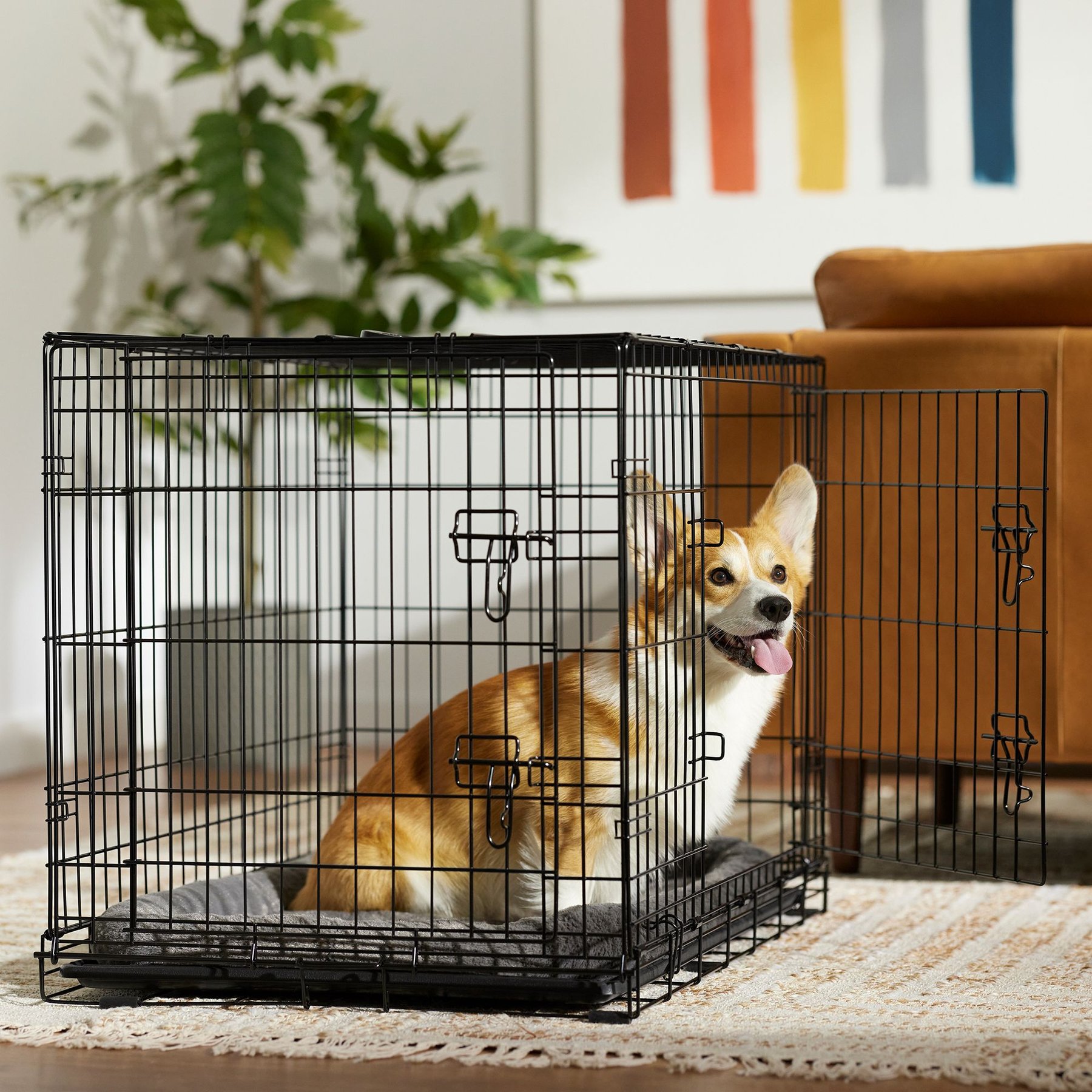
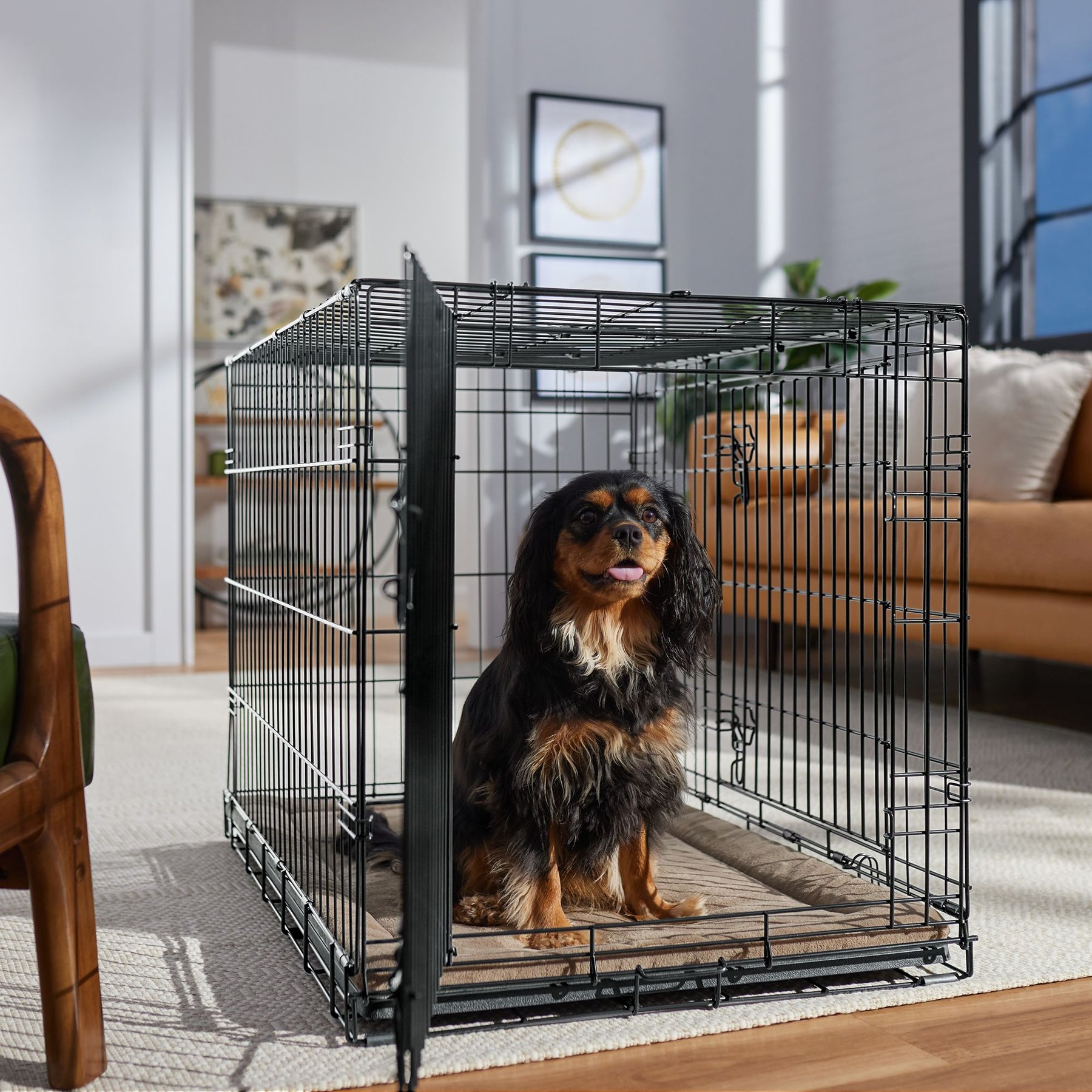
Stand without ducking, turn around, lie fully stretched on one side. That is the specification, and it is smaller than most people's instinct.
For a growing puppy, buy for the adult size and use the divider to shrink it. That is what the divider is for, and it is why the standard wire crate is still the default recommendation. More on measurement in what size crate does my dog need.
Two doors is not a luxury. It decides where the crate can go in a room, and a crate that has to sit in the hallway because the door faces the wrong way tends to end up unused.
Some dogs bend standard wire. The fix is a heavier gauge, not a bigger crate.
Worth saying plainly though: a dog working that hard to get out is usually telling you something, and the section below is more relevant to you than the section above.
Crate, pen, or gated room
| Setup | Best for | Fails when |
|---|---|---|
| Crate | Housetraining, sleeping, short absences | Used for a full working day |
| Exercise pen | Longer absences, puppies, a separate toilet area | Dog climbs or shifts the panels |
| Gated room | Adult dogs that are reliable but not fully loose | Room has chewable furniture or cables |
| Loose in the house | Settled adult dogs | Housetraining is unfinished |
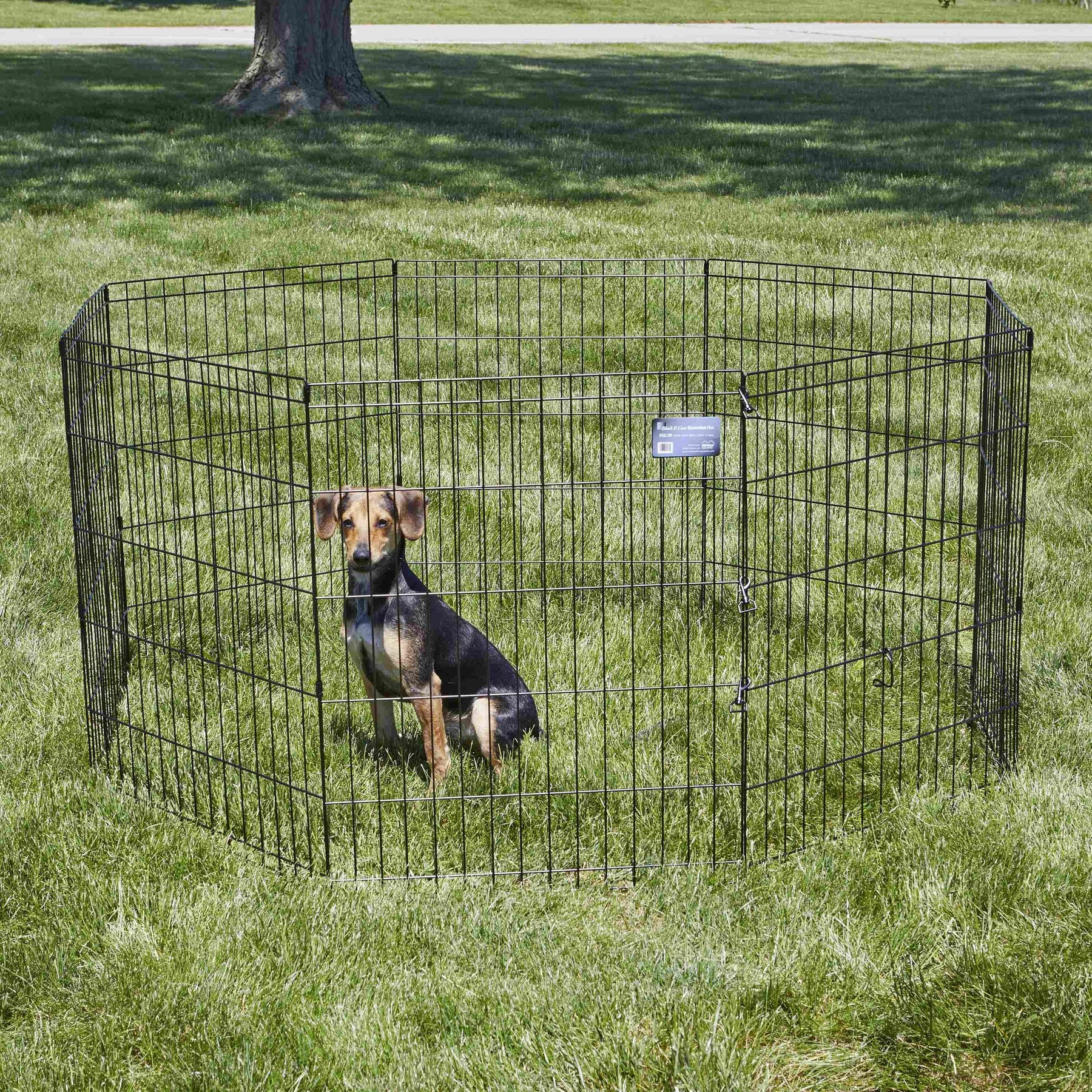
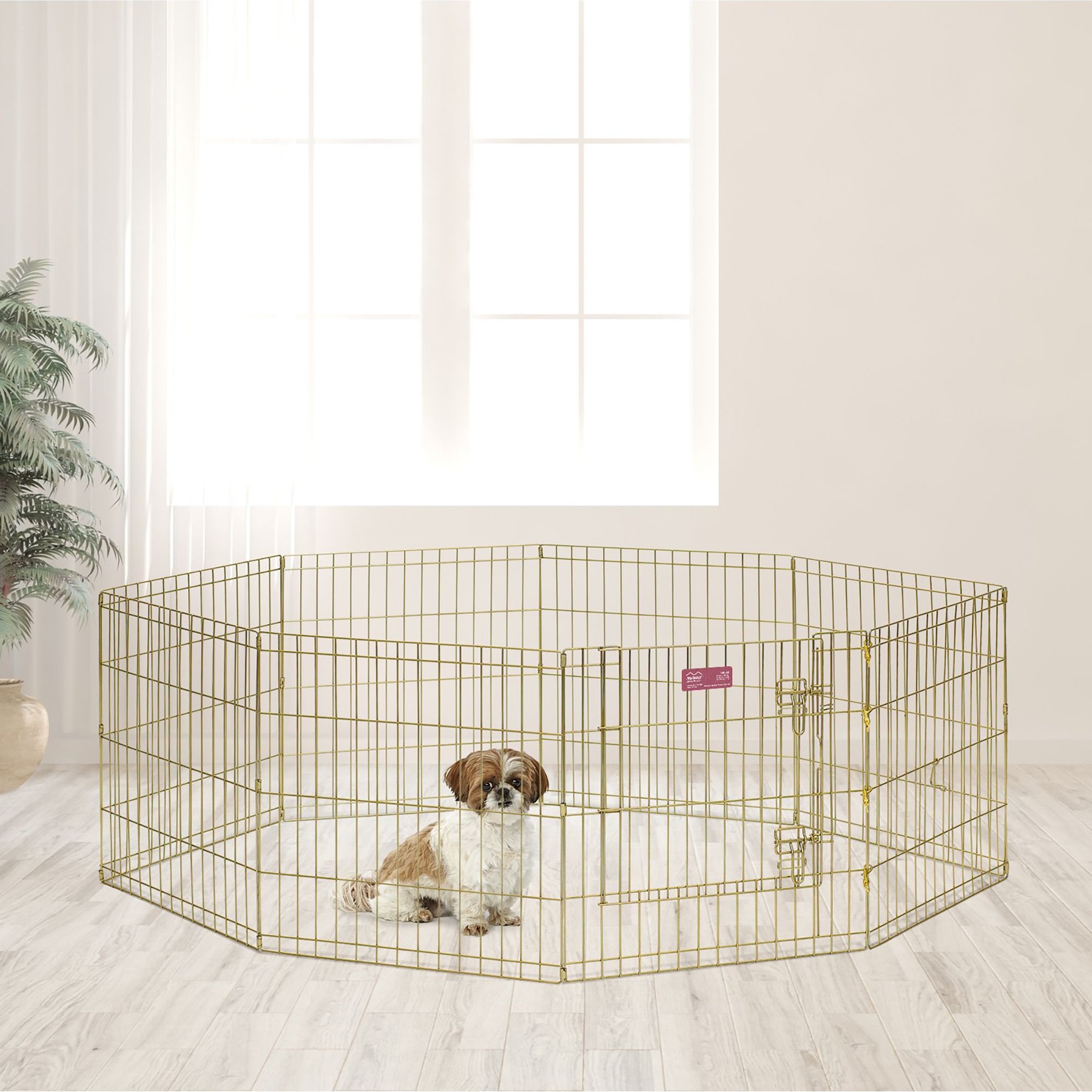
The pen is the underused answer. It gives the dog room to stand, stretch, change position and keep a toilet area away from the bed, and it is the honest choice for the hours most people actually work.
A step-through door saves you climbing over the panels twenty times a day, which sounds trivial and is the difference between a pen that gets used and one that gets folded away.
Climbers are the common pen failure. A mesh roof solves it without going up to a taller panel the dog can still scale.
How long is too long
For an adult dog, treat a few hours as the working ceiling for a crate. For a puppy, roughly one hour per month of age up to about eight months is the usual guide, and it is a ceiling rather than a target.
A dog crated for nine hours is not contained, it is stored. The dog is forced to choose between soiling its own bed and holding on far longer than is reasonable, and neither outcome is one you want to train. If those are your hours, the answer is a pen, a gated room, a midday walker, or daycare. It is not a bigger crate. See can I leave my dog home alone for 8 hours.
Whatever the setup, the dog needs something to do inside it. A stuffed frozen toy converts the first twenty minutes from a countdown into a job, which is the window that decides how the rest of the absence goes. See enrichment and puzzle toys for dogs home alone.
Where confinement is the wrong tool
If the dog is panicking rather than protesting, a crate is not the answer and may be a hazard.
Dogs in genuine separation distress have broken teeth on crate bars, torn nails on the door, and injured their jaws trying to force a gap. The crate does not calm the panic. It gives the panic somewhere to do damage, and it removes the pacing that would otherwise take the edge off.
Telling the two apart is straightforward and costs nothing: record the first twenty minutes. Distress that starts inside the first few minutes, with pacing, drooling and vocalizing, is a different problem from a bored dog that settles for an hour and then gets busy. Our dog cameras with treat dispensers guide covers what to look for, canine separation anxiety covers the clinical side, and calming aids for separation anxiety covers what the evidence supports.
For a dog in that category, the order is a veterinary conversation and a graduated absence plan first. The containment decision comes afterward, and it is usually a pen or a gated room rather than a crate.
What to skip
- A crate for a nine-hour day. The wrong tool for those hours, whatever size you buy.
- The crate as punishment. It has to stay the good place, or the housetraining mechanism goes with it.
- A large crate for a puppy with no divider. You have built a bedroom with an en suite.
- Soft-sided crates for an untrained dog. They are travel gear for a dog that already settles, not containment.
- A second, bigger crate because the dog escaped the first. Diagnose the escape before you buy anything.
How to choose
Housetraining a puppy: wire crate sized for the adult dog, divider in, introduced over a week with food and the door open.
Working a full day: pen, or a gated room, with a stuffed frozen toy and a midday break if you can arrange one.
Settled adult dog: you may not need any of this. A bed in a quiet room is often the whole answer.
Dog that panics when you leave: none of the above yet. Start with the camera and the veterinary appointment, and buy the containment once you know what you are containing.
FAQ
Frequently asked
What size crate does my dog need?
Big enough to stand without ducking, turn around, and lie fully stretched on one side. Not bigger, while housetraining is still in progress: the reason crate training helps with toileting is that most dogs avoid soiling where they sleep, and that only holds if the space is roughly bed-sized. For a growing puppy, buy the crate for the adult size and use the divider panel to shrink it in the meantime.
How long can a dog be crated?
Treat a few hours as the working ceiling for an adult dog, and roughly one hour per month of age for a puppy up to about eight months. A dog crated through a nine-hour workday is not being contained, it is being stored, and the practical result is a dog forced to choose between soiling its bed and holding on far too long. If those are the hours, the answer is a pen, a gated room, or a midday visit, not a bigger crate.
Is a crate or an exercise pen better?
Different jobs. A crate is a bed and a short-term safe space, and it is the better tool for housetraining because the small footprint is the mechanism. A pen gives a dog room to move, stretch, and use a separate toilet area, which makes it the better choice for longer absences and for puppies. Many households end up using both: crate for sleeping, pen for the working day.
Will a crate help my dog with separation anxiety?
Usually not, and it can make things worse. A dog in genuine separation panic may try to escape the crate, and dogs have broken teeth, torn nails and injured their jaws doing exactly that. Confinement constrains the behavior without touching the panic driving it. If your dog is distressed rather than merely bored, the crate decision comes after a veterinary conversation and a graduated absence plan, not before.
My dog bends the wire on standard crates. What now?
Move up to a heavy-duty wire gauge rather than a larger standard crate, and check the crate is not the real problem. Determined escape attempts in an adult dog are often distress rather than athleticism, and the useful next step is putting a camera on the first twenty minutes after you leave to find out which one you are dealing with.
Featured in this guide
The picks referenced above—priced and in stock at time of publication.
Affiliate links. Prices and availability change—we filter unavailable items nightly, but the retailer's page is source of truth.
Keep reading
back to school routine
Best Lick Mats for Dogs: A Good Tool With an Overstated Claim
back to school routine
Dog Cameras with Treat Dispensers: What They Diagnose, and What They Can't Fix
back to school routine
Puzzle Toys for Dogs Home Alone: What They Fix, and What They Don't
back to school routine
Best Automatic Feeders for Dogs: What Actually Holds Up on a Work Schedule
back to school routine
Enrichment for Working Owners: Redistributed Time, Not a Drawer of Toys
back to school routine
Scratching Posts That Actually Last: Height, Stability, and Re-Roping
Discussion
Talk about Crates and Pens for Dogs Home Alone: What Confinement Fixes, and What It Hides
Real questions from real pet owners. Add yours—signed-in members only, first three posts held for review.
Loading threads…