Best Automatic Feeders for Dogs: What Actually Holds Up on a Work Schedule
Automatic feeders solve timing, not portioning. Here is which mechanism fails least, why an elevated hopper is a real risk for deep-chested dogs, and the specs worth paying for.
petsupplies.co earns a commission if you buy through the product links on this page, and the price you pay is the same either way.

Automatic feeders get bought for the wrong reason. Owners buy them to solve absence, and they solve timing. The dog still eats the amount you programmed, on the schedule you set, from a bowl at a height you chose, and every one of those three decisions matters more than the machine does.
Still, timing is a real problem worth solving. A dog fed at 6:30 a.m. and 6:30 p.m. by a human whose commute varies by ninety minutes is a dog on an inconsistent metabolic schedule, and once school and work resume in August, that variance gets worse. A feeder removes the variance. What it will not do is decide how much your dog should eat, notice that your dog has stopped eating, or refill your water bowl.
This guide covers what breaks, what the specs actually mean, and where the veterinary evidence contradicts the product design.
The elevated-hopper problem
Most hopper-style automatic feeders put the bowl on a raised tray, six to ten inches off the floor. That is a design convenience, not a health feature, and for large and giant breeds it points the wrong direction.
Purdue University's prospective study of gastric dilatation-volvulus in large and giant breed dogs found that raised feeding bowls were associated with an increased incidence of GDV, and the authors estimated that a meaningful share of cases in their cohort were attributable to having a raised bowl (Glickman et al., Journal of the American Veterinary Medical Association, 2000). That is the opposite of the folk advice that circulated for two decades. GDV is a surgical emergency, and a design choice with any plausible association is not worth taking casually. Our gastric dilatation-volvulus reference covers presentation and response.
The practical rule: if your dog is a Great Dane, Standard Poodle, Weimaraner, Setter, or any other deep-chested breed over roughly 50 pounds, buy a feeder that dispenses into a floor-level bowl, or route the chute into your own bowl on the floor. If your dog is a 12-pound terrier, bowl height is a non-issue and you can decide on other criteria. See elevated feeder for the full argument on both sides.
Feeder types, ranked by how they fail
Every category fails in a specific, predictable way. Pick the failure you can live with.
| Type | How it fails | Right for |
|---|---|---|
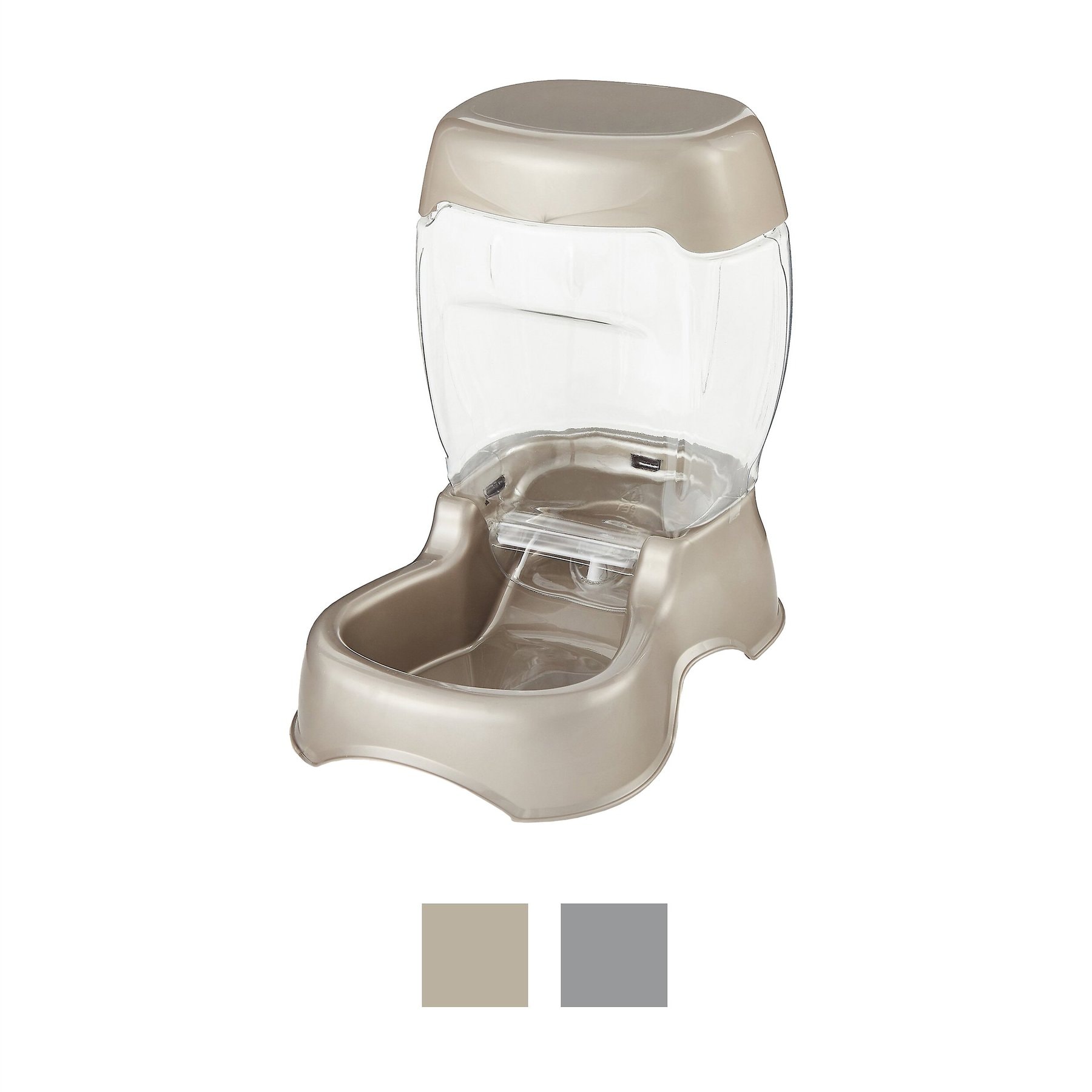
| Gravity / hopper refill | Free-choice feeding, no portion control; kibble goes stale in the column | Stable-weight dogs with zero food drive, or as a backup |
| Timed carousel (compartments) | Fixed number of meals, usually 4 to 6; portions capped by compartment volume | Small dogs, medication-adjacent schedules, wet food with ice packs |
| Auger hopper, offline timer | Auger jams on irregular kibble; no alert when it does | Single-dog homes, dry kibble, owners who verify daily |
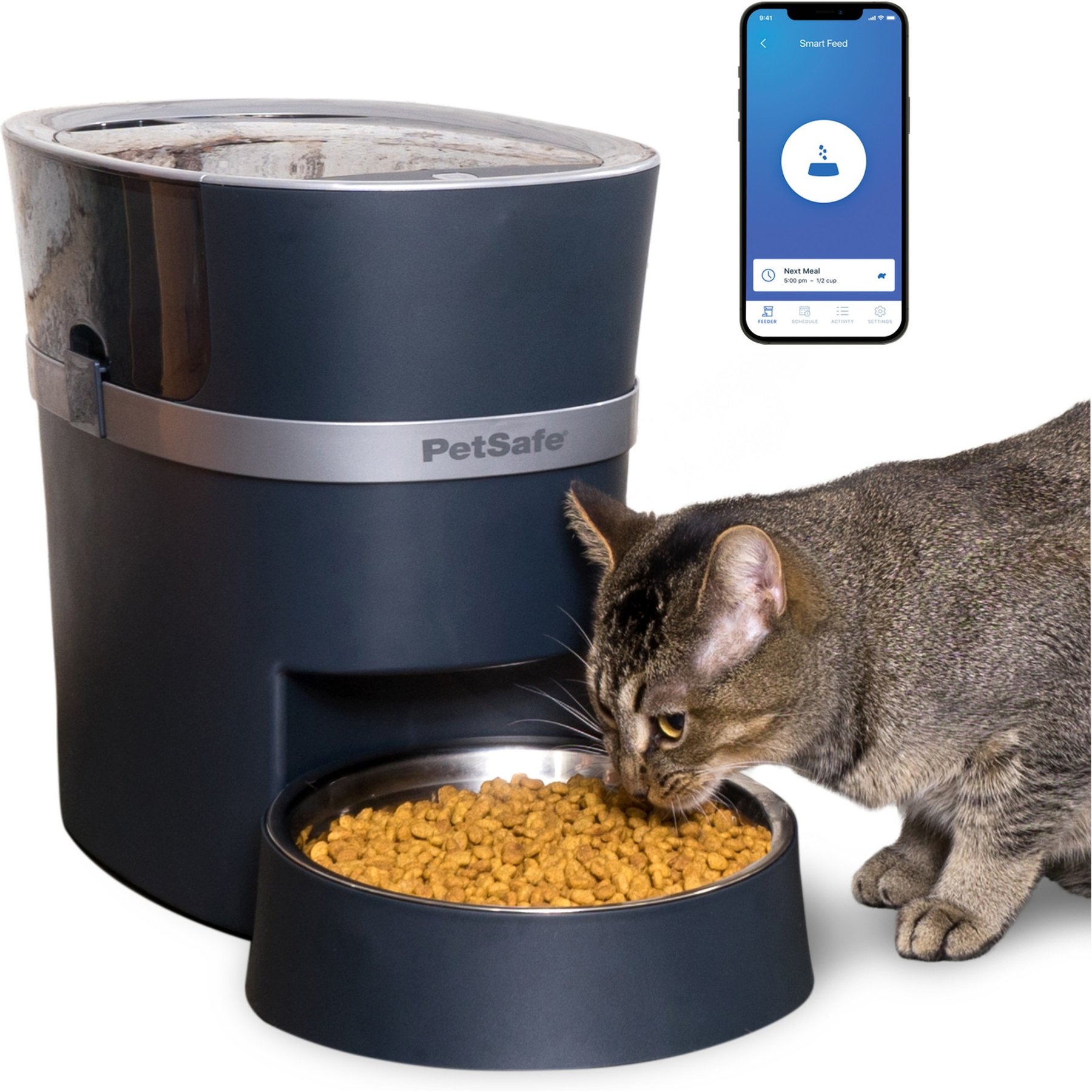
| Auger hopper, Wi-Fi and app | Same jam risk, but reports it; depends on your network and the vendor's cloud | Anyone who wants confirmation the meal actually dispensed |
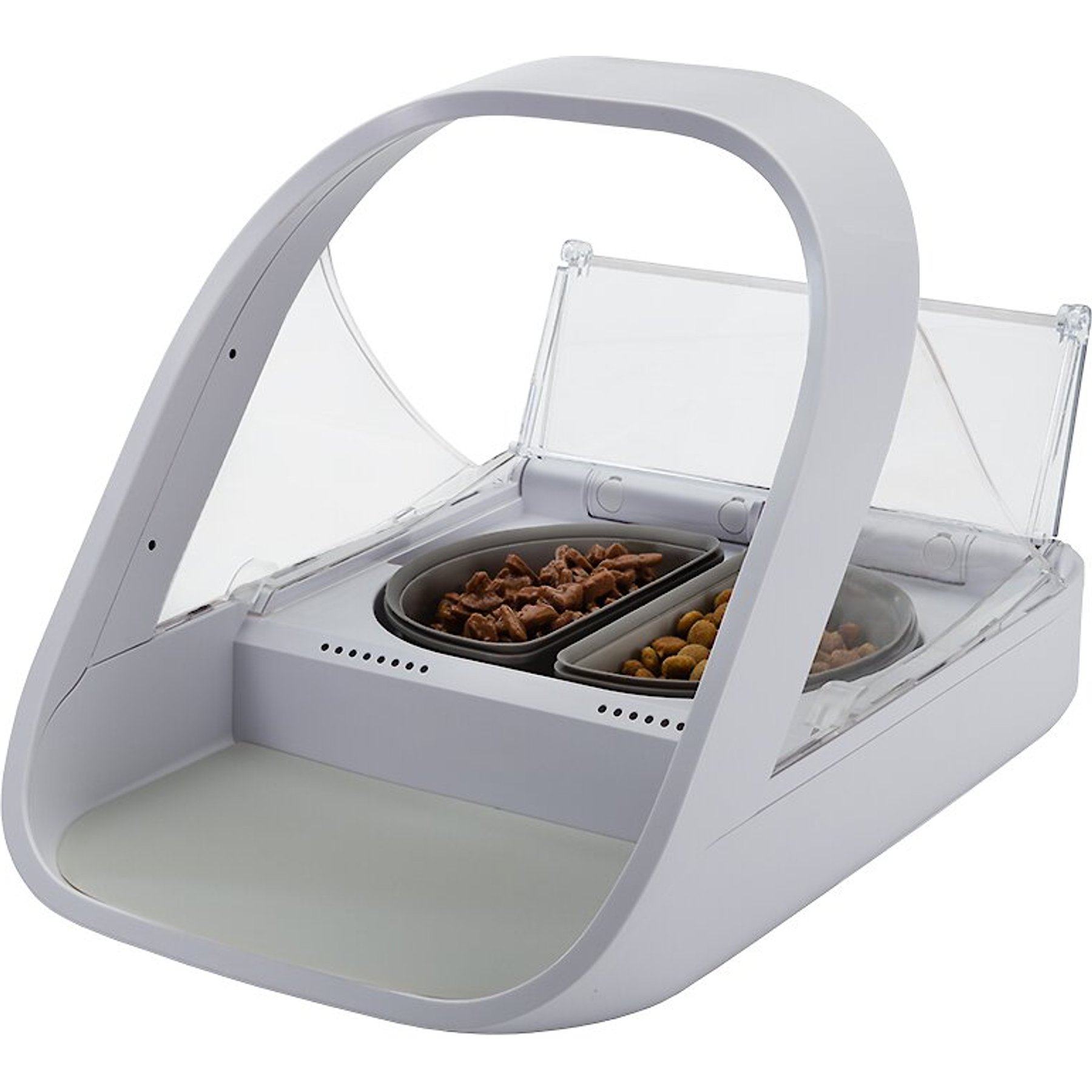
| Microchip / RFID gated | Higher cost; needs a chip or collar tag per pet | Multi-pet homes with different diets or a weight-loss patient |
| Refrigerated / cooled wet food | Small capacity, short safe window, more parts to clean | Wet-food diets, renal and urinary patients |
The single most useful feature on this list is dispense confirmation. A feeder that jams silently is worse than no feeder, because you believe the dog ate. A feeder that pushes a notification saying the 5 p.m. meal did not dispense gives you four hours to fix it.
The specs that predict whether it will work
Marketing copy on feeders is close to useless. Four numbers are not.
- Kibble diameter range. Manufacturers publish one, usually in the neighborhood of 0.2 to 0.6 inch (5 to 15 mm). Undersized kibble leaks past the auger between cycles and overfeeds; oversized or irregular pieces bridge the outlet and underfeed. Measure your actual food. Re-measure after a formula change, because kibble geometry differs between life-stage formulas and between production runs.
- Minimum portion increment. A feeder with a 1/8-cup increment can serve a 10-pound dog properly. One with a 1/4-cup increment cannot, because the rounding error is 10 to 20 percent of the daily ration.
- Hopper capacity in days, not cups. A 6-liter hopper is roughly 18 days of food for a Chihuahua and 4 days for a Labrador. Capacity only means something once you divide by the actual daily ration.
- Battery backup runtime. Grid power fails. A feeder that holds its schedule on three D cells for weeks is a different product from one that resets to zero and forgets the schedule after a nine-second brownout.
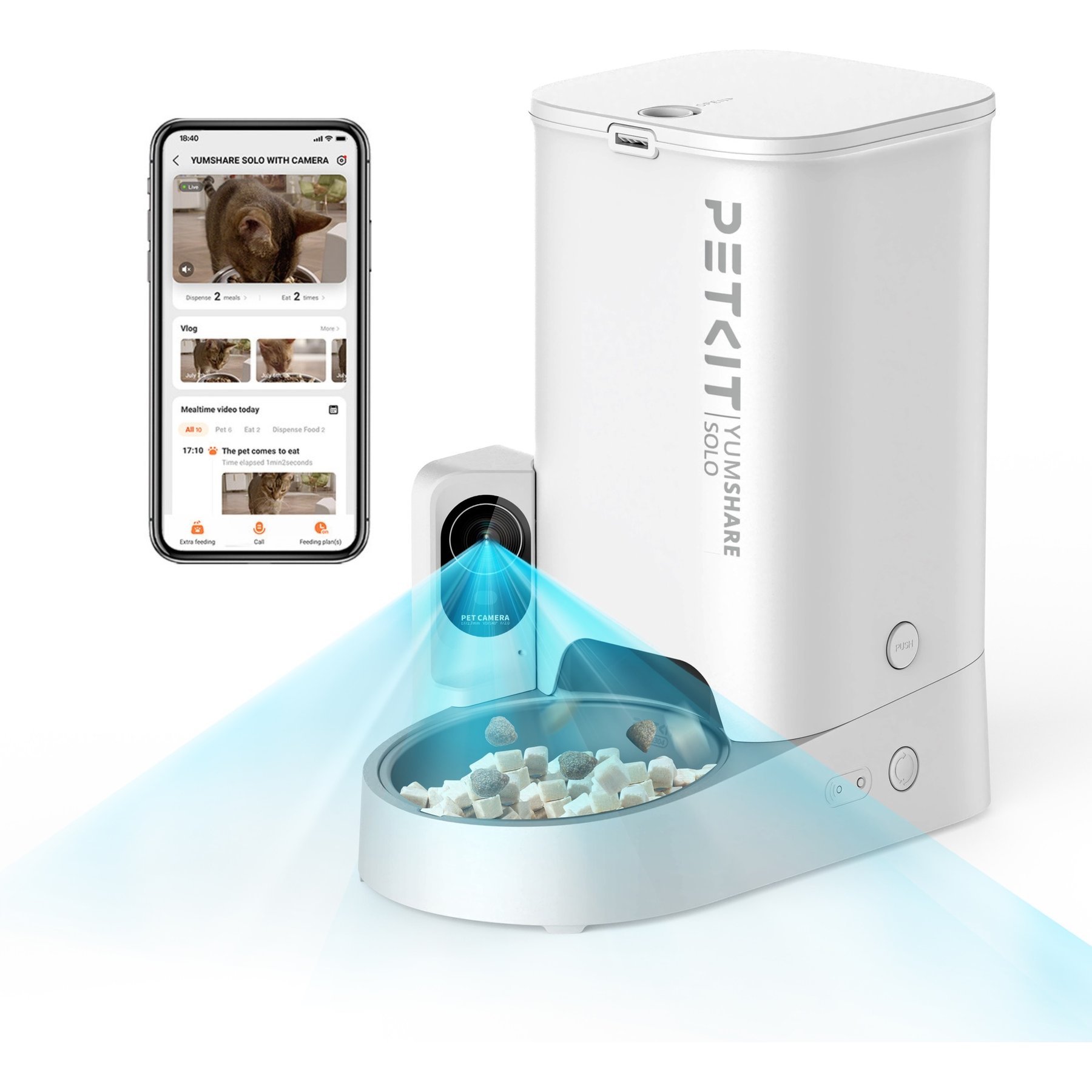
Cameras are the one soft feature worth paying for, and not for the reason vendors advertise. The value is not watching your dog eat. It is seeing whether the dog approached the bowl at all, which is the earliest signal that something is wrong.
Multi-dog and multi-pet homes
Two dogs and one feeder is not a feeding system, it is a competition. The faster eater takes the slower eater's ration, and if either animal is on a prescription diet or a weight-loss plan, the plan is fiction.
Microchip-gated feeders solve this properly. The lid opens for the registered chip or collar tag and closes when that animal steps away, which means a diabetic dog and a healthy dog can eat different foods in the same room. The WSAVA global nutrition guidelines treat controlled intake as the foundation of any therapeutic diet, and in a multi-pet home there is no controlled intake without a gate.
Wet food is a different machine
Do not attempt wet food in a dry-kibble feeder. The auger fouls, residue accumulates in the chute, and you cannot fully clean the mechanism.
Purpose-built wet feeders use sealed rotating compartments with ice packs, or active thermoelectric cooling. Manufacturer safe windows are short, generally a single working day for ice-pack models. The FDA's guidance on safe handling of pet food is the operating standard: treat opened wet food the way you treat opened human food, and do not extend the window because the dog seems fine.
This listing is no longer available.
Portioning: the part the feeder cannot do
This is where automatic feeders quietly cause harm. A feeder that dispenses precisely the wrong amount, twice a day, forever, is a very efficient obesity machine.
The evidence on portion control in dogs is unusually strong. In the Nestle Purina lifetime study, paired Labrador Retrievers fed 25 percent less than their free-fed littermates lived a median of roughly two years longer and showed later onset of chronic disease (Kealy et al., JAVMA, 2002). A 2019 analysis of clinical records from more than 50,000 neutered dogs across twelve breeds found overweight body condition associated with shorter life span in every breed examined (Salt et al., Journal of Veterinary Internal Medicine, 2019).
So before you program anything:
- Get a body condition score from your veterinarian, on the 9-point scale, with a number written down. "He looks fine" is not a baseline.
- Use your food's actual caloric density in kcal per cup, from the bag, not a generic chart. Densities range from roughly 300 to over 500 kcal per cup, so the same "one cup" can differ by 60 percent between foods.
- Divide the daily ration across meals and program that, then weigh the dog every two weeks for the first two months and adjust. Bag guidelines are population averages and routinely overshoot an individual dog.
- Re-check after any diet change, neuter, or activity change. See how much should I feed my dog and how do I know if my dog is overweight for the arithmetic.
If your dog is already carrying extra weight, the feeder is a tool inside a plan, not the plan. Our canine obesity reference covers the clinical side.
What to skip
- Free-choice gravity feeding for any dog with food drive. It is the default failure mode of the category. Gravity feeders earn their place as a quiet, unjammable backup or for the rare dog that self-regulates, and nowhere else.
- Feeders as a fix for separation anxiety. A scheduled meal helps a bored dog. It does nothing for a panic disorder. That needs a structured protocol, and our back-to-school separation anxiety guide plus the canine separation anxiety reference cover what actually works.
- Weekend-alone plans. A feeder does not refill water, does not notice vomit, and does not clear a jam. Past 10 to 12 hours you need a person.
- Any feeder you have not tested for a week while home. Jams, leaks, and schedule bugs surface in the first several cycles. Discover them while you are standing there.
How to choose
If you have one dog on dry kibble and a variable commute, buy a Wi-Fi auger feeder with dispense confirmation, a 1/8-cup increment, and battery backup, and put the bowl on the floor if the dog is deep-chested. If you have two animals on different diets, the microchip gate is not optional and the extra cost buys you a functioning diet plan. If you feed wet, buy a cooled feeder and respect the manufacturer's window.
And if your dog inhales the ration in eleven seconds regardless of who serves it, the feeder is not the fix, the bowl is. A slow feeder insert stretches a meal from seconds to minutes, which is worth more to a fast eater than any scheduling feature.
FAQ
Frequently asked
Are automatic feeders safe for dogs?
Yes, with two caveats. The feeder must dispense a portion you calculated, not a portion it guessed, and the bowl height must suit the dog. Purdue's prospective cohort of large and giant breeds found raised feeding bowls associated with a higher rate of gastric dilatation-volvulus, so deep-chested dogs should eat from a floor-level bowl rather than the elevated tray built into many hopper feeders.
Do automatic feeders work with wet food?
Only purpose-built ones. A dry-kibble auger jams on anything moist. Wet-food feeders use sealed compartments plus ice packs or active cooling, and manufacturers rate them for a limited window, typically a single working day rather than a weekend. Refrigerated models extend that, but no consumer feeder makes wet food safe to leave out indefinitely.
Can I leave a dog alone for a weekend with an automatic feeder?
No. A feeder handles meals; it does not handle water failure, diarrhea, a jammed hopper, or a dog that stops eating. Food is the easiest problem to solve remotely and the least important one. Anything beyond about 10 to 12 hours needs a person, a sitter, or boarding.
What size kibble jams automatic feeders?
Most manufacturers specify a kibble diameter range, commonly around 0.2 to 0.6 inch (5 to 15 mm), and jams cluster at both ends. Very small kibble leaks past the auger and overfeeds; very large or irregular pieces bridge across the outlet and underfeed silently. Check the spec against your actual food before buying, and re-check after a formula change.
Is a gravity feeder good enough?
For a dog with stable weight and no food motivation, yes. It is quiet, unjammable, and has nothing to fail. For anything else it is the worst option available, because free-choice feeding removes the portion control that drives long-term outcomes. Gravity feeders are appropriate for a small subset of dogs and are chosen by a much larger one.
Do automatic feeders help with separation anxiety?
Not directly. A scheduled meal is a predictable event, which helps a mildly under-stimulated dog. True separation anxiety is a panic disorder and does not respond to food arriving on time; it responds to a structured desensitization plan, and often to medication.
Featured in this guide
The picks referenced above—priced and in stock at time of publication.
Affiliate links. Prices and availability change—we filter unavailable items nightly, but the retailer's page is source of truth.
Keep reading
Discussion
Talk about Best Automatic Feeders for Dogs: What Actually Holds Up on a Work Schedule
Real questions from real pet owners. Add yours—signed-in members only, first three posts held for review.
Loading threads…