Enrichment for Working Owners: Redistributed Time, Not a Drawer of Toys
Enrichment has become a shopping category, which is convenient for everyone except the animal. The highest-leverage change costs nothing and takes ten minutes, and most of it involves food you are already buying.
petsupplies.co earns a commission if you buy through the product links on this page, and the price you pay is the same either way.

Enrichment has become a shopping category. That is convenient for retailers, tolerable for owners who feel guilty about the hours they are out, and largely beside the point for the animal, who does not care whether the food came out of a bowl or a nine-dollar rubber mat but cares a great deal about how long the day was.
The honest version is less saleable. Enrichment is mostly redistributed time and redistributed food, and the highest-leverage changes are free. You are already feeding your dog or cat twice a day. Delivering that same food differently is the single biggest improvement available to a working owner, and it costs nothing but a change of habit.
What follows assumes you leave the house for eight or nine hours and feel bad about it. The goal is not to buy your way out of that. It is to make the hours structurally better.
What the alone-hours actually look like
Start by being accurate about the problem, because the fix depends on which one you have.
A dog left alone for nine hours has, in most households, a day shaped like this: a burst of activity when you leave, then sleep, then a long flat stretch of nothing, then a burst when you return. The flat stretch is where the welfare cost sits. It is not usually distress; it is absence of anything to do, which over months shows up as weight gain, attention-seeking in the evenings, and a dog that struggles to settle.
Cats have a different problem with the same shape. An indoor cat's natural pattern is ten to twenty small hunts across a day, and a bowl of food eaten in ninety seconds removes the entire structure of that. What is left is a lot of sleeping and very little to solve. The AAFP and ISFM feline environmental needs guidelines treat the opportunity to express predatory and foraging behavior as a pillar of a healthy environment rather than a nice extra.
Two things are worth separating out now, because no product on this page addresses either:
- Separation anxiety is not boredom. If the distress front-loads into the first fifteen minutes (pacing, drooling, vocalizing, destruction at exit points, house-soiling in a trained adult), that is a panic response and needs a graduated absence plan rather than a toy. See canine separation anxiety and separation anxiety.
- Under-exercise is not under-stimulation. A dog that has not walked does not need a puzzle; it needs the walk. See how much exercise does my dog need.
Move the food out of the bowl
If you change one thing, change this.
A bowl converts the most interesting event of the animal's day into a ninety-second transaction. The same ration delivered through something that has to be worked at turns it into twenty or thirty minutes of occupied, problem-solving time, and it happens twice a day whether or not you are feeling motivated, which is what makes it stick where a new routine usually does not.
The mechanics matter less than the principle, but a few things are worth knowing.
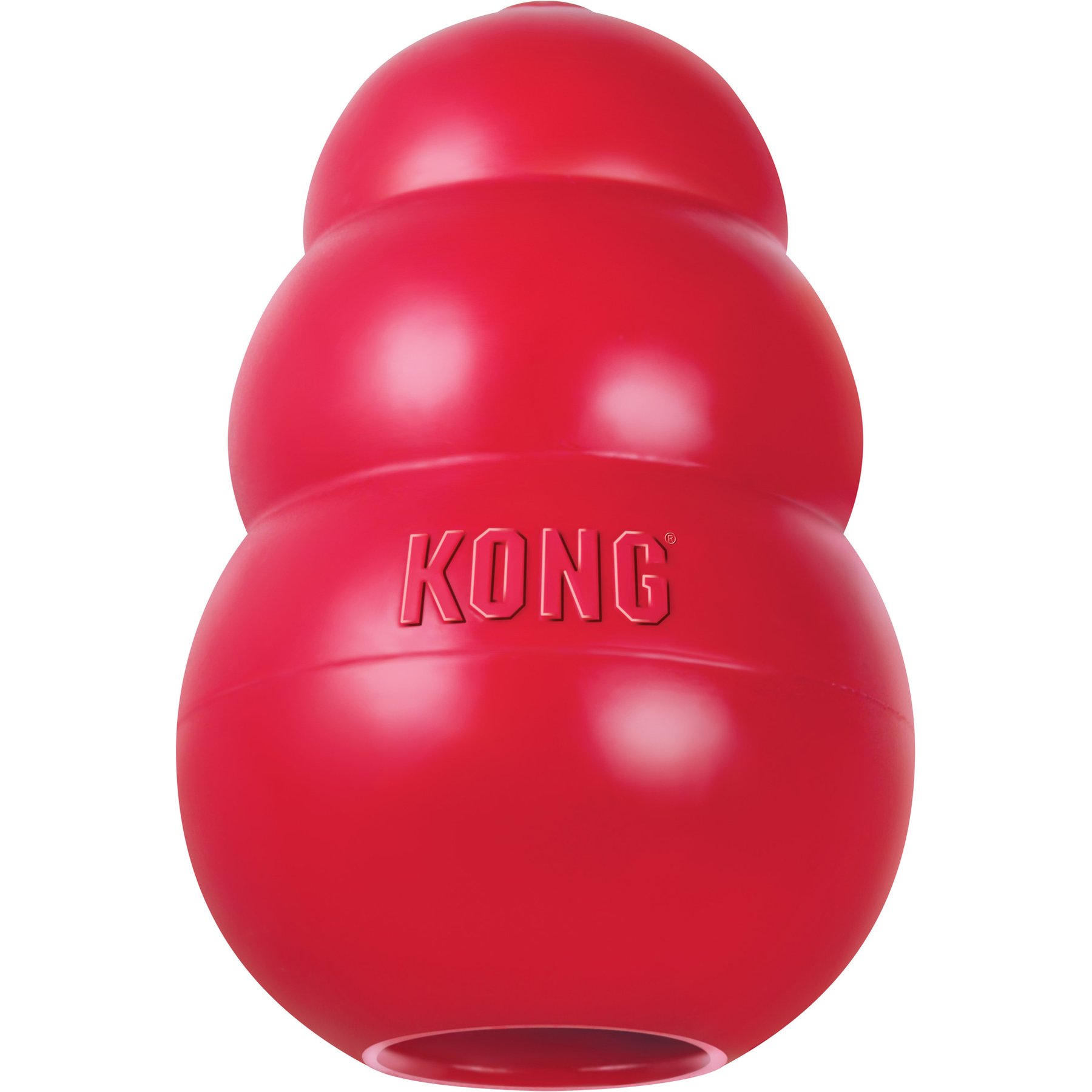
Stuffable rubber toys are the workhorse for dogs, because they are the one format generally sound to leave with a dog unsupervised, and because freezing them turns a ten-minute toy into a forty-minute one. Portion the wet food or soaked kibble from the daily ration, freeze overnight, hand it over on the way out.
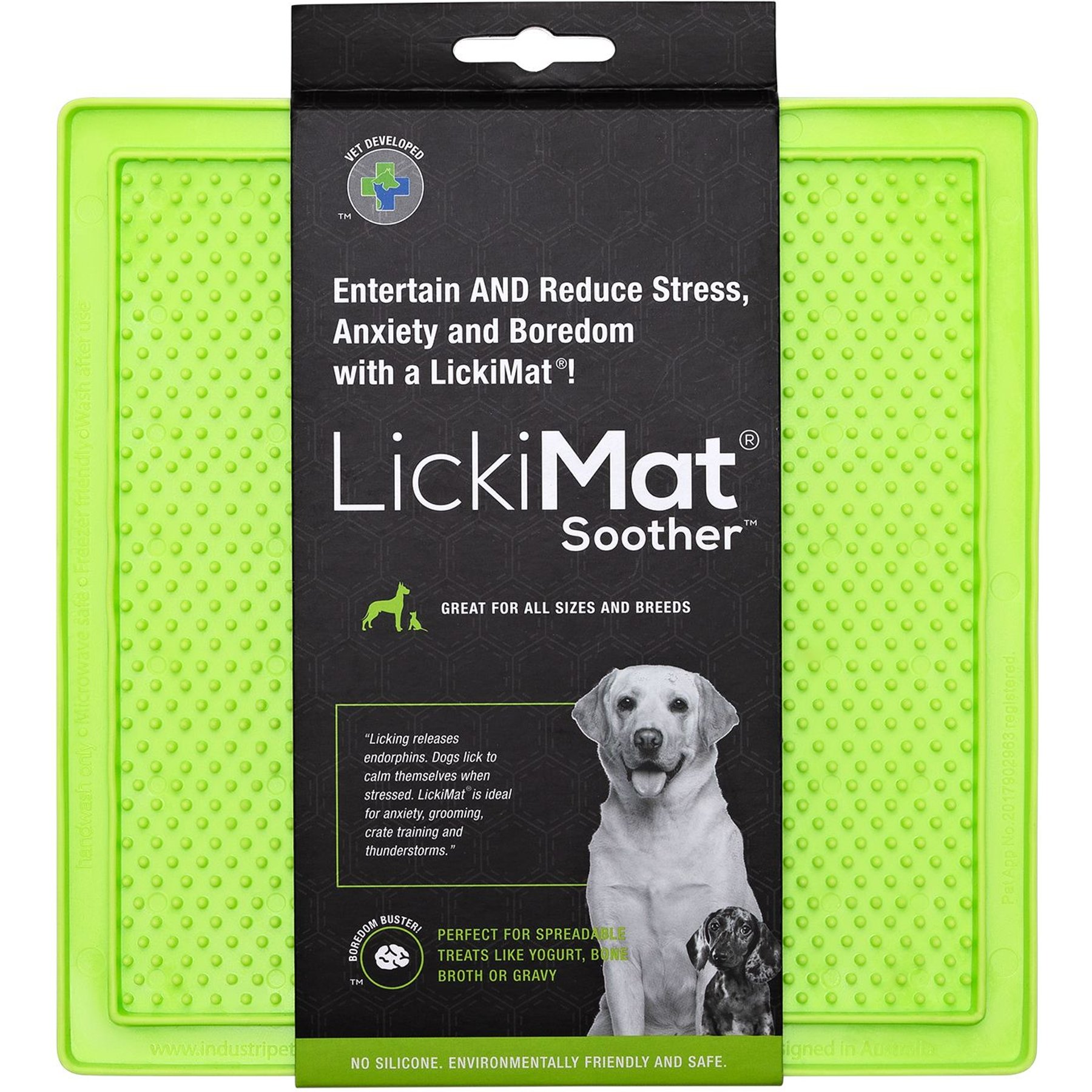
Lick mats do a different job. Spreading soft food thin turns eating into a long, repetitive, low-arousal activity, which suits the wind-down end of the day and the departure window better than a high-energy puzzle does. See lick mat.
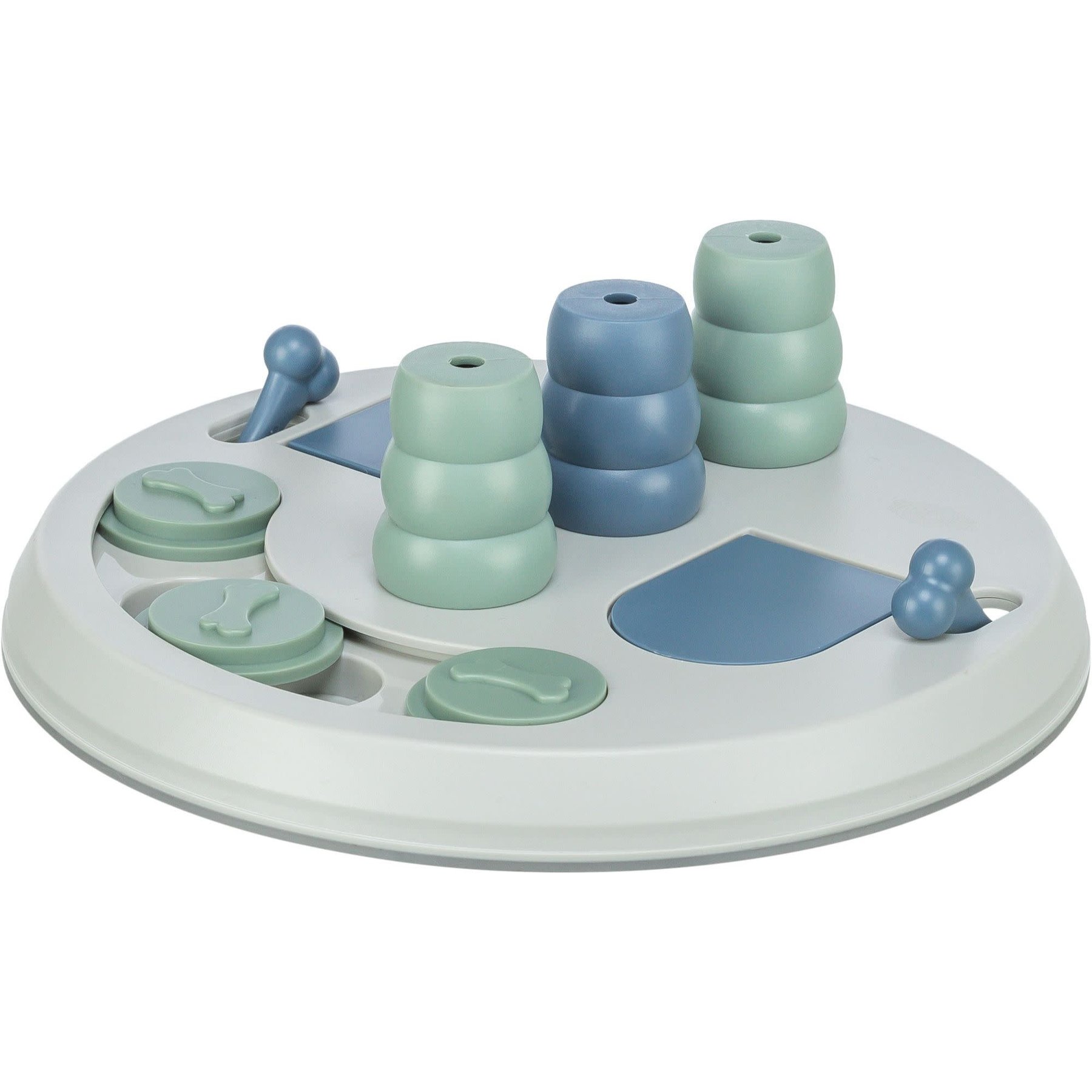
Puzzle boards work the problem-solving rather than the chewing, and they are the format most people buy at the wrong difficulty. Start easier than seems necessary. A dog or cat that fails at a puzzle once will often not come back to it, and a board that gets solved quickly can be made harder; a board that has been abandoned is usually finished. See puzzle feeder.
Rolling dispensers put movement into the equation, which suits dogs that get restless rather than bored, and they work well scattered across a room so the dog has to find them.
Cats need the cat-sized version of the same idea rather than a scaled-down dog product. Shallow, wide and low is the shape that works, and whisker contact is a genuine aversion for some cats.
One more free option, which needs no purchase at all: scatter feeding. Throwing the dry ration across a lawn or a rug turns a meal into twenty minutes of nose work, and for most dogs it is at least as engaging as anything sold in a box. A snuffle mat is the tidy indoor version of the same trick if you would rather not scatter kibble on the carpet.
The catch, and it is the one that quietly undoes people: the calories count. Everything delivered through a toy comes out of the measured daily ration, not on top of it. Work from your food's caloric density and a veterinary body condition score, because enrichment that adds a hundred calories a day is a weight problem with good intentions. See canine obesity and feline obesity.
The things that cost nothing
Money is the least useful input here, so it is worth listing the free changes that outperform most purchases.
Rotate, do not accumulate. Four things out, the rest in a cupboard, swapped every two weeks. Novelty is the resource you are managing, and a permanently available basket of toys is a basket of boring toys by week two.
Feed before you leave, not only when you return. A meal that has to be worked at, given as you go out the door, lands in the window that matters. A meal in a bowl at 7am does not.
Give the cat a view. A window with something happening outside is worth more to an indoor cat than most objects, and vertical space to watch it from costs nothing if you clear the top of a bookshelf. See cat tree and enrichment.
Ten minutes of your actual attention. For a cat, that means wand play that ends in a capture. For a dog, five minutes of training something trivial (a nose touch, a chin rest) is more tiring than a mile of walking and can be done in a kitchen while dinner cooks.
Split the absence if you can. A midday visit, a neighbor, a walker. Nine hours broken into two fours is a materially different day. See can I leave my dog home alone for 8 hours and how long can I leave my cat alone.
How this goes wrong
| What gets bought | How it fails | What it is actually good for |
|---|---|---|
| A basket of toys, all out at once | Everything is boring by week two; nothing is novel | Four out, rest away, rotated every two weeks |
| The hardest puzzle available | Animal fails once and never returns to it | Starting easy and increasing only after success |
| Treats to fill the toys | Adds calories on top of meals; slow weight gain | Using the measured ration itself as the filling |
| Fabric or rope toy left down all day | Stripped and swallowed; a genuine surgical risk | Supervised play only, then put away |
| An automatic gadget bought to replace the walk | Covers stimulation, not exercise or company | The flat middle of the day, alongside the walk |
| Enrichment bought to treat separation anxiety | Delays the real treatment by weeks or months | Scaffolding inside a proper absence plan |
What to skip
- Anything marketed as curing boredom while you are at work for nine hours. It can improve those hours. It cannot make them short.
- Toys with squeakers, stuffing or rope for unsupervised use. Fine while you are watching, a foreign-body risk when you are not.
- Buying a second pet as enrichment. Sometimes it works, often it doubles the problem, and it is the least reversible thing on this list.
- Screens and television left on for dogs. No good evidence, and it is usually bought to make the owner feel better.
- Replacing the walk with a puzzle. Different needs. The puzzle does not tire the body and the walk does not occupy the mind.
How to choose
If you buy nothing, do this: put the daily ration into a stuffable toy and a scatter feed instead of a bowl, freeze the toy the night before, and hand it over on the way out. That is most of the available benefit.
If you buy one thing, make it the stuffable toy, sized for your dog and used frozen.
If you buy two, add a lick mat for the evening wind-down, or a cat-scaled version if you have cats rather than dogs.
Add a puzzle board only if the first two are being solved too quickly, and buy it easier than you think you need.
And if the problem you are actually trying to solve is a dog that panics when you leave, none of this is the answer. That is a behavior plan and a veterinary conversation, and the sooner it starts the shorter it is.
FAQ
Frequently asked
How much enrichment does a dog actually need per day?
Less than the internet implies, and more consistently than most people manage. A useful floor is that the daily food gets delivered through something other than a bowl, plus one short session of your actual attention. That is perhaps fifteen minutes of your day in total, most of it hands-off. Piling on more novelty is far less valuable than doing that much every day rather than in bursts at the weekend.
Will enrichment fix my dog's separation anxiety?
No, and this is the most important thing on this page. Separation anxiety is a panic disorder that needs a graduated absence plan, usually veterinary input, and often medication. A food toy given at departure is useful inside that plan and useless as a substitute for it. There is also a simple diagnostic in it: a dog that will not touch high-value food a minute after you leave is over threshold, which tells you the problem is not boredom.
Is it safe to leave a food toy with a dog unsupervised?
It depends on the toy and the dog. Solid rubber stuffable toys sized correctly for the dog are the usual choice for unsupervised use. What should not be left down is anything with rope, fabric, squeakers or small parts a determined dog can strip and swallow, and anything small enough to be a choking risk. If your dog destroys and eats things, the answer is supervision, not a tougher toy.
Do the calories from puzzle feeding count?
Yes, all of them. This is where enrichment quietly turns into weight gain. Take the food out of the measured daily ration rather than adding it on top, work from your food's caloric density rather than a generic scoop, and have your veterinarian give you a body condition score to work against. If you use commercial treats to fill a toy, they count too.
My cat ignores everything I buy. What am I doing wrong?
Probably offering too much at once and too easy a start. Cats habituate quickly, so four things out and the rest away, rotated every couple of weeks, beats a full basket permanently available. Difficulty matters too: a puzzle a cat fails at once is often a puzzle it never returns to, so start it easier than you think is necessary and make it harder only after success.
Featured in this guide
The picks referenced above—priced and in stock at time of publication.
Affiliate links. Prices and availability change—we filter unavailable items nightly, but the retailer's page is source of truth.
Keep reading
back to school routine
Puzzle Toys for Dogs Home Alone: What They Fix, and What They Don't
fall
Back-to-School Separation Anxiety in Dogs: A Vet-Backed Protocol and Kit
summer
Freeze-Safe Dog Treat Recipes: Safe Ingredients, Smart Portions
new year basics
Puppy Starter Kit: Essential Items for New Owners
back to school routine
Best Lick Mats for Dogs: A Good Tool With an Overstated Claim
back to school routine
Scratching Posts That Actually Last: Height, Stability, and Re-Roping
Discussion
Talk about Enrichment for Working Owners: Redistributed Time, Not a Drawer of Toys
Real questions from real pet owners. Add yours—signed-in members only, first three posts held for review.
Loading threads…