Dog Heatstroke First Aid: What To Do in the First 15 Minutes
Heatstroke kills dogs quickly, and the biggest predictor of survival is what happens before the vet sees them. Recognition, cooling, and a triage-level protocol you can run at home.
petsupplies.co earns a commission if you buy through the product links on this page, and the price you pay is the same either way.

Heatstroke does not build slowly on a hot afternoon. It compounds. A dog on a walk, a dog left in a car for "just a minute," a bulldog playing in the yard at 82°F, all move through the same physiology, and the window between "panting hard" and "organ damage" is often less than twenty minutes.
The single biggest predictor of survival is not the drive time to the emergency vet. It is what happens in the first fifteen minutes at home. In a 2020 UK primary-care study of over 900,000 dogs, Hall, Carter, and O'Neill (Scientific Reports, 10:9128) found a case fatality rate of 14.2% for heat-related illness. The dogs that lived were the ones cooled aggressively before transport.
This guide is the protocol. It is not a substitute for a veterinary exam. Any dog you suspect of heatstroke needs to be seen by a vet even if they look normal thirty minutes later, because internal organ damage often unfolds over the following 24 to 72 hours.
Recognize it before you name it
Panting is normal. Heatstroke panting is different, and it stacks with other signs:
- Heavy, open-mouthed panting that does not slow when the dog rests
- Thick, ropey saliva or drooling
- Bright red or brick-colored gums (or, later, pale/gray gums, which is worse)
- Wobbling, stumbling, or a dog that will not stand up
- Vomiting, diarrhea, or blood in either
- Collapse or seizure
A dog does not have to show every sign. In the Hall 2020 cohort, collapse and vomiting were the two most common presentations at intake, and 14 percent of affected dogs died. If you are debating whether it is heatstroke, treat it as heatstroke.
The 15-minute protocol
Speed matters more than technique. Do these steps in order, and do not stop to look things up.
- Move the dog to shade or air conditioning. Off pavement, off turf, out of the car. If you are outdoors and there is no shade, make some with a jacket or towel.
- Start active cooling within the first minute. Cold or cool water poured over the whole body, or full immersion in a lake, pool, kiddie pool, bathtub, or livestock trough. Wet down the underside of the neck, the armpits, the groin, and the paw pads first, then keep water moving over the coat.
- Move air across the wet dog. A fan, an open car window on the drive, or someone waving a towel. Evaporation is where most of the cooling actually happens.
- Offer small amounts of cool water to drink. Do not force it. A dog that cannot swallow safely should not be made to.
- Call the emergency vet while you cool. Tell them you are on the way and that you are actively cooling. Do not wait to leave until the dog is cool if the ER is more than 10 minutes away; keep cooling in the car.
- Stop active cooling at a rectal temperature of 103°F (39.4°C). Cooling past this point risks overshoot and hypothermia, which is its own emergency. If you do not have a rectal thermometer, stop when panting slows meaningfully and the dog is alert enough to stand.
Do not use ice packs directly on skin without a barrier, and do not wrap the dog in wet towels then leave the towels on: soaked, un-moving towels trap heat like a sauna. Wet, then move air.
The cold-water myth
The old advice was "never use cold water on a hot dog, it causes shock." That advice is out of date. Peer-reviewed veterinary emergency literature and the current position from the American Veterinary Medical Association both support cold-water immersion as the fastest safe cooling method for heatstroke in dogs.
The shock-and-vasoconstriction concern was extrapolated from human exertional heatstroke management guidance from decades ago, and even in humans the current consensus for exertional cases is aggressive cold-water immersion. Dogs cooled by whole-body cold water immersion or cold water pour reach the target temperature faster, and time-to-target is the variable that maps to survival.
The only real caveats: do not submerge an unconscious dog's head, and do not use ice packed in a bag directly against skin for prolonged contact.
Cooling methods ranked, honestly
| Method | Speed | Practicality | Notes |
|---|---|---|---|
| Cold-water immersion (pool, tub, trough) | Fastest | Only if water is available | The reference standard when accessible |
| Cold-water dousing plus fan | Fast | Excellent (a hose and a breeze) | The realistic field default |
| Wet towels with active air movement | Moderate | Good | Only if you keep the towels wet and moving |
| Wet towels, static | Slow to counterproductive | Poor | Static wet towels trap heat |
| Ice packs to armpits/groin, with fabric barrier | Adjunct only | Fine as supplement | Not a primary method |
| Alcohol on paw pads | Trivial | Not recommended | Old advice; barely moves core temp |
| Air conditioning alone | Slow | Fine as adjunct | Not sufficient as primary treatment |
The ranking above tracks the small-animal emergency and critical care consensus reflected in the Recover Initiative CPR and post-arrest guidelines and standard emergency-medicine references. If you have access to a hose and shade, that is a first-line treatment, not a fallback.
When to skip cooling and just drive
Two situations override the "cool first, transport second" rule:
- The dog is seizing or unconscious. Get moving, cool in the car en route.
- The ER is under five minutes away. Get moving, cool in the car en route.
Everyone else: two to five minutes of aggressive cooling before you put the dog in the car meaningfully improves outcomes. Then keep cooling on the drive, with windows down and, if you have a passenger, water and towels working on the dog.
This listing is no longer available.
Who is at highest risk
The Hall 2020 study identified several risk factors that stack, and none of them are individually surprising, but the effect sizes are worth internalizing:
- Brachycephalic (flat-faced) breeds. Bulldogs, French Bulldogs, Pugs, and Boxers had substantially elevated odds versus mesocephalic breeds. Their airway anatomy limits the evaporative cooling that dogs primarily rely on.
- Dogs over 110 pounds (50 kg). Larger body mass shifts the surface-area-to-volume ratio the wrong way for shedding heat.
- Older dogs (age 12+). Cardiac reserve and thermoregulation both decline.
- Overweight dogs of any breed. Fat is insulation.
- Dogs with underlying respiratory or cardiac disease. They start closer to the ceiling.
Exertional heatstroke (a dog collapsing during exercise) had a case fatality rate roughly on par with environmental heatstroke (hot cars, hot conservatories, sunbathing dogs), and both were meaningfully lethal. The idea that "healthy dogs bounce back" from a hot walk is not supported by the data.
Prevention, without the platitudes
Most heatstroke advice online rounds off to "walk in the morning, bring water." That is fine and not enough. The additions that matter:
- Use the surface temperature rule for pavement. Press the back of your hand to the asphalt for seven seconds. If you cannot hold it, your dog cannot walk on it. For a full-length treatment, see our pavement-too-hot guide.
- Watch the humidity, not just the temperature. Panting is evaporative cooling. In high humidity it stops working.
- Never leave a dog in a parked car, even briefly, even with cracked windows. Interior temperature exceeds ambient by 20°F within 10 minutes on a sunny day.
- Give brachycephalic breeds a lower ceiling. A hot day for a Labrador is a medical emergency for a Bulldog.
- Skip midday exercise on a heat-advisory day. Move it to dawn or dusk. If in doubt, skip.
- Provide shade and airflow when outdoors, not just water. Evaporation needs moving air.
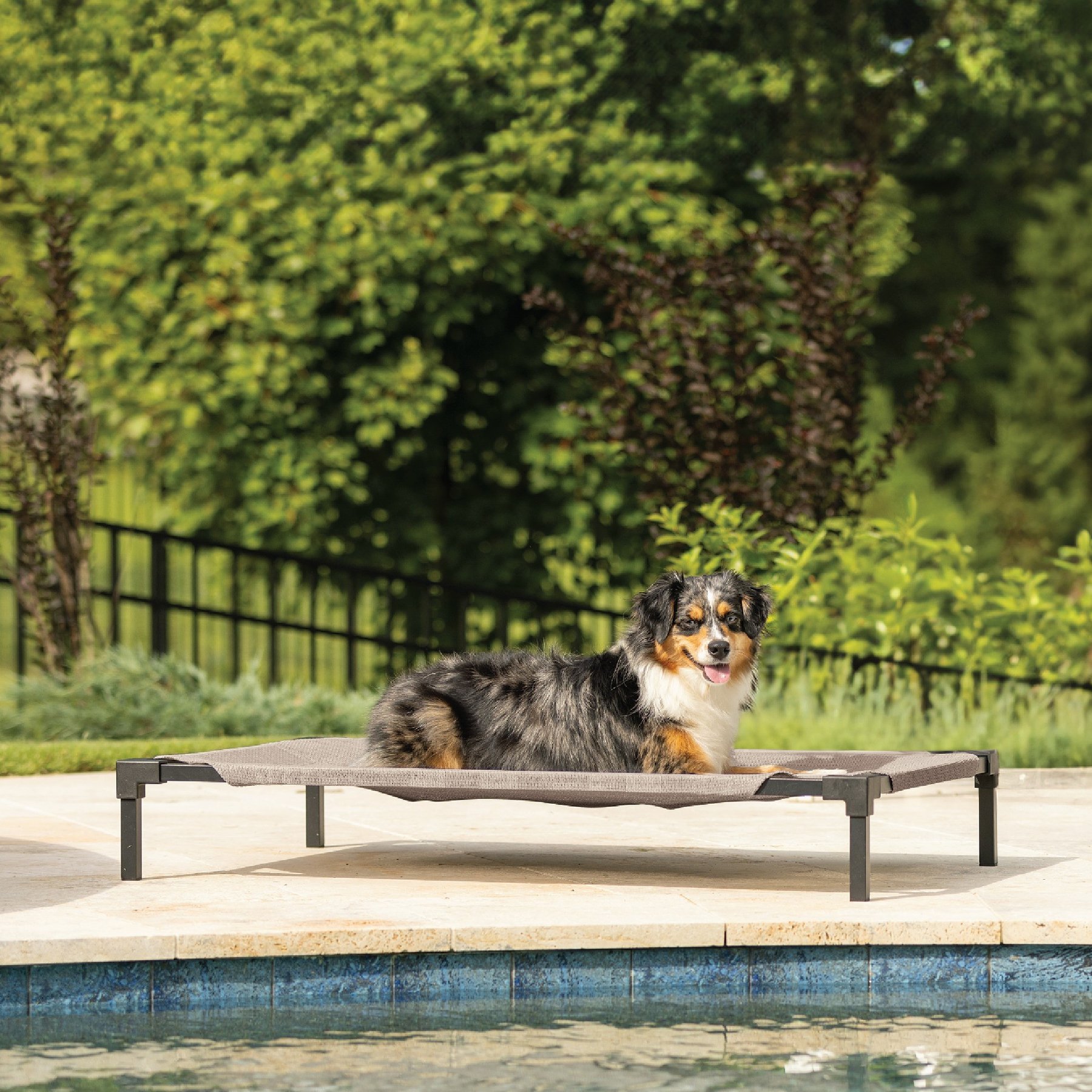
For dogs that live outdoors part of the day, an elevated, shaded rest surface with airflow underneath meaningfully lowers resting body temperature versus a solid surface in shade.
After the emergency
Even a dog that recovers on the drive to the ER needs to be seen. Internal complications from heat-related illness unfold over the next one to three days and include:
- Acute kidney injury
- Disseminated intravascular coagulation (DIC), a clotting disorder that shows up on bloodwork before it shows up on the dog
- Rhabdomyolysis (muscle breakdown)
- Delayed neurologic signs
A vet will typically run bloodwork, run IV fluids, and monitor for at least several hours. Follow-up bloodwork at 24 to 48 hours is standard. Skipping the vet because your dog "seems fine now" is the most common preventable second-hit in heatstroke cases.
Where this fits in our summer coverage
- Hydration tips for senior dogs in heat
- Best cooling mats for dogs in summer
- Best travel water bottles for dogs
- Best dog booties for hot or rough ground
- Outdoor pet safety checklist
If your dog is at higher baseline risk (flat-faced, older, or heavy), the case for making the cooling equipment permanent, and not just seasonal, is strong.
FAQ
Frequently asked
Is cold water really safe for a dog with heatstroke?
Yes. Current veterinary emergency guidance and the AVMA support cold-water immersion or cold-water dousing as the fastest safe cooling method for dogs. The old warm-water-only rule is outdated. Do not submerge an unconscious dogs head, and stop active cooling at 103F rectal temperature.
How do I know if my dog has heatstroke or is just hot?
Look for signs that stack: heavy panting that does not slow with rest, thick ropey saliva, bright red or pale gums, wobbling or collapse, and vomiting or diarrhea. If more than one is present, treat it as heatstroke and cool aggressively while calling the emergency vet.
Should I cool my dog first or drive to the vet first?
Cool first for two to five minutes if the emergency vet is more than five minutes away, then keep cooling in the car. Two exceptions: skip the pre-drive cooling and go immediately if the dog is seizing or unconscious, or if the ER is under five minutes away.
At what temperature do I stop cooling?
103F (39.4C) rectal. Cooling past this risks hypothermia, which is its own emergency. If you do not have a rectal thermometer, stop when the dogs panting meaningfully slows and they can stand and respond to their name.
Which dogs are at highest risk?
Flat-faced (brachycephalic) breeds like Bulldogs, French Bulldogs, and Pugs; dogs over 110 pounds (50 kg); dogs age 12 and older; overweight dogs of any breed; and dogs with pre-existing respiratory or heart disease. Their thresholds for a dangerous day are lower than the ambient temperature suggests.
Does my dog still need the vet if they seem fine after cooling?
Yes. Kidney injury, clotting disorders, and neurological complications from heatstroke unfold over 24 to 72 hours and are often not visible from the outside. Standard workup includes bloodwork, IV fluids, and follow-up bloodwork at 24 to 48 hours.
Featured in this guide
The picks referenced above—priced and in stock at time of publication.
Affiliate links. Prices and availability change—we filter unavailable items nightly, but the retailer's page is source of truth.
Keep reading
summer safety travel
Best Cooling Mats for Dogs in Summer: A Buyer's Guide
summer
Freeze-Safe Dog Treat Recipes: Safe Ingredients, Smart Portions
summer
Cats in Summer Heat: The Signs of Feline Heat Stress Owners Miss
summer
Hot Spots on Dogs: What Actually Stops Them Before They Spread
evergreen
Probiotics for Dogs: What the Evidence Supports, and What the Label Has to Say
holiday wellness planning
Dog Beds for Cold Floors: A Layer Between Dog and Tile Does More Than Extra Fluff
Discussion
Talk about Dog Heatstroke First Aid: What To Do in the First 15 Minutes
Real questions from real pet owners. Add yours—signed-in members only, first three posts held for review.
Loading threads…